

Priyanka Gandhi Slams Government Over VB-G RAM Scheme, Says “I Don’t Understand the Craze for Changing Names”
Indian politics once again witnessed a sharp exchange of ideas as Congress leader and Wayanad MP Priyanka Gandhi launched a strong attack on the central government over the VB-G RAM scheme. Speaking with visible frustration, she questioned the government’s priorities and remarked, “I don’t understand the craze for changing names,” a statement that quickly became a focal point of political debate. As Priyanka Gandhi slams the government, her comments have reignited a larger discussion on governance, symbolism, and the direction of public policy in India.
The VB-G RAM Scheme and the Controversy
The VB-G RAM scheme, announced by the government as a rebranding or restructuring of an existing initiative, was projected as a step toward better governance and administrative clarity. However, critics argue that it reflects a pattern of renaming schemes rather than introducing substantive reforms. As Priyanka Gandhi slams this approach, she questioned whether such cosmetic changes genuinely benefit the common citizen.
According to her, governments are elected to solve people’s problems, not to repeatedly rename schemes that already exist. She emphasized that unemployment, inflation, women’s safety, and rural distress deserve far more attention than symbolic exercises.
“I Don’t Understand the Craze for Changing Names”
This single line from Priyanka Gandhi resonated widely. When Priyanka Gandhi slams the government’s naming obsession, she taps into a sentiment shared by many citizens who feel overwhelmed by constant changes in terminology while their lived realities remain unchanged. Her statement suggested that the focus on renaming reflects a lack of fresh ideas and policy innovation.
She argued that changing names neither creates jobs nor lowers prices. Instead, it often creates confusion at the grassroots level, where beneficiaries struggle to understand whether a renamed scheme is new or simply a repackaged version of an older one.
Congress’ Broader Political Narrative
The Congress party has consistently accused the BJP-led government of prioritizing optics over outcomes. As Priyanka Gandhi slams the VB-G RAM scheme, she placed it within this broader narrative. According to her, the government prefers headline-friendly announcements instead of addressing structural economic challenges.
She pointed out that millions of young Indians are looking for employment, farmers are demanding fair prices, and women are asking for safety and dignity. In this context, repeated renaming exercises appear disconnected from ground realities.

Government Defense and Counterarguments
The ruling party, on the other hand, defended the VB-G RAM scheme by stating that renaming reflects a new vision and improved implementation framework. Government spokespersons argued that names matter because they communicate intent and values. However, as Priyanka Gandhi slams this logic, she questioned whether intent without tangible results holds any value for citizens.
She challenged the government to present data showing how such rebranded schemes have transformed lives. Without measurable outcomes, she argued, renaming remains an empty exercise.
The Symbolism vs Substance Debate
Indian politics has long struggled with the balance between symbolism and substance. When Priyanka Gandhi slams the VB-G RAM scheme, she is essentially criticizing what she sees as excessive symbolism. According to her, governance should be judged by delivery, not by how creatively schemes are named.
She reminded Parliament and the public that India’s founders envisioned a welfare state focused on social justice and equality, not on constant reinvention of labels.
Public Reaction and Political Impact
Public reaction to Priyanka Gandhi’s remarks was swift. Supporters praised her for voicing what they believe is a common concern, while critics accused her of ignoring the government’s development initiatives. Still, as Priyanka Gandhi slams the government, she has succeeded in shifting the conversation from branding to accountability.
Social media platforms were flooded with debates, memes, and discussions around the “craze for changing names,” indicating that the issue struck a chord with a wide audience.
Women Leadership and Political Voice
Priyanka Gandhi’s intervention also highlighted the growing role of women leaders in shaping political discourse. When Priyanka Gandhi slams policy decisions, she does so with a mix of emotional appeal and political logic, making her voice particularly influential.
Her emphasis on everyday issues—jobs, prices, and security—reflects a people-centric approach that contrasts with abstract policy debates. This style has helped her connect with voters beyond traditional party lines.
Federalism and State Concerns
Another dimension of her critique was federalism. Priyanka Gandhi argued that frequent changes in centrally sponsored schemes create administrative burdens for states. As Priyanka Gandhi slams the VB-G RAM scheme, she highlighted how states are forced to adjust documentation, awareness campaigns, and implementation strategies every time a scheme is renamed.
According to her, true cooperative federalism requires stability and consultation, not unilateral decisions driven by branding considerations.
Economic Challenges and Missed Priorities
At the heart of Priyanka Gandhi’s criticism lies a concern about economic priorities. When Priyanka Gandhi slams the government, she repeatedly brings the focus back to inflation, unemployment, and inequality. She argued that these issues demand urgent attention and sustained policy intervention.
In her view, renaming schemes does little to address the anxiety of families struggling to make ends meet or young graduates unable to find suitable jobs.
The Political Strategy Behind Renaming
Political analysts suggest that renaming schemes serves a strategic purpose: it helps the ruling party claim ownership of welfare initiatives. As Priyanka Gandhi slams this practice, she accused the government of erasing the legacy of previous administrations instead of building upon it.
She argued that governance should be a continuous process, not a competition over credit. For her, the obsession with renaming reflects insecurity rather than confidence.
Opposition Unity and Messaging
Priyanka Gandhi’s remarks also contribute to a broader opposition strategy of highlighting governance gaps. When Priyanka Gandhi slams the VB-G RAM scheme, she aligns with other opposition leaders who have criticized similar practices.
This convergence of voices strengthens the opposition’s message that the government must be held accountable not just for announcements, but for outcomes.
A Question That Lingers
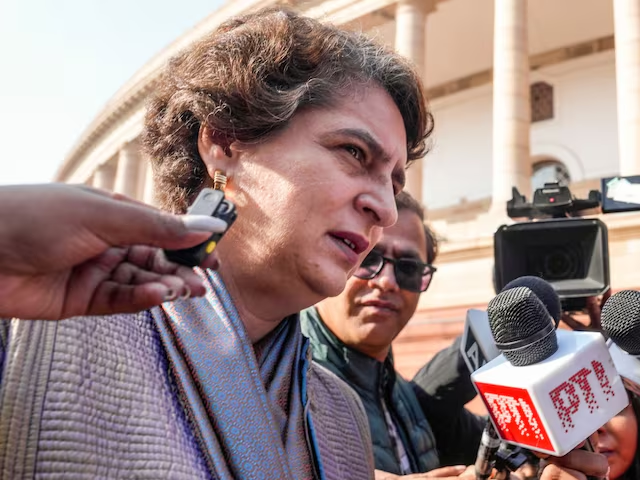
Perhaps the most enduring aspect of her statement is the question it raises: why this obsession with names? As Priyanka Gandhi slams the government, she leaves this question open for public reflection. It challenges citizens to look beyond slogans and ask whether policies are truly improving their lives.
Conclusion: Beyond Names, Toward Accountability
In the end, Priyanka Gandhi’s criticism of the VB-G RAM scheme goes beyond a single policy decision. It is a commentary on governance philosophy. As Priyanka Gandhi slams the government’s approach, she calls for a return to substance, accountability, and people-first politics.
Her words serve as a reminder that democracy thrives not on rebranding, but on results. Whether the government responds with data, dialogue, or dismissal will shape how this debate evolves in the days ahead.
Read more latest news

