
From CM Rekha Gupta to CM Dhami and Shivraj Singh: Politicians Celebrate Karwa Chauth by Sighting the Moon!
Introduction: A Night of Devotion, Love, and Tradition
Karwa Chauth — a festival that symbolizes love, sacrifice, and spiritual faith — once again brought together millions of married couples across India under the silvery moonlight. On this auspicious evening, women across the country observed a fast for the long life and prosperity of their husbands, breaking it only after sighting the moon and performing rituals with deep reverence.
But what made this year’s celebration special was the participation of several political leaders who blended their public responsibilities with personal devotion. From Delhi Chief Minister Rekha Gupta to Uttarakhand CM Pushkar Singh Dhami and Madhya Pradesh’s Shivraj Singh Chouhan, many prominent figures took part in the rituals, offering the nation glimpses of their personal side — rooted in Indian tradition and family values.
The moon may have been late in some parts of India, but the enthusiasm was unmatched. From chief ministers’ residences to local communities, Karwa Chauth 2025 transformed into a celebration of India’s living culture — where love, spirituality, and politics gracefully intertwined.
Karwa Chauth: A Festival of Faith and Feminine Strength
Before delving into the political celebrations, it’s essential to recall the cultural significance of Karwa Chauth. The festival, predominantly observed in North India, especially in Uttar Pradesh, Delhi, Haryana, Punjab, Madhya Pradesh, and Uttarakhand, celebrates marital devotion and the spiritual bond between husband and wife.
Women observe a strict fast from sunrise until the moonrise, abstaining from food and water. The rituals begin with Sargi — a pre-dawn meal prepared by mothers-in-law, followed by prayers in the evening where women gather to listen to the Karwa Chauth Katha. Once the moon rises, they view it through a sieve, offer Arghya (water offering), and finally look at their husbands’ faces, breaking the fast with love and blessings.
This ritual isn’t just a display of faith — it’s a poetic symbol of devotion and strength, and in recent years, men too have started observing fasts in solidarity with their wives. This year, political leaders were no exception to this beautiful tradition.
CM Rekha Gupta’s Elegant and Devotional Celebration
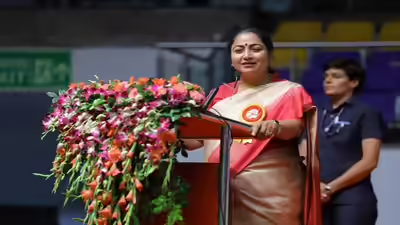
At the Delhi Chief Minister’s residence, the air was filled with festivity and devotion. CM Rekha Gupta, known for her simplicity and graceful approach to public life, celebrated Karwa Chauth in a traditional yet heartwarming manner.
Wearing a stunning red Banarasi saree with golden zari work, Rekha Gupta performed the rituals alongside her husband and family. The Chief Minister was seen holding the traditional Karwa (pot) and sieve, offering water to the moon before her husband helped her break the fast.
She later shared glimpses from the celebration on social media, captioning her post:
“Karwa Chauth is a festival that celebrates love, commitment, and trust. It reminds us of the beauty of togetherness and the strength that faith gives us. Wishing everyone prosperity and happiness.”
Her post quickly went viral, garnering admiration from citizens for maintaining the perfect balance between her role as a leader and as a devoted wife.
Guests and party workers who visited her residence described a warm, family-like atmosphere. Traditional sweets like Mathri, Ghevar, and Kaju Katli were distributed, while devotional songs dedicated to Goddess Parvati and Lord Shiva echoed through the evening.

CM Pushkar Singh Dhami’s Devotional Simplicity in Uttarakhand
In Dehradun, Uttarakhand Chief Minister Pushkar Singh Dhami celebrated Karwa Chauth with his wife, Geeta Dhami, in a simple yet spiritually profound way. The CM, known for his deep-rooted values and humility, joined his wife in offering prayers to the moon from their official residence’s terrace.
Geeta Dhami, dressed in a vibrant pink Pahadi saree, performed the traditional rituals, while the Chief Minister assisted her during the Arghya ceremony. The couple’s chemistry and quiet devotion reflected the simplicity of hill culture — where spirituality meets everyday life.
CM Dhami, in a heartfelt social media post, wrote:
“The love and devotion of our women keep our traditions alive. Karwa Chauth is a festival that symbolizes strength, patience, and the eternal bond of trust. Wishing all married couples happiness and long life.”
The post, accompanied by a serene photo of the couple gazing at the moon, won hearts online. Supporters and citizens praised the CM for embodying the cultural ethos of Uttarakhand and leading by example.
Local BJP leaders organized community Karwa Chauth gatherings across the state, where women shared their experiences, sang devotional songs, and celebrated sisterhood. The Chief Minister’s gesture added a personal touch to the festival, inspiring many couples to follow traditional customs with sincerity.
Shivraj Singh Chouhan: Continuing the Tradition with Family Warmth
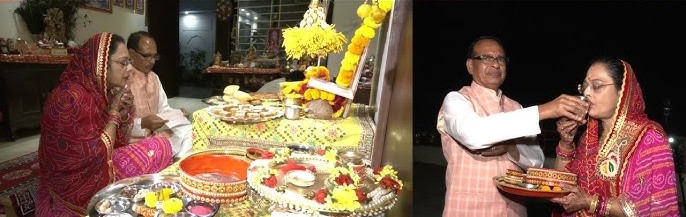
In Bhopal, former Madhya Pradesh Chief Minister Shivraj Singh Chouhan also celebrated Karwa Chauth in a manner that reflected both personal devotion and cultural rootedness. A man known for his emotional connect with people and his devotion to Indian traditions, Shivraj has often shared glimpses of his family’s Karwa Chauth celebrations in previous years.
His wife, Sadhna Singh Chouhan, observed the fast and performed rituals under the moonlight at their residence. Dressed in an elegant traditional silk saree, Sadhna Singh was seen performing the puja with other women of the household. Shivraj Singh Chouhan joined her later in the evening, and the couple performed the moon-sighting ritual together.
In a social media post, Shivraj Singh wrote:
“Karwa Chauth is not just a ritual, but a celebration of the divine bond between husband and wife. My heartfelt gratitude to all women who keep our traditions alive through love, faith, and sacrifice.”
The couple’s photos went viral, with citizens commenting on how gracefully the former CM preserves cultural traditions despite his busy schedule.

Across Party Lines: A Shared Cultural Sentiment
Interestingly, the Karwa Chauth celebrations this year transcended political lines. Leaders from various parties, whether ruling or opposition, joined in the festivities, sharing pictures of their families and extending greetings to citizens.
- Smriti Irani, Union Minister, shared an Instagram story thanking women who fasted with love and strength, calling them “the torchbearers of Indian tradition.”
- Priyanka Gandhi Vadra shared an image of Karwa decorated with flowers, symbolizing her wishes for all married women.
- Akhilesh Yadav’s wife Dimple Yadav was also seen performing the rituals quietly at home, keeping the celebrations private yet devotional.
This collective observance of Karwa Chauth across political spectrums showed that despite ideological differences, India’s shared cultural fabric remains strong and unifying.
Karwa Chauth 2025: A Social and Cultural Spectacle
This year’s Karwa Chauth was celebrated with exceptional grandeur across the country. Temples were beautifully decorated, community gatherings saw women dressed in vibrant traditional attire, and markets were flooded with items like bangles, sindoor, puja thalis, and designer sarees.
In cities like Delhi, Lucknow, Jaipur, and Chandigarh, special Karwa Chauth Melas were organized where women could buy festive accessories, mehndi artists created intricate designs, and sweet shops reported record sales.
Meanwhile, social media platforms turned into digital arenas of celebration — with hashtags like #KarwaChauth2025, #MoonSighting, #KarwaChauthVibes, and #FestivalOfLove trending for hours.
From newlyweds celebrating their first Karwa Chauth to elderly couples continuing their decades-long tradition, the day became a showcase of enduring love, faith, and family values.
Rekha Gupta’s Message on Women’s Empowerment and Tradition
Chief Minister Rekha Gupta didn’t just celebrate — she used the occasion to send a deeper message. During a media interaction after performing the rituals, she emphasized how traditional festivals like Karwa Chauth reflect both spiritual devotion and women’s inner strength.
She said:
“Our festivals are not just about rituals, but about values. Karwa Chauth teaches patience, discipline, and love. It’s a festival where women lead with faith — and their strength keeps the foundation of families and society strong.”
She also highlighted how the Delhi government is planning initiatives to promote handmade Karwa Chauth products under women’s self-help groups, encouraging people to buy locally-made items for festive occasions. Her statement drew parallels to the Vocal for Local initiative, linking tradition with empowerment.
Faith Meets Modernity: The Changing Face of Karwa Chauth
Interestingly, the 2025 Karwa Chauth celebration showcased how the festival is evolving in the modern era. Many young couples shared posts where husbands too observed fasts, reflecting changing dynamics of equality and mutual respect.
Leaders like Pushkar Singh Dhami even praised this shift, saying,
“Faith becomes stronger when both partners walk together. These traditions will continue to thrive as long as they adapt to changing times without losing their essence.”
Technology too played a role — from Karwa Chauth moon tracker apps to virtual group pujas for NRIs, the festival showed how digital India can preserve traditional emotions in contemporary ways.
The Symbolism of the Moon: A Unifying Image Across States
Across India, as the moon finally appeared after hours of anticipation, the scenes were magical. From rooftops of Delhi and Lucknow to terraces of Dehradun and Bhopal, millions of women lifted their sieves to the sky, their eyes filled with devotion.
For leaders like Rekha Gupta, Pushkar Singh Dhami, and Shivraj Singh Chouhan, this act was more than a personal ritual — it was symbolic of faith guiding leadership. The sight of them performing the same rituals as ordinary citizens created a rare emotional connect — reminding people that before being politicians, they too are part of the same social and cultural rhythm.
Public Reaction: “Our Leaders Stay Connected to Our Culture”
The public’s response to these celebrations was overwhelmingly positive. Citizens across social media appreciated the simplicity and sincerity of their leaders.
A user commented on Rekha Gupta’s post:
“This is why people love her — she stays grounded and respects our traditions even as a Chief Minister.”
Another wrote under Dhami’s tweet:
“Our CM shows that spirituality and governance can go hand in hand.”
Similarly, Shivraj Singh Chouhan’s posts were flooded with comments calling him “a family man and a cultural leader.”
Such reactions underline how deeply cultural values resonate in Indian politics. In a country where festivals often unite communities, leaders participating wholeheartedly reinforces emotional bonds with citizens.
The Broader Message: Culture as India’s Political Strength
The participation of top political figures in Karwa Chauth festivities reflects a broader truth about Indian democracy — that culture and politics are deeply intertwined. Festivals like Karwa Chauth not only connect families but also strengthen social harmony, reminding everyone of shared values beyond political divides.
CM Rekha Gupta, CM Dhami, and Shivraj Singh Chouhan, through their simple acts of devotion, conveyed that India’s progress and cultural preservation go hand in hand. Their message was clear:
“Modernity should never mean abandoning tradition; it should mean celebrating it with renewed pride.”
Conclusion: The Moon of Devotion Shines on All
As the moonlight bathed cities and villages on Karwa Chauth night, the spirit of togetherness illuminated the hearts of millions. From ordinary homes to the residences of chief ministers, the essence remained the same — love, faith, and cultural continuity.
CM Rekha Gupta’s elegant celebration in Delhi, CM Pushkar Singh Dhami’s humble rituals in Dehradun, and Shivraj Singh Chouhan’s family devotion in Bhopal became reflections of India’s unity in diversity. They showed that whether one governs a state or manages a household, the values of commitment, patience, and love remain timeless.
In a world rapidly modernizing, Karwa Chauth reminds India of its emotional roots — of faith that transcends material life and connects souls under one divine moon. And this year, as political leaders too looked up to that same moon with devotion in their eyes, they reminded the nation that power, when grounded in culture, becomes truly human.
Read More latest news

