

Pakistan Train Hijack: Over 150 Passengers Rescued, 27 Baloch Rebels Killed In Gunfight
Introduction
In an incident that has sent shockwaves across Pakistan, a daring and violent train hijack unfolded in the country’s southwestern region. The hijacking, which involved a group of armed Baloch separatists, escalated into a high-stakes standoff with Pakistani security forces. The dramatic rescue of over 150 passengers, coupled with the loss of 27 rebels’ lives, marks one of the most intense and dangerous encounters in the region in recent years.
The hijacking of a passenger train, typically seen as a symbol of normalcy and routine, turned into a battleground. It was a reminder of the ongoing conflict between the Baloch separatist insurgents and the state of Pakistan, a struggle that has simmered for decades in the restive Balochistan province.
This blog will break down the series of events surrounding the hijacking, the broader context of Baloch insurgency, the rescue operation, and the implications of the attack on Pakistan’s security situation.
The Hijacking Incident: A Chronology of Events
The incident occurred on the morning of March 12, 2025, when a passenger train traveling from Quetta, the capital of Balochistan, to Karachi was forcibly stopped by a group of armed men. The attackers, identified as members of the Balochistan Liberation Army (BLA), one of the most prominent separatist groups in the region, took control of the train as it was passing through a remote stretch of Balochistan.
According to eyewitnesses, the hijackers, clad in military fatigues, overpowered the train’s security personnel before taking control of the locomotive and its carriages. The hijackers then barricaded themselves inside, holding the passengers hostage and demanding the release of their comrades imprisoned by Pakistani authorities.
Immediate Reaction and Mobilization of Security Forces
The Pakistani authorities were swift to react to the hijacking. As soon as news of the incident broke, the Pakistan Railways, the federal body responsible for the country’s railway services, contacted the local law enforcement agencies and military units to deploy forces to the scene.
A quick response unit of the Pakistan Army’s Special Services Group (SSG) was dispatched, and the Border Security Force (BSF) was also mobilized to coordinate the operation. In addition to securing the passengers’ safety, the primary goal was to neutralize the attackers without causing harm to the hostages.
The Standoff and Intense Gunfight
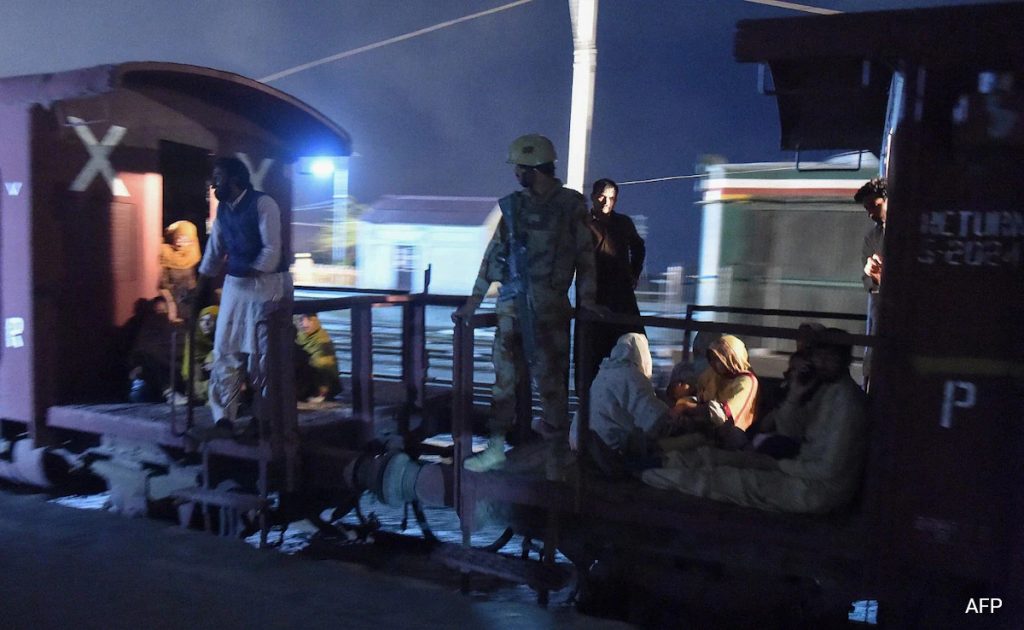
What followed was a tense standoff that lasted for hours. The hijackers, seemingly well-prepared for such a confrontation, fortified themselves within the train, using the confined space to their advantage. Pakistani forces surrounded the area, but the rebels were determined not to surrender. Negotiations between the hijackers and authorities failed, escalating the situation into a full-blown military confrontation.
The gunfight between the BLA militants and Pakistani security forces became intense, with automatic gunfire and explosions ringing out across the desert landscape. The Pakistani forces, knowing the importance of rescuing the hostages without causing significant casualties, had to carefully approach the situation with a combination of precision tactics and overwhelming force.
According to military sources, 27 Baloch separatists were killed in the ensuing battle, with several others reportedly wounded. As Pakistani forces closed in, they were able to free over 150 passengers, many of whom were visibly traumatized by the ordeal. The rescue operation, though a success, came at a cost. Four Pakistani security personnel were injured in the gunfight, though none sustained life-threatening injuries.
Context: The Baloch Insurgency
To fully understand the significance of the train hijacking, it’s essential to grasp the broader context of the Baloch insurgency. Balochistan, the largest and most resource-rich province in Pakistan, has been at the center of a long-running separatist movement for several decades. The Baloch people, a distinct ethnic group with their own language, culture, and history, have long felt marginalized by the central government in Islamabad.
At the heart of the insurgency is the demand for greater autonomy and control over the region’s vast natural resources. Balochistan is home to significant reserves of natural gas, minerals, and oil, but many Baloch separatists argue that the central government has not only failed to invest in the region’s development but has also exploited its resources for the benefit of the federal state. This has led to an ongoing sense of alienation and resentment within the Baloch community.
Groups such as the Balochistan Liberation Army (BLA) and the Balochistan Liberation Front (BLF) have waged an insurgency against the Pakistani military and state institutions, using tactics ranging from ambushes to bombings. Their ultimate goal is to establish an independent Baloch state, separate from Pakistan.
The Pakistani government, in turn, has implemented heavy military and paramilitary operations in the region, attempting to crush the insurgency and restore control. These operations have been marked by frequent human rights abuses, with allegations of enforced disappearances and extrajudicial killings of suspected separatists.
The Balochistan Liberation Army (BLA) and its Operations
The BLA is one of the most influential and well-organized insurgent groups in Balochistan. Founded in 2000, the BLA operates both inside Pakistan and across the border in Iran and Afghanistan. The group has carried out numerous attacks against Pakistani military personnel, government installations, and infrastructure.
The BLA claims to fight for the rights of the Baloch people and the establishment of an independent Balochistan. Their tactics often include armed raids on security posts, ambushes on military convoys, and acts of sabotage targeting government infrastructure, including oil pipelines and railway tracks. The train hijacking represents a rare but high-profile tactic that the BLA has used to draw international attention to their cause.
While the BLA’s attacks have mainly targeted military and government institutions, civilian casualties have also occurred as a result of these insurgent actions. The hijacking of a passenger train, with its obvious risk to innocent lives, was a clear attempt to make a political statement, though it is unclear whether the BLA intended to take such drastic measures.

The Aftermath and Implications of the Attack
Following the rescue operation, Pakistani authorities moved swiftly to control the narrative surrounding the hijacking. The government hailed the swift response by the security forces, emphasizing the successful evacuation of the passengers and the elimination of the rebel threat. President Arif Alvi and Prime Minister Imran Khan both extended their condolences to the families of the injured and expressed gratitude to the security forces for their bravery.
In a public statement, the Prime Minister also reiterated Pakistan’s commitment to maintaining sovereignty over Balochistan and promised to address the grievances of the Baloch people through political and economic means. This has been a common refrain from Islamabad in recent years, but many critics argue that the central government’s actions in the region often serve to inflame the separatist sentiment rather than quell it.
A Broader Security Concern for Pakistan
The hijacking has also raised broader security concerns for Pakistan, particularly in the context of its ongoing battle with both domestic insurgent groups and external threats. Balochistan, with its proximity to Afghanistan and Iran, is a geopolitically significant region. The province has often been used as a route for smuggling, and the unstable security situation has attracted both international attention and scrutiny.
In addition, the incident has once again highlighted the challenges of counterinsurgency warfare in a region where the enemy is often embedded within the civilian population, making it difficult for security forces to differentiate between combatants and non-combatants. The use of trains and other forms of civilian infrastructure as targets is becoming increasingly common among insurgent groups, adding a new layer of complexity to Pakistan’s security challenges.
The International Reactions
The international community has closely followed the hijacking incident, with some countries expressing concern over the escalating violence in Balochistan. The United States, the United Kingdom, and other Western countries have reiterated their support for Pakistan’s sovereignty but have also called for dialogue and a political resolution to the ongoing conflict in the region.
Meanwhile, neighboring countries like India, which has long been accused of supporting Baloch separatists, have largely remained silent on the incident. However, it is widely believed that Baloch insurgents have received varying levels of support from external actors over the years, further complicating the situation for Islamabad.
Conclusion: A Complex and Ongoing Crisis
The hijacking of the passenger train in Balochistan is just one chapter in the long-running struggle between the Pakistani state and the Baloch separatists. While the immediate operation ended in a successful rescue, it is clear that the underlying issues driving the insurgency remain unresolved.
The attack serves as a stark reminder of the deep-rooted discontent that exists within Balochistan and the challenges that Pakistan faces in attempting to integrate this strategically important and resource-rich province into the national fold. Until the grievances of the Baloch people are adequately addressed, incidents like this are likely to continue, further straining Pakistan’s ability to maintain peace and security in the region.
As the world watches, the ultimate question remains: can a political solution be found, or will Balochistan’s insurgency continue to escalate, with violence and bloodshed becoming an all-too-familiar feature of Pakistan’s troubled landscape? Only time will tell.
Read More Latest News

