
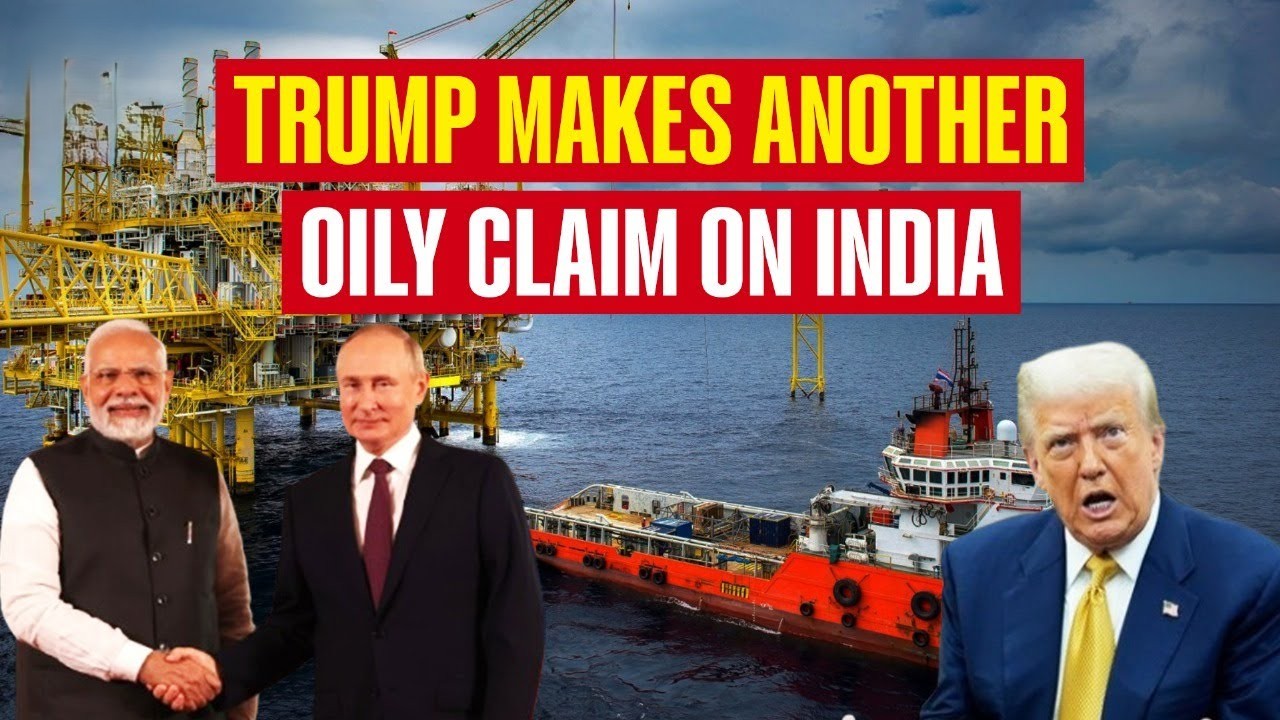
India Not Stop Buying Russian Oil
Despite pressure from former US President Donald Trump, India is unlikely to halt its import of Russian crude oil, according to recent reports. The economic and strategic benefits derived from discounted Russian oil are proving too significant for New Delhi to ignore. After the Ukraine war, India emerged as one of the largest importers of Russian crude, purchasing it at prices well below global benchmarks. This move not only helped control domestic fuel inflation but also strengthened India’s energy security.
While Trump has issued warnings and hinted at possible diplomatic or economic consequences, Indian policymakers have made it clear that their energy decisions are driven by national interest. In a rapidly changing geopolitical landscape, India continues to follow a policy of strategic autonomy, maintaining balanced relations with both the West and Russia. Analysts believe that unless new sanctions are imposed directly on India, it is unlikely to shift its current stance on oil imports. India’s stand reflects a broader global reality—energy needs and economic compulsions often outweigh political pressure.
Introduction: India’s Energy Dilemma
As global geopolitical tensions flare, India finds itself at the center of an intensifying tug-of-war over energy policy. Former U.S. President Donald Trump recently issued a 25% tariff threat and even warned of 100% duties on imports from countries continuing to buy Russian oil if Moscow does not agree to a peace settlement. Despite this pressure, India has chosen to hold firm on its policy of continuing Russian crude imports, a move grounded in economic pragmatism and energy security concerns.
Chapter 1: Why India Continues Buying Russian Oil
1. Deep Dependence and Discounted Price Advantage
India imports over 85% of its crude demand, and for three years, Russia has become its largest single supplier, overtaking Middle Eastern producers. India imported roughly 1.75–2.08 million barrels per day (bpd) of Russian crude in mid‑2025, amounting to 35–40% of its total imports. Russian oil has often traded at discounts of 8%–23% compared to Iraqi or Saudi alternatives, helping refiners collectively save billions—estimates range up to $5.8 billion in early FY24 and $2–3 billion in later periods.
2. Strategic Energy Security
With multiples crises—including the Israel–Iran conflict—raising volatility in Middle Eastern supply, Russia provides reliability and deep inventory options. In June, imports peaked at 2.08 m bpd, even as overall global inbound declined—highlighting India’s reliance during turbulent times.
3. Payment Mechanisms and Logistical Flexibility
India and Russia have developed alternative systems for payment beyond mainstream Western financial networks. Mechanisms using rupee–ruble transactions and shipping via shadow tankers (e.g., Indian-managed or flagged vessels) allowed trade to continue despite sanctions. Entities like Gatik Ship Management facilitate discreet Russian oil imports under “convenient flags”.
Chapter 2: U.S. Pressure and India’s Response
1. Trump’s Escalating Sanctions and Tariff Threats
In August 2025, Trump announced 25% tariffs on Indian goods and warned of 100% tariffs on oil‑importing nations unless Russia ceases its military actions. Senior adviser Stephen Miller went further—accusing India of indirectly financing Russia’s war.
2. Indian Leadership’s Defiance
India has firmly rejected these demands. Prime Minister Narendra Modi affirmed that oil procurement is guided by economic, logistical, and sovereign interests—not by foreign diktats. Government denies directing refiners to halt Russian imports and insists the nation remains compliant with legal frameworks, including G7 price caps.
3. Selective Pause by Public Refineries
As of late July, state-owned refiners (IOC, HPCL, BPCL, MRPL) temporarily paused spot purchases of Russian oil, citing falling discounts and increasing U.S. pressure. However, private refiners like Reliance Industries and Nayara Energy continue under long‑term contracts and account for over 60% of Russia imports.

Chapter 3: Data by the Month—India’s Russian Oil Trends
- April 2024: Russian crude imports hit ~1.8 m bpd, accounting for 38% of imports.
- May 2025: 10‑month high at 1.96 m bpd, Russian share ~38%.
- June 2025: Surged to 2.08 m bpd, ~40–43% share of India’s intake, highest since July 2024.
- H1 2025: Steady at ~1.67 m bpd average, accounting for ~35% of total imports; U.S. crude rose to 270k bpd, and Brazil to 73k bpd—signs of light diversification.
Chapter 4: Economic Benefits vs. Global Criticism
1. Economic Buffering
Purchasing discounted Russian crude has contributed to lower inflation, reduced fiscal strain, and eased pressure on foreign exchange reserves. Analysts credit these imports with shoring up India’s current account and allowing budgetary flexibility.
2. Defending Global Energy Stability
Union Minister Hardeep Singh Puri argued India’s imports helped stabilize global fuel prices; without Indian demand, price spikes could have affected poorer nations.
3. Critics’ Concerns
Western voices question whether India’s trade with Russia indirectly funds Moscow’s war machine. They point to shadow fleets, insurance circumvention, and logistical workarounds.
Chapter 5: Strategic Calculus and Future Options
1. Diversification Plans
India is exploring increased sourcing from Saudi Arabia, Iraq, the U.S., Brazil, and West Africa to reduce overdependence. Recent EU sanctions on Nayara Energy’s Vadinar refinery (49% Rosneft-owned) threaten export channels to Europe—prompting India to adapt logistics and sourcing.
2. Infrastructure Enhancements
India–Russia maritime cooperation is deepening. The Chennai–Vladivostok Maritime Corridor became operational in late 2024, reducing shipping time and strengthening bilateral trade logistics.
3. Risk Factors Ahead
The path is not risk‑free. Secondary sanctions, shrinking discounts, and tighter insurance rules impose pressure. While private refiners have shielded their deals, public firms may scale back if Western penalties intensify.
Chapter 6: Geo-strategic Implications
1. India’s Assertion of Sovereignty
By prioritizing economic interest over external pressure, India reinforces its position as a non-aligned, self-reliant global actor—even within the complex interplay of U.S.–China–Russia trilateral dynamics.
2. India–Russia Bilateral Depth
The energy trade is embedded in a broader strategic partnership, which includes major arms deals, technology cooperation, and financial systems. Between 2022 and 2024, their trade nearly doubled—from $13 bn to $27 bn—anchored by oil and fertilizer imports.
3. Navigating Western Friction
As Trump escalates rhetoric and threats, India must balance its global relationships—maintaining strategic autonomy while managing ripple effects in trade, finance, and diplomacy.
Chapter 7: What Lies Ahead?
India’s continued imports of discounted Russian crude have so far served strategic ends. However:
- Policy shifts in U.S. or EU sanctions may compel deeper diversification.
- Refiners’ margin pressures as discounts shrink could alter procurement decisions.
- Domestic political pressures or fuel pricing trends could amplify calls for alternate suppliers.
Still, India’s leadership maintains that there is no immediate policy reversal planned. Energy decisions remain grounded in economic rationality, national interest, and supply stability.
Conclusion: Not Easy to Stop, But Complexity Growing
India’s continuation of Russian oil imports may appear defiant—but it’s rooted in long‑term strategy, cost‑effectiveness, infrastructure alliances, and sovereign decision-making. While Western pressure has intensified, Indian officialdom insists that oil buys are legal, compliant, and commercially driven. Divestment or major shift is not untenable—but it is complex and multifaceted.
For now, the report is clear: “It is not easy to stop buying Russian oil.” Unless geopolitics or market conditions drastically change, India sees this path as the most viable for sustaining its energy security and economic growth—regardless of external threats.
Read More latest news

