Nikki Haley’s Message to Trump Administration: If You Want to Stop China, Improve Relations with India
Introduction
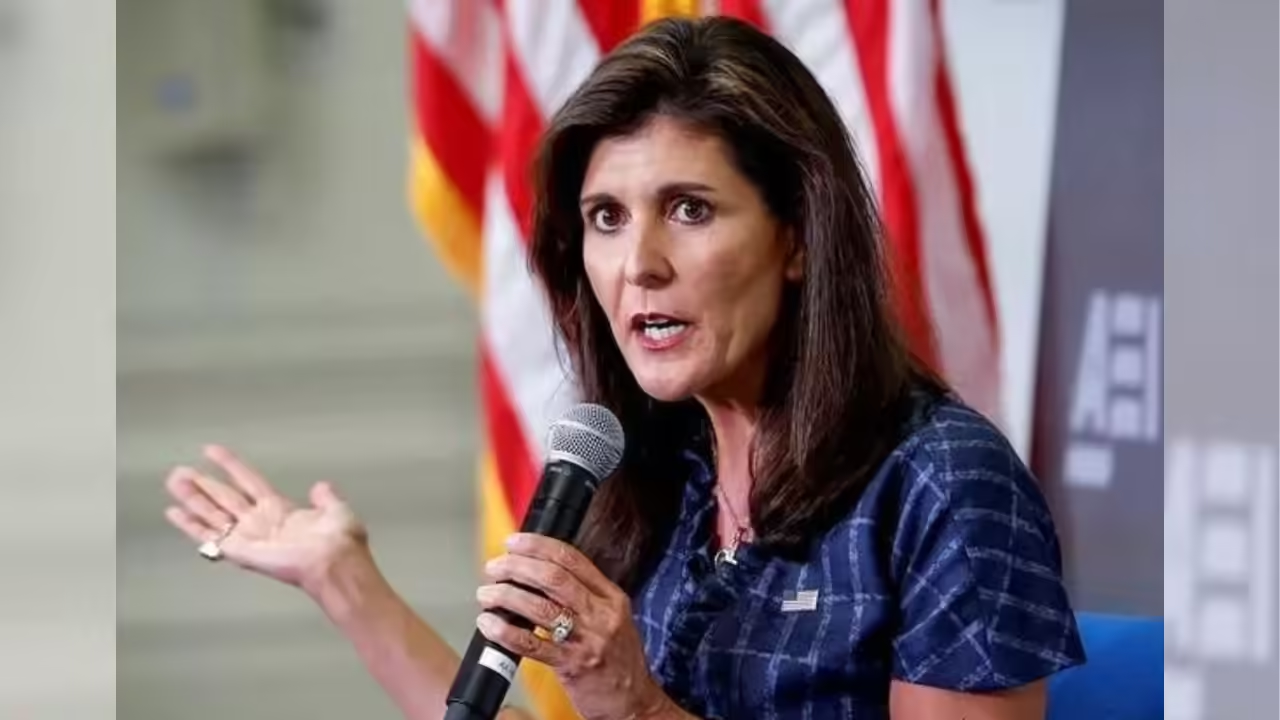
Nikki Haley Tells Trump Team In an era defined by global power shifts, India has emerged as a critical player in maintaining balance in the Indo-Pacific region. The rise of China as a geopolitical and economic powerhouse has prompted strategic recalibrations across the world, especially in Washington. Recently, former U.S. Ambassador to the United Nations, Nikki Haley, sent a pointed message to the Trump administration: “If you want to stop China, improve relations with India.”
Her statement has reverberated across international policy circles, highlighting the significance of U.S.-India relations in countering China’s expanding influence. In this blog, we will analyze Haley’s statement, explore the historical context of U.S.-India relations, assess China’s growing assertiveness, and examine why stronger bilateral ties are a strategic necessity for Washington.
The Context of Nikki Haley’s Statement
Nikki Haley, known for her forthright approach on foreign policy matters, made this observation during a strategic forum addressing Indo-Pacific security. Her message was clear: India is not just another democratic ally—it is central to the U.S. strategy in Asia.
Key Points from Haley’s Statement:
- India’s Strategic Location – Situated in the heart of the Indo-Pacific, India controls key maritime routes and serves as a buffer against China’s expansion.
- Economic Potential – As the world’s fastest-growing large economy, India offers strategic leverage for trade and investment partnerships.
- Shared Democratic Values – The U.S. and India share democratic principles that can be a soft power counterweight to authoritarian China.
Haley’s advice underscores a shift in U.S. thinking: countering China is not just about military presence but strengthening partnerships with regional powers, of which India is paramount.
Historical Overview of U.S.-India Relations
To understand the gravity of Haley’s statement, one must consider the evolution of U.S.-India relations over the past decades.
Cold War Era
During the Cold War, India followed a non-aligned policy, maintaining distance from both the U.S. and the Soviet Union. U.S.-India ties remained limited, mostly centered on trade and humanitarian aid.
Post-Cold War Shift
After the 1991 economic reforms in India, the U.S. recognized India’s potential as a market and a strategic partner. However, tensions persisted over nuclear development, especially India’s nuclear tests in 1998.
21st Century and Strategic Partnership
The post-2000 era witnessed a deepening of U.S.-India ties:
- 2005: Civil nuclear agreement between the U.S. and India.
- 2014 onwards: Strengthened defense cooperation, intelligence sharing, and joint military exercises.
- Indo-Pacific Strategy: India became a pillar of the U.S. strategy to maintain balance in Asia.
Despite these advancements, Haley’s statement signals that more proactive engagement is necessary to fully leverage India’s potential against China.

China’s Growing Assertiveness
China’s rise as a global power has been rapid and assertive. From aggressive territorial claims to expanding its Belt and Road Initiative, China is challenging the status quo.
Military Expansion
- Significant investments in South China Sea bases.
- Development of hypersonic missiles and advanced naval capabilities.
- Increasing presence near India’s borders in the Himalayas.
Economic Influence
- Belt and Road Initiative projects across Asia, Africa, and Europe.
- Investments in strategic ports and infrastructure to enhance geopolitical leverage.
Technological Ambitions
- Lead in 5G technology, AI, and space exploration.
- Competing with the U.S. and India for tech dominance in the Indo-Pacific.
Haley’s message implies that without leveraging India’s strategic position and potential, the U.S. may struggle to maintain balance in Asia.
Why India is Central to U.S. Strategy
1. Geopolitical Location
India controls the Indian Ocean, through which 80% of global trade flows. Its location enables strategic monitoring of Chinese maritime activities.
2. Military Capabilities
- Nuclear arsenal and modernized armed forces.
- Growing naval and air power, capable of countering regional threats.
- Experience in counterinsurgency and asymmetric warfare, useful for joint U.S.-India operations.
3. Economic Leverage
India’s massive market, technological expertise, and growing manufacturing sector complement U.S. economic interests in the region.
4. Democratic Alliance
Shared democratic values strengthen soft power alliances, contrasting with authoritarian models in China.
Steps the Trump Administration Could Take
Haley’s advice suggests actionable measures:
- Strengthen Defense Cooperation – Expand joint military exercises, share intelligence, and sell advanced defense technology.
- Enhance Trade Relations – Facilitate bilateral trade, reduce tariffs, and collaborate on technology and infrastructure.
- Support India in Multilateral Forums – Encourage India’s participation in global governance, UN reforms, and Indo-Pacific coalitions.
- Invest in Technology Partnerships – Collaborate in AI, cybersecurity, space, and 5G to counter China’s dominance.
- Diplomatic Engagement – Foster high-level exchanges and resolve lingering policy differences to build trust.
Challenges in Strengthening U.S.-India Ties
While Haley’s message is clear, implementing it is not without challenges:
- India’s Non-Aligned Tradition – India prefers strategic autonomy, not becoming a formal ally in any conflict.
- Trade and Tariff Disputes – Bilateral trade tensions could slow deeper economic cooperation.
- Regional Complexities – India’s relationship with neighboring countries (like Pakistan) requires careful diplomatic balancing.
- Domestic Politics in the U.S. – Policy continuity is affected by political shifts in Washington.
Despite these challenges, Haley emphasizes that the benefits outweigh the risks, making it imperative to act strategically.
Expert Opinions
- Dr. C. Raja Mohan (Indian foreign policy expert): “Haley’s message is a wake-up call. India has matured as a strategic power, and the U.S. must engage proactively.”
- Michael Kugelman (Asia policy analyst): “India’s role in countering China is underappreciated. Stronger ties can reshape the Indo-Pacific balance.”
- Nikki Haley (former U.N. Ambassador): “India is central to maintaining freedom of navigation, countering authoritarian expansion, and upholding democratic norms.”
Case Studies: Successful India-U.S. Collaboration
1. Malabar Naval Exercises
Joint exercises between India, the U.S., and Japan demonstrate India’s capability to operate in coalition scenarios, enhancing maritime security.
2. Civil Nuclear Cooperation
The 2008 U.S.-India nuclear deal enabled India to modernize its energy sector, reflecting trust and shared strategic interests.
3. Technology and Space Collaboration
Joint satellite launches and space research have boosted India’s technological profile while providing strategic leverage to the U.S.
These successes underscore why Haley’s message is grounded in historical precedent.
The Future of U.S.-India-China Dynamics
Haley’s warning also reflects the triangular dynamics of U.S.-India-China relations:
- India must maintain autonomy while collaborating with the U.S.
- The U.S. must recognize India as a partner, not just a counterweight.
- China’s assertiveness will continue to shape regional security.
Failure to engage India effectively could weaken the U.S.’s position in Asia, while proactive collaboration can reshape regional geopolitics.
Broader Implications
1. For Global Security
Stronger India-U.S. ties can stabilize the Indo-Pacific, ensuring freedom of navigation and economic security.
2. For India
Enhanced cooperation strengthens India’s defense, economy, and international stature, positioning it as a global power.
3. For China
A strategic India-U.S. partnership could act as a deterrent against aggressive expansion, forcing China to reconsider assertive policies.
Conclusion
Nikki Haley’s statement—“If you want to stop China, improve relations with India”—is more than a recommendation; it is a strategic roadmap for Washington. India’s geopolitical position, economic potential, military capabilities, and democratic values make it an indispensable partner in countering China’s rise.
The Trump administration, and indeed any U.S. leadership, must take heed. Strengthening bilateral ties through defense, trade, technology, and diplomacy is not just beneficial—it is essential for regional and global stability.
Read more latest news