
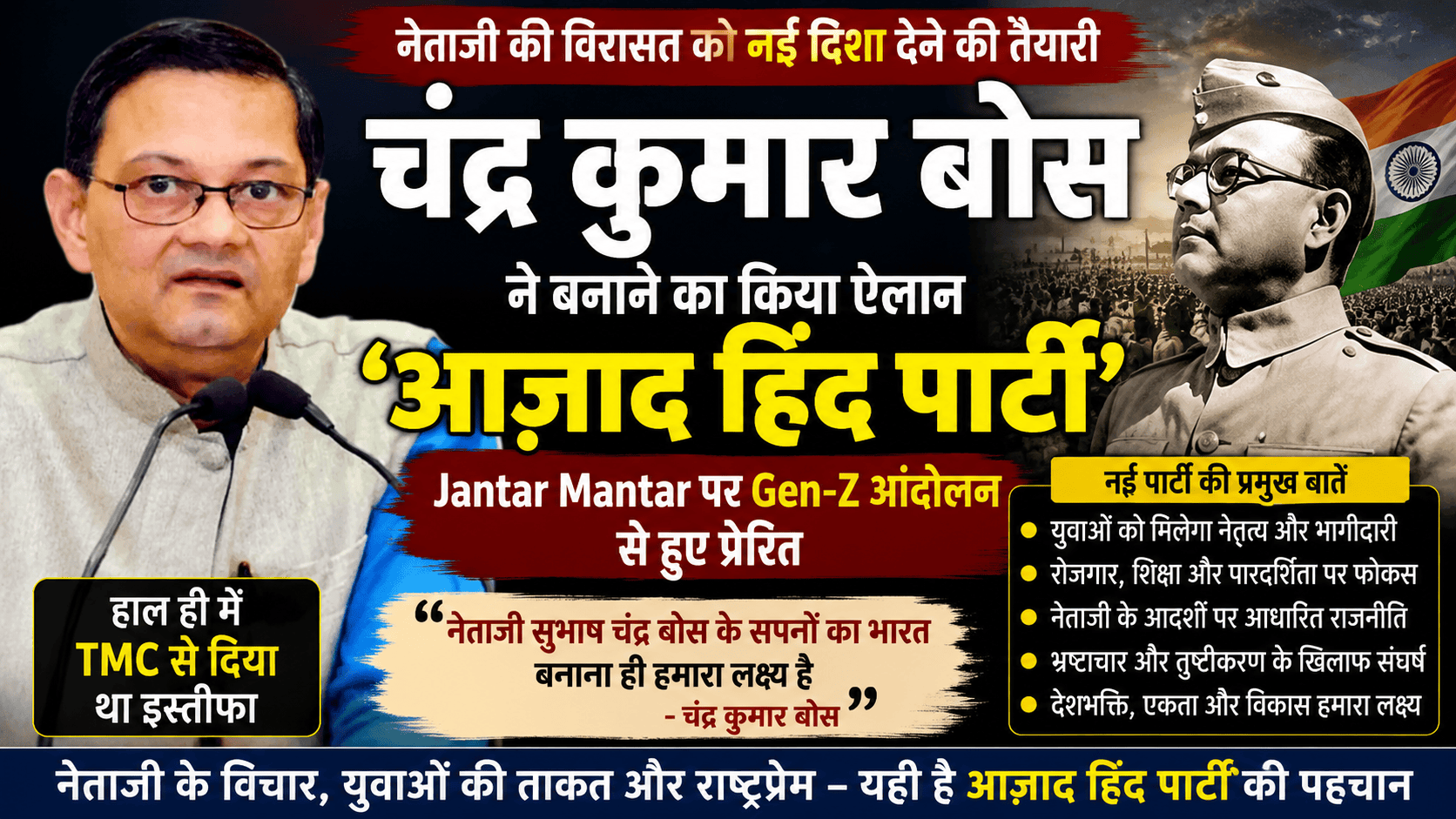
Chandra Kumar Bose to Form New Azad Hind Party, Says Gen-Z Movement Inspired His Decision
Netaji Subhas Chandra Bose, The proposed political initiative has attracted attention because of its association with the legacy of Netaji Subhas Chandra Bose and the historical significance of the Azad Hind name. The name itself immediately recalls the Indian National Army and the political and military movement associated with Netaji Subhas Chandra Bose during India’s struggle for independence.
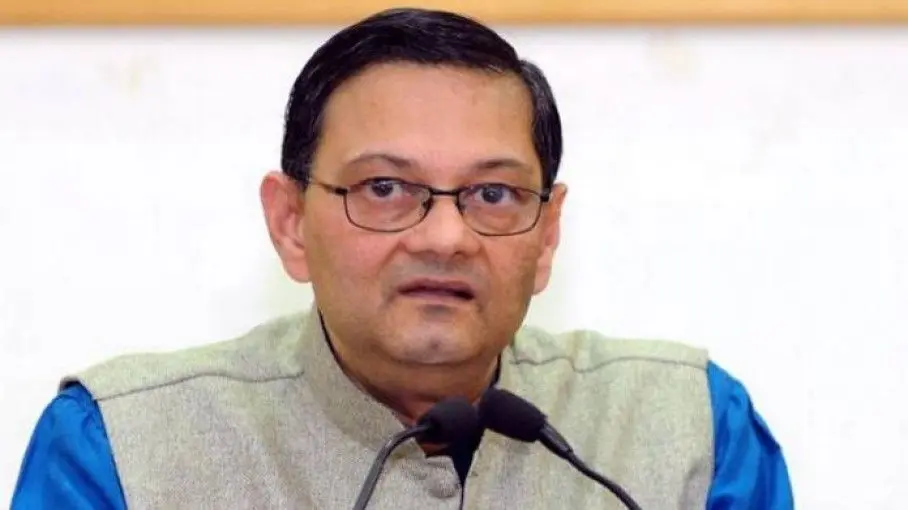
Chandra Kumar Bose, a descendant of the Bose family and a relative of freedom fighter Netaji Subhas Chandra Bose, is preparing to launch a new political platform called the Azad Hind Party. According to his reported statement, the decision was influenced by the recent Gen-Z-led movement at Jantar Mantar, which he viewed as an indication of growing political awareness and dissatisfaction among young Indians. His announcement comes shortly after he resigned from the Trinamool Congress (TMC), adding another development to his changing political journey.
From TMC Exit to a New Political Beginning
Chandra Kumar Bose recently resigned from the TMC after expressing dissatisfaction with mainstream political parties. Reports said he described the BJP and TMC as being similar in important respects and said he had become disillusioned with established political formations. His resignation marked another major shift in his political career.
His political journey has already included association with different parties. He joined the BJP in 2016 and later joined the TMC in April 2026 ahead of the West Bengal Assembly elections. At the time of joining the TMC, he had criticised the BJP and argued that its politics did not reflect the ideals associated with Netaji Subhas Chandra Bose.
Now, the proposed Azad Hind Party represents an attempt to create a political platform outside the established parties.
Gen-Z Movement at Jantar Mantar Becomes an Inspiration
Chandra Kumar Bose has linked his decision to the Gen-Z movement that emerged at Jantar Mantar. The youth-led mobilisation became a prominent political development during the summer, with young protesters raising concerns related to education, employment and political accountability.
The movement eventually attracted considerable national attention and became a symbol of youth participation in political debate. Reports described the Jantar Mantar agitation as a major Gen-Z-driven campaign that brought together young people around a range of demands.
For Bose, the movement appears to have demonstrated that a section of India’s younger generation wants to participate directly in politics rather than simply support traditional political parties. His proposed party could therefore attempt to convert that sentiment into a formal political organisation.
The connection with Netaji Subhas Chandra Bose also gives the proposed party a distinctive historical identity. The Azad Hind name evokes ideas of independence, national unity, sacrifice and political mobilisation that have long been associated with Netaji Subhas Chandra Bose.

Why the Azad Hind Name Matters
The choice of the name Azad Hind is politically and historically significant. Netaji established the Provisional Government of Free India, commonly associated with Azad Hind, during the freedom struggle. His Indian National Army also became an important symbol of resistance to British rule.
By choosing the name Azad Hind Party, Chandra Kumar Bose appears to be seeking a direct association with the legacy of Netaji Subhas Chandra Bose. However, creating a political party around a historical legacy also brings considerable expectations.
The party would have to explain how the principles associated with Netaji Subhas Chandra Bose can be applied to contemporary issues such as unemployment, education, economic development, national security, social welfare and governance.
A political organisation cannot depend solely on historical symbolism. It requires a clear ideology, organisational structure, leadership, grassroots workers and a detailed policy programme.
Youth Politics Could Become a Central Theme
The influence of the Gen-Z movement suggests that young voters could be at the centre of the proposed political strategy. India’s youth population represents a large and politically important demographic.
Issues such as employment opportunities, competitive examinations, education quality, skill development, entrepreneurship and access to technology are increasingly important in political discussions.
The proposed party could attempt to present itself as an alternative for voters who believe existing political parties have failed to adequately address these concerns.
This approach would also allow Bose to connect contemporary youth aspirations with the nationalist legacy of Netaji Subhas Chandra Bose. The challenge will be turning that connection into a practical political programme.
A Different Political Path
Chandra Kumar Bose’s decision also highlights the difficulties faced by political figures who move between established parties. His departure from the TMC comes only months after he joined the party. Before that, he had been associated with the BJP.
His political journey therefore reflects a search for a platform that he believes is closer to his interpretation of Netaji Subhas Chandra Bose‘s principles.
The creation of the Azad Hind Party would give him an opportunity to build a political identity independently rather than working within the organisational framework of a major party.
However, launching a political party in India is a substantial challenge. There are numerous registered political parties, but only a relatively small number have significant electoral influence. Building a statewide or national organisation requires substantial resources, volunteers and sustained grassroots engagement.
Can the New Party Attract Gen-Z?
The biggest question surrounding the proposed Azad Hind Party will be whether it can attract the young people who inspired its creation.
The Gen-Z movement at Jantar Mantar demonstrated the ability of young citizens to organise, communicate through social media and bring political issues into the national spotlight. However, converting a protest movement into an electoral organisation is a very different task.
A successful political party needs candidates, local committees, fundraising mechanisms, voter outreach and a clear strategy for elections.
If the Azad Hind Party intends to appeal to young voters, it may need to focus heavily on issues that affect their everyday lives rather than relying primarily on historical references to Netaji Subhas Chandra Bose.

The Legacy of Netaji and Modern Politics
The legacy of Netaji Subhas Chandra Bose remains powerful across India. His contribution to the freedom struggle, his call for sacrifice and his emphasis on national unity continue to influence political discourse.
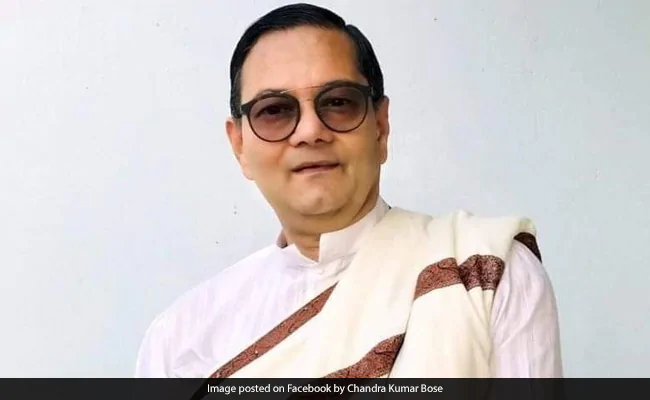
For Chandra Kumar Bose, invoking that legacy is also a family connection. But the political relevance of Netaji Subhas Chandra Bose will ultimately depend on how the new party interprets his ideas in the context of modern India.
Questions about economic independence, national development, social unity and strong institutions could become part of the party’s ideological framework.
The challenge will be ensuring that references to Netaji Subhas Chandra Bose are accompanied by concrete policies rather than remaining only as political symbolism.
What Lies Ahead?
The announcement of the proposed Azad Hind Party marks a new chapter in Chandra Kumar Bose’s political career. After leaving the TMC, he is now considering an independent political path inspired partly by the Gen-Z movement at Jantar Mantar.
The initiative could attract attention in West Bengal and beyond, particularly because of its association with Netaji Subhas Chandra Bose and the Azad Hind legacy.
Whether the party becomes a serious electoral force will depend on its organisational strength, leadership, policy agenda and ability to connect with voters.
For now, the proposed political formation represents an attempt to combine the historical legacy of Netaji Subhas Chandra Bose with the aspirations of a new generation.
The coming months will reveal whether Chandra Kumar Bose can transform the inspiration drawn from the Gen-Z movement into a sustainable political organisation. If he succeeds, the Azad Hind Party could add another dimension to India’s evolving political landscape, particularly at a time when younger voters are demanding greater representation and new political alternatives.
Netaji Subhas Chandra Bose remains at the heart of the proposed political identity, while the Gen-Z movement provides its immediate contemporary inspiration. The combination of historical legacy and youth-driven political energy could become the defining feature of this new political experiment.
Read more latest news

