
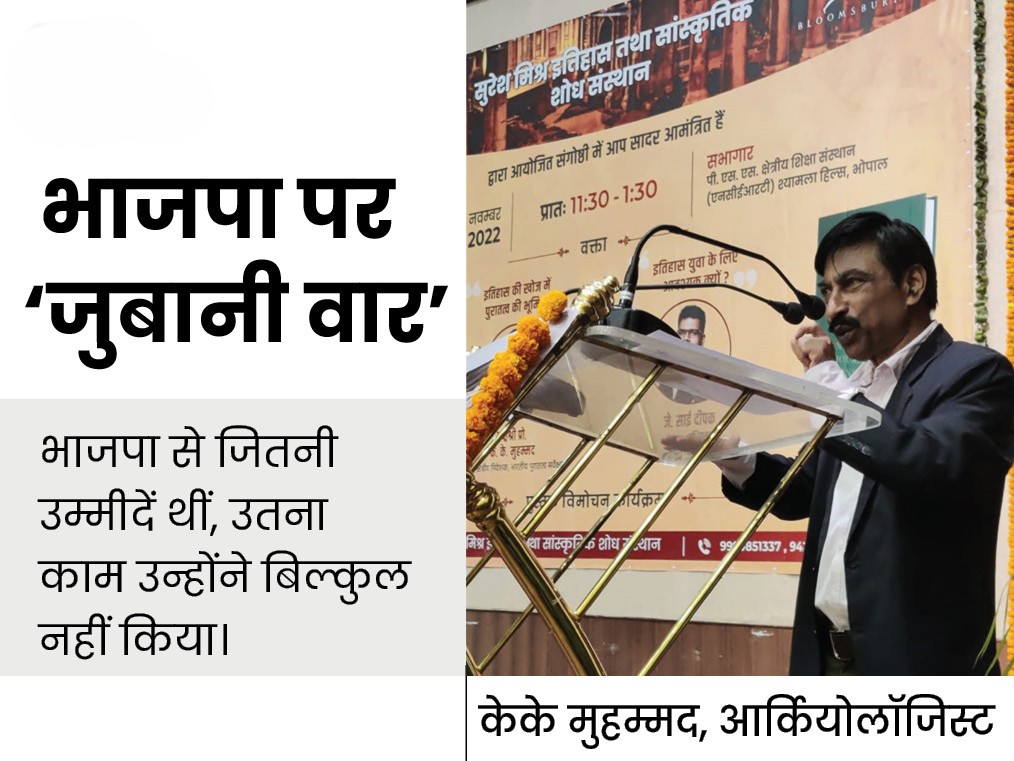
KK Muhammed Calls for Restraint: Why the Temple–Mosque Debate Should Now Focus Only on Ram Janmabhoomi, Mathura, and Gyanvapi
KK Muhammed call for restraint, Religious disputes in India are often deeply emotional, historically layered, and politically charged. In such times, voices that bring balance, maturity, and a sense of historical responsibility become extremely important. One such prominent voice is that of KK Muhammed, former Regional Director of the Archaeological Survey of India (ASI), a respected archaeologist known for his technical expertise and his courage to speak plainly about historical facts.
Recently, KK Muhammed appealed to the country to exercise restraint in the sensitive temple–mosque issue. His message comes at a time when many new disputes are emerging in different parts of the country, leading to political confrontation, legal battles, and social tension. According to KK Muhammed, instead of opening endless new fronts, national attention should be focused only on three sites—Ram Janmabhoomi in Ayodhya, the Krishna Janmabhoomi dispute in Mathura, and the Gyanvapi structure in Varanasi.
This blog takes a deep, analytical look at his position, his reasoning, and the larger implications for India’s socio-political environment. It also examines why KK Muhammed’s statements have historically carried weight and why his call for restraint requires serious attention in the current climate.
Who Is KK Muhammed and Why His Voice Matters
To understand the significance of this appeal, it is essential to understand who KK Muhammed is and why he commands respect across ideological lines.
As a former Regional Director of the ASI, KK Muhammed played a key role in several major archaeological studies, including the much-discussed excavations related to the Ram Janmabhoomi site. His first-hand knowledge of archaeological evidence, combined with decades of experience working on sensitive historical sites, makes him one of the most credible voices in this field.
Throughout his career, KK Muhammed has maintained a reputation for speaking based on evidence, not emotion. He has repeatedly said that India’s heritage should be understood, preserved, and discussed with care, not with confrontation. This is why, whenever he comments on temple-mosque issues, people across the political spectrum pay attention.
KK Muhammed’s Appeal: Restraint, Maturity, and Focus
In his recent statement, KK Muhammed made a clear and calm appeal:
Stop widening the dispute. Focus only on three historically documented sites—Ram Janmabhoomi of Ayodhya, Krishna Janmabhoomi of Mathura, and the Gyanvapi complex in Varanasi.
According to him, these three locations have:
- A historical foundation
- Strong cultural significance
- Long-standing disputes
- Documented evidence
- Ongoing legal battles
He emphasized that diverting attention to new sites will only increase communal tensions, destabilize social harmony, and unnecessarily complicate an already sensitive environment. By urging restraint, KK Muhammed is essentially calling for a controlled, evidence-based approach instead of an emotional wave that leads to unending disputes.

Why KK Muhammed Believes These Three Sites Are Unique
1. Ram Janmabhoomi – The Epicenter of a Centuries-Old Dispute
Ram Janmabhoomi is not just a religious site; it was the flashpoint of one of India’s most prolonged socio-political movements. The dispute spans centuries and involves archaeological studies, legal scrutiny, and mass mobilizations.
KK Muhammed was one of the archaeologists who confirmed the presence of a pre-existing temple structure beneath the Babri Masjid. He has frequently mentioned that Ayodhya stands on much firmer historical ground compared to newer, recently created controversies.
2. Mathura – The Krishna Janmabhoomi Debate
Mathura, the birthplace of Lord Krishna, has also been the subject of long-held claims about temple destruction and rebuilding. The region’s history traces back thousands of years, and the dispute around the Shahi Idgah mosque and Krishna Janmabhoomi temple is well-documented.
According to KK Muhammed, Mathura deserves calm, structured debate rather than emotional rhetoric. Historical evidence exists there, but it must be interpreted scientifically, legally, and peacefully.
3. Gyanvapi – A Living Archaeological Question
The Gyanvapi issue in Varanasi has already gained national attention. With court-ordered surveys, structural studies, and multiple claims regarding the presence of older temple remains, the dispute is moving legally rather than chaotically.
KK Muhammed believes that since Gyanvapi is already under judicial consideration supported by archaeological analysis, the nation should wait for the legal process rather than ignite fresh controversies elsewhere.
The Problem With Opening New Disputes
In recent years, several groups have begun raising claims over new sites, creating a chain reaction of disputes. KK Muhammed warns that such proliferation is dangerous.
Here’s why:
1. It Distracts From Core Issues
Adding new sites dilutes national focus. According to KK Muhammed, the country should first resolve long-standing disputes before entertaining newer claims.
2. It Intensifies Social Division
Multiplying disputes risks inflaming communal tension. Even a single spark can cause unrest, and KK Muhammed stresses that unnecessary confrontations should be avoided.
3. It Politicizes Archaeology
Archaeology is a science, not a political tool. KK Muhammed has often said that using archaeology to justify political motivations damages academic integrity and public trust.
4. It Overburdens the Judiciary
The courts are already handling several complex cases. Adding dozens of new disputes serves no constructive purpose and only clogs the judicial system further.

A Call for Peace and Responsibility
One of the most important aspects of KK Muhammed’s message is the tone of responsibility. Instead of taking a confrontational approach, he is urging all communities to participate calmly, with mutual respect.
His message is clear:
- India’s unity is more important than political gains
- Historical grievances must be resolved wisely
- Religious identities should not become tools for conflict
- Academic evidence should lead discussions, not emotions
For a country as diverse as India, this approach is both practical and essential.
How His Statement Was Received Across India
The response to KK Muhammed’s appeal has been mixed but largely respectful.
Supporters Say:
- His reasoning is logical and grounded
- As an archaeologist, he speaks with credibility
- His focus on only three sites is sensible
- His neutrality is refreshing in a polarized environment
Critics Say:
- The nation should not restrict itself to only three disputes
- Sentiments of other communities should not be dismissed
- Historical injustices should not be selectively addressed
However, even among critics, there is acknowledgement that KK Muhammed’s views cannot be ignored due to his expertise and integrity.
Why KK Muhammed Continues to Emphasize Scientific Evidence
Throughout his career, KK Muhammed has repeatedly highlighted that archaeology should guide debates on historical sites. He believes that emotions, politics, and assumptions cannot replace scientific study.
He has argued that:
- Excavations must be done professionally
- Findings must be peer-reviewed
- Reports must be preserved as public documents
- Court decisions must rely on evidence
In an era when misinformation spreads rapidly, KK Muhammed’s insistence on scientific approach is more relevant than ever.
The Larger Message Behind KK Muhammed’s Statement
Beyond the religious context, his message carries a broader meaning:
India must learn to prioritize stability over confrontation.
Historical justice should align with national harmony.
Archaeology should inform, not inflame.
Legal processes must be respected.
In other words, KK Muhammed is telling India:
Let us resolve, not multiply disputes.
Conclusion: A Voice of Reason in Turbulent Times
At a moment when historical debates can easily ignite political or communal sparks, KK Muhammed has chosen to speak with calm, clarity, and responsibility. His position is not just about temples or mosques; it is about safeguarding India’s future.
By urging the nation to limit the dispute to three major sites—Ayodhya, Mathura, and Gyanvapi—he is promoting discipline, evidence, and long-term communal harmony. Whether people agree with him or not, his message carries the weight of experience and sincerity.
India needs more voices that speak not for headlines, but for harmony. In that sense, KK Muhammed has played his role once again—reminding the nation that progress lies not in multiplying disputes, but in resolving them wisely.
Read More latest news

