
Tej Pratap Yadav Files Nomination from Mahua Seat with His Grandmother’s Photo, Not Parents — A Symbolic Step Reflecting Change in Bihar’s Political Landscape
Introduction: A Nomination That Spoke Louder Than Words Janshakti Janata Dal
Janshakti Janata Dal Bihar politics is no stranger to drama, symbolism, and emotional moments — but Tej Pratap Yadav’s nomination for the Mahua Assembly seat in the upcoming 2025 Bihar elections stood out for a very different reason. The eldest son of RJD supremo Lalu Prasad Yadav and former Chief Minister Rabri Devi, and now the chief of Janshakti Janata Dal (JJD), Tej Pratap surprised everyone by bringing a photo of his grandmother, Marchia Devi, instead of being accompanied by his famous political parents.
In a state where political legacies often dominate electoral symbolism, Tej Pratap’s move was not just emotional but deeply political. It conveyed a message of independence, reverence for his roots, and possibly a subtle statement on his current equations with the family and his brother, Tejashwi Yadav.
Let’s dive deep into this development — the background, the meaning behind this gesture, the reactions it triggered, and what it could mean for Bihar’s ever-evolving political equation.
A Glimpse into the Event: Nomination Day at Mahua Janshakti Janata Dal
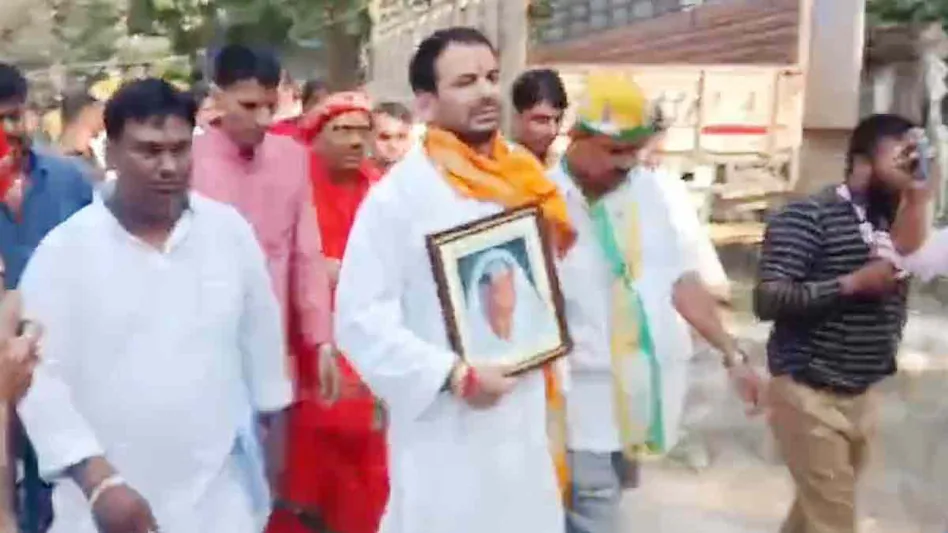
On Wednesday morning, Tej Pratap Yadav arrived at the Mahua Block Office in Vaishali district amid a sea of supporters, chants, and flashing cameras. Dressed in his signature kurta-pajama with a gamcha on his shoulder, Tej Pratap appeared calm and composed. However, what caught everyone’s attention was the framed photograph he carried carefully in his hand — it was not of Lalu Prasad Yadav or Rabri Devi, but of his grandmother, Marchia Devi, the late matriarch of the Yadav family.
He offered prayers before submitting his nomination papers, touched the photograph to his forehead, and declared,
“It is the blessings of my grandmother that guide me today. Whatever I am, it is because of her sacrifices and teachings.”
This statement alone was enough to set off a wave of interpretations across Bihar’s political circles.

Who Was Marchia Devi? The Forgotten Matriarch of the Yadav Clan Janshakti Janata Dal
Before understanding the political weight of Tej Pratap’s gesture, it’s important to recall who Marchia Devi was. The mother of Lalu Prasad Yadav, Marchia Devi lived a simple life in Phulwaria village, Gopalganj. She represented the heart of rural Bihar — a woman who raised her family amid poverty and struggle, instilling in them values of hard work, simplicity, and devotion.
While Lalu Prasad Yadav rose to political stardom, Marchia Devi remained away from the limelight, living a humble life. For Tej Pratap to invoke her image during his nomination is a symbolic return to the roots — a reminder of the original socialist spirit and moral foundation upon which the Yadav political legacy was built.
Why Mahua? The Emotional and Political Significance Janshakti Janata Dal
Mahua holds a special place in Tej Pratap’s political journey. It was from this very Mahua constituency in Vaishali that he first entered politics in 2015 as an RJD candidate. He won the seat comfortably and went on to serve as the Environment Minister in the Nitish Kumar-led government, where RJD was then an ally.
However, after years of political turbulence, changing alliances, and differences with his younger brother Tejashwi, Tej Pratap is once again contesting from Mahua — this time under his own party banner, Janshakti Janata Dal (JJD).
By choosing Mahua again, Tej Pratap seems to be reclaiming his political identity, trying to reconnect with the people who first believed in him. And by bringing his grandmother’s photo, he’s signaling a return to his origins, perhaps distancing himself from the high-profile politics that surrounded his family in Patna.
Janshakti Janata Dal Tej Pratap’s Political Journey: From Heir to Rebel
Tej Pratap Yadav’s political life has been full of highs and lows. Once seen as the natural heir to Lalu Prasad Yadav, he quickly found himself overshadowed by his younger brother Tejashwi Yadav, who proved to be more politically astute and emerged as the face of the RJD.
Over time, Tej Pratap developed a reputation for being unpredictable and outspoken, often taking spiritual or philosophical stands that baffled political observers. His fondness for religious attire, astrology, and statements invoking Lord Krishna or Lord Shiva gave him a unique image — somewhere between a politician and a mystic.
However, his growing differences with RJD leadership, particularly with Tejashwi, led him to float his own party, Janshakti Janata Dal, in 2024. Many saw it as a move driven by frustration, but Tej Pratap maintained that it was about returning to the people and socialist ideals his father once championed.
Symbolism of the Grandmother’s Photo: What Does It Mean?
In politics, symbols matter — often more than words. By choosing to carry his grandmother’s photograph instead of his parents’, Tej Pratap Yadav may be sending multiple messages at once:
- An Emotional Tribute: A gesture of gratitude towards the woman who raised the Yadav family from humble beginnings.
- A Return to Roots: A signal that he identifies more with the original, rural socialist values of his family’s political legacy rather than the urbanized, power-centric politics of today.
- A Silent Statement: A possible expression of his current emotional distance or ideological difference with his parents and brother.
- An Appeal to Simplicity: By invoking his grandmother, he connects with Bihar’s rural voters who value humility, tradition, and family bonds.
This single photograph turned what could have been a routine nomination filing into a powerful political message.
Reactions from Political Circles Janshakti Janata Dal
Tej Pratap’s unusual choice of symbolism sparked mixed reactions across Bihar’s political spectrum.
- RJD Leaders largely avoided commenting directly, but insiders admitted that the gesture was “loaded with meaning.”
- A senior RJD functionary anonymously told the media, “Tej Pratap ji always surprises everyone. But this move shows he wants to create his own identity.”
- Tejashwi Yadav, when asked about his brother’s nomination, gave a diplomatic answer: “Everyone has the right to contest elections. I wish him the best.”
Meanwhile, BJP and JD(U) leaders used the occasion to point out the rising divisions within the Yadav family, suggesting that RJD’s dominance over the Yadav vote bank may be weakening.
However, several political analysts disagree. They believe Tej Pratap’s move could actually split only a small percentage of votes but create significant emotional resonance among certain sections of the Yadav community.
Public Reaction: From Curiosity to Admiration Janshakti Janata Dal
Among the people, especially in Mahua, Tej Pratap’s act struck a chord. Many villagers recalled stories of Marchia Devi and her humble background. Local residents told reporters that they felt “he was bringing his roots back to Mahua.”
On social media, photos of Tej Pratap holding his grandmother’s picture went viral.
- Supporters called it “a beautiful gesture of love and simplicity.”
- Critics, however, called it “a political gimmick.”
Yet, even his detractors admitted that the emotional optics worked — it portrayed Tej Pratap not as a privileged heir, but as a grandson who hasn’t forgotten where he came from.
The New Identity of Janshakti Janata Dal
Tej Pratap’s Janshakti Janata Dal (JJD) is positioning itself as a party of “truth, spirituality, and social justice.” It combines elements of traditional socialist politics with Tej Pratap’s unique spiritual tone.
In his speech after filing the nomination, he said:
“Politics for me is not about power. It is about truth and dharma. My grandmother always told me to do what is right, not what is easy.”
The JJD’s symbol and manifesto highlight themes like environmental protection, youth employment, and moral politics — concepts that may appeal to a small but growing section of Bihar’s youth who are tired of caste-based rivalries.
Janshakti Janata Dal Mahua Constituency: The Battle Ahead
Mahua will witness an interesting triangular contest this time:
- Tej Pratap Yadav (JJD) — as the emotional favorite and independent force.
- RJD Candidate (yet to be announced) — possibly someone close to Tejashwi Yadav.
- BJP or JD(U) Candidate — expected to consolidate upper-caste and non-Yadav OBC votes.
The 2025 election in Mahua is more than a local contest; it’s a family and ideological battle that will test how much influence Tej Pratap still holds among Lalu Yadav’s traditional support base.
Media Coverage and Analysis Janshakti Janata Dal
National and regional media have covered Tej Pratap’s nomination with enthusiasm, describing it as “one of the most emotional moments of the Bihar election season.”
Political analysts on television debates highlighted how Tej Pratap’s act reflected changing generational attitudes within political dynasties.
Senior journalist Ravish Kumar remarked on his social media page:
“Tej Pratap’s use of his grandmother’s photograph is more than a family statement. It is a call for reconnecting with the soil — something all leaders must remember.”
Emotional Undercurrents: Beyond Politics Janshakti Janata Dal
At its core, Tej Pratap’s decision is not just political but deeply emotional. It reflects a yearning for maternal blessings — a connection that transcends politics. In Indian culture, grandmothers often symbolize unconditional love, sacrifice, and purity. By invoking her memory, Tej Pratap has cleverly humanized his campaign, making it less about rivalry and more about values.
Even among those who may not support him politically, the gesture resonated as a touching act of devotion — something rare in modern-day politics dominated by aggression and power plays.
Janshakti Janata Dal Challenges Ahead for Tej Pratap
Despite the emotional appeal, Tej Pratap faces a tough road ahead:
- Organizational Weakness: JJD is still a new party with limited structure and cadre strength.
- Voter Base: RJD continues to dominate the Yadav vote bank. Splitting it will be a challenge.
- Public Perception: Tejashwi Yadav is still seen as the main opposition leader; Tej Pratap’s credibility as a serious contender remains in question.
- Family Politics: The lack of open support from his parents might hurt his campaign’s reach in some areas.
However, politics in Bihar has often turned on emotional and symbolic moments, and Tej Pratap’s nomination could be one of those turning points if played strategically.
A Message of Faith and Independence Janshakti Janata Dal
In his closing remarks after filing the nomination, Tej Pratap said:
“I began my political journey from Mahua, and I am returning here with faith and blessings. My grandmother is watching over me. I am not alone.”
This emotional tone is set to be a defining theme of his campaign — presenting himself as a leader guided by faith, not family pressure.
Conclusion: A Grandson’s Political and Emotional Rebirth Janshakti Janata Dal
Tej Pratap Yadav’s decision to file his nomination from Mahua while carrying the photograph of his grandmother, Marchia Devi, marks a poignant moment in Bihar’s political story. It’s a blend of emotion, symbolism, and strategy — all wrapped in one frame.
Whether it translates into electoral success or not, one thing is clear: Tej Pratap has succeeded in making people talk about him again, not as Lalu’s son or Tejashwi’s brother, but as Tej Pratap Yadav — the grandson who remembers his roots.
In a state where political legacies are often reduced to power struggles, this act stands out as a rare and genuine tribute to family values and rural simplicity.
As the campaign heats up, Mahua will not just witness a political contest but also a clash between tradition and transformation, between dynasty and individuality, and between memory and ambition.
One photograph — of an old woman who once lived quietly in a Gopalganj village — has now become a symbol of Tej Pratap Yadav’s rebirth as a political force in Bihar.
Read more latest news

