

Delhi Blast: Home Minister Amit Shah Reaches LNJP Hospital, Meets the Injured
The capital of India was shaken on the evening of 10 November 2025, when a powerful blast ripped through the area near the historic Red Fort metro station. Within moments, chaos unfolded on the streets — vehicles were reduced to debris, smoke covered the skyline, and cries of fear echoed across one of Delhi’s busiest intersections. The blast, which reportedly killed at least eight people and injured several others, has raised major concerns about the city’s security apparatus and preparedness for emergencies.
Within hours of the explosion, Union Home Minister Amit Shah arrived at Lok Nayak Jai Prakash (LNJP) Hospital, where many of the injured were being treated. His visit was both a gesture of compassion and an assertion that the central government is closely monitoring every development related to this tragedy.
This 3000-word blog explores the blast, the chaos that followed, the hospital scenes, Amit Shah’s visit, and the deeper implications of this shocking event on India’s security and governance.
1. The Evening of the Blast: Chaos Near Red Fort Home Minister Amit Shah
Around 7 PM, just as Delhi’s rush hour was easing, an explosion was heard near the Red Fort metro station. Eyewitnesses described it as a deafening sound followed by a fireball that lit up the area. The blast reportedly originated from a white Hyundai i20, which instantly turned into a heap of twisted metal.
People in the vicinity were thrown off their feet. Those who were dining at nearby stalls or waiting at the traffic light suddenly found themselves amidst flying glass, dust, and flames. Some described the scene as “a war zone.” Several vehicles parked nearby were severely damaged, while others caught fire.
Panic spread like wildfire — shopkeepers shuttered their stores, commuters abandoned their vehicles, and sirens soon filled the air as police and emergency teams rushed to the scene.
2. Eyewitness Accounts: ‘We Saw Body Parts on the Road’
One eyewitness, a local shopkeeper named Rafiq Ahmed, said,
“When we reached closer, we saw body parts scattered on the road. No one could understand what had happened. Several vehicles were also severely damaged. People were crying and shouting for help.”
Another bystander mentioned that the blast shook the windows of nearby buildings and triggered a brief stampede as people tried to flee.
Local residents rushed to help before ambulances arrived. Many used bedsheets and clothes to carry the injured to safer areas. Within 10 minutes, Delhi Police, fire tenders, and ambulances reached the location. Traffic was blocked for nearly two kilometers as rescue operations began.
3. Emergency Response: Delhi’s Hospitals on High Alert
The injured were immediately taken to LNJP Hospital, RML Hospital, and AIIMS Trauma Centre. LNJP, being closest to the site, received most of the casualties. Within minutes, its emergency ward was packed. Doctors, nurses, and staff worked tirelessly to treat those suffering from severe burns, shrapnel wounds, and fractures.
Eyewitnesses at LNJP described scenes of heartbreak — family members crying in corridors, volunteers rushing with stretchers, and medical teams working without pause. The hospital administration activated Code Red, summoning additional surgeons and trauma specialists.
Some victims were unrecognizable due to the intensity of the blast, and identification became difficult. The Delhi government soon released helpline numbers for the public to contact for information on their relatives.
4. Home Minister Amit Shah Swift Visit to LNJP Hospital
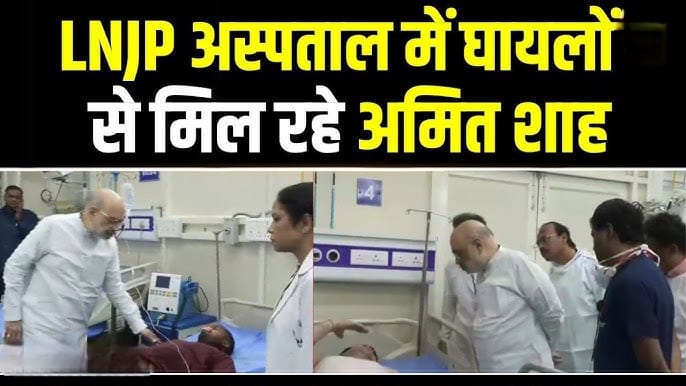
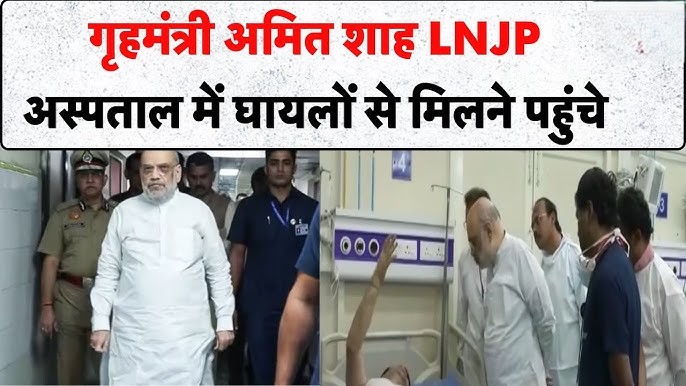
Home Minister Amit Shah, known for his quick crisis management, arrived at LNJP Hospital shortly after midnight. His visit was unannounced but deliberate — to personally assess the condition of the injured and review the medical and security situation.
He went room to room, meeting victims and their families. According to hospital officials, Shah spent considerable time listening to survivors’ accounts. Some victims reportedly expressed fear that the explosion was not accidental.
Shah assured them that the government would uncover the truth and that no possibility would be ruled out — whether it was a terrorist act, a sabotage attempt, or a mechanical failure.
He later interacted with the doctors and instructed them to provide the best possible medical care, assuring that all expenses would be covered by the central government. He also commended the medical staff for their swift response.
5. The Investigations Begin
Soon after the blast, the Delhi Police Special Cell, National Investigation Agency (NIA), and Forensic Science Laboratory (FSL) teams were deployed to the site. The National Security Guard (NSG) also joined to examine if the explosion had traces of military-grade explosives (Home Minister Amit Shah).
Preliminary findings suggested that the explosion originated inside the car, which had been parked for a few minutes near the traffic signal. Whether the driver was inside or not remains under investigation.
Security agencies are probing three major angles:
- Terrorism: Possible use of Improvised Explosive Device (IED).
- Mechanical accident: A gas cylinder or fuel tank explosion.
- Targeted attack: A planned blast intended to spread fear.
By the next morning, police had collected CCTV footage from nearby buildings and metro cameras to trace the vehicle’s movement before the explosion.
6. Delhi on High Alert
Following the blast, Delhi was placed on high alert. Security was intensified at major landmarks such as India Gate, Parliament House, and Connaught Place. Metro security checks were increased, and drones were deployed to monitor large crowds.
The Home Ministry also issued an advisory to all state governments to tighten security at public places, railway stations, and airports. Intelligence agencies were instructed to monitor suspicious communications and digital footprints related to the incident Home Minister Amit Shah.
This was the first major explosion in the national capital since the 2011 Delhi High Court blast, and naturally, fear resurfaced among citizens.
7. Political and Public Reactions
As news spread, leaders from across political lines expressed concern. Prime Minister Narendra Modi was briefed about the situation and reportedly spoke with Home Minister Amit Shah and the Delhi Police Commissioner. The PM emphasized that every possible help should be extended to victims and families.
Delhi Chief Minister Arvind Kejriwal called the incident “extremely alarming” and visited the site later, urging the Home Ministry to take strict action against those responsible. Opposition leaders, including Rahul Gandhi, condemned the act and called for “accountability and transparency” in the investigation.
Public outrage on social media was intense — citizens demanded improved surveillance, stronger intelligence coordination, and stricter monitoring of abandoned vehicles in public zones.
8. Inside LNJP Hospital: The Real Battle Home Minister Amit Shah
Even as the political discussions continued, the real battle was happening inside LNJP Hospital.
Doctors described the injuries as among the most complex they had ever handled. Many victims had deep lacerations from shrapnel; others suffered burns from the car fire. The hospital’s burn unit was overwhelmed, and surgeons worked continuously for hours.
One doctor and Home Minister Amit Shah said,
“We are doing everything possible. Some patients are critical, but the team hasn’t stopped since last night.”
Home Minister Amit Shah’s visit brought relief to some families who felt that the government was standing with them. He promised financial assistance and ensured that specialized treatment would continue until recovery.
9. Emotional Stories from the Victims’ Families
Each injured person carried a story of tragedy and survival.
- Ramesh Kumar, a taxi driver, was waiting at the red light when the blast occurred. He sustained serious injuries to his chest and arms but managed to pull out two children from a nearby auto-rickshaw engulfed in flames.
- Neha Sharma, a 25-year-old student, suffered burns on her face. Her mother wept as she described how Neha was returning from coaching classes when the explosion occurred.
- Amit Verma, a food delivery agent, was one of the first responders who helped move the injured before ambulances arrived. He said, “I didn’t think twice. People were burning; I just picked them up and ran.”
These accounts remind us that behind every headline lies a human story — of courage, pain, and resilience.
10. The Symbolism of Home Minister Amit Shah Visit
When leaders visit victims in times of crisis, it sends a strong message. Home Minister Amit Shah presence at LNJP was more than symbolic; it reflected the central government’s urgency in handling such sensitive incidents.
His visit achieved multiple objectives:
- Reassurance: It comforted families and victims.
- Accountability: It reminded officials that negligence would not be tolerated.
- Coordination: It ensured medical, administrative, and investigative teams worked in sync.
- Public Confidence: It calmed public fear by showing visible leadership.
However, the visit also comes with expectations — that the investigation will be swift, transparent, and result in justice for the victims.
11. Security Lessons for the Future
The Delhi blast once again exposes the vulnerabilities of urban centers. Despite extensive surveillance systems, incidents like these can occur unexpectedly. Key lessons include:
- Intelligence Coordination: Agencies must share information faster and more effectively.
- Surveillance Expansion: More CCTV cameras and AI-based monitoring can detect unattended vehicles.
- Public Awareness: Citizens should be trained to identify suspicious objects and vehicles.
- Emergency Response Drills: Hospitals and police must regularly simulate large-scale emergencies.
- Legislative Strengthening: Updating anti-terror and public safety laws to cover emerging threats.
Delhi, being the political and administrative capital, must be equipped to handle such emergencies with precision and speed.
12. The Aftermath: Healing and Hope
As the days pass, the investigation continues, but the focus now shifts to healing — both for the victims and the city. Memorials have been planned near the blast site to honor those who lost their lives.
The Delhi government has announced compensation for the deceased and injured. Meanwhile, civil society groups have begun offering counseling to affected families.
For many survivors, the road to recovery will be long and painful. Yet, their resilience and the unity shown by citizens across Delhi prove that even in tragedy, humanity shines brightest.
13. A City Tested, A Nation Alert
The Delhi blast is not just an isolated event — it is a reminder that peace and safety demand constant vigilance. It has once again tested the city’s preparedness and the government’s ability to respond under pressure.
From the first responders at the site to the doctors at LNJP and the Home Minister himself, every individual played a role in navigating the chaos. The challenge ahead is not only to find who is responsible but also to ensure such horrors never repeat.
Conclusion
The night of November 10, 2025, will remain etched in Delhi’s memory — a night when the heart of India trembled, and when the resilience of its people was tested. Amid the darkness and despair, stories of courage and leadership emerged.
Home Minister Amit Shah’s visit to LNJP Hospital symbolized not just government accountability but also empathy. His words to the injured — that the government stands firmly with them — resonated deeply.
Yet, beyond the symbolism, this tragedy calls for stronger security systems, faster intelligence sharing, and better urban preparedness. Every life lost is a lesson — and every survivor a reminder — that India’s unity and strength lie in how it responds to adversity.
Delhi mourns today, but it also stands together — determined that no blast, no fear, and no darkness can shatter its spirit.
Read more latest news

