

Hijab Controversy Sparks Political Firestorm From Bihar to Maharashtra
The hijab controversy has once again pushed identity politics to the center of national debate, heating up the political atmosphere in Bihar and echoing loudly in Maharashtra as well. What began as a social and cultural issue has now transformed into a sharp political weapon, with leaders across party lines using it to mobilize voters, polarize opinions, and draw ideological boundaries.
In Bihar, the hijab controversy has intensified discussions around secularism, minority rights, and governance, placing Chief Minister Nitish Kumar under renewed political pressure. Opposition leaders and allies alike are questioning his silence and strategic positioning as the issue gains traction on the ground.
The political ripple of the hijab-controversy was felt far beyond Bihar when senior AIMIM leader Imtiaz Jalil raised the issue during the municipal council election campaign in Sambhaji nagar, Maharashtra. His remarks not only targeted Bihar’s political leadership but also extended to the Uttar Pradesh government, signaling a broader national narrative.
From Social Issue to Political Flashpoint
Originally framed as a debate over dress code and institutional rules, the hijab-controversy has evolved into a symbol of larger ideological conflicts. Questions about personal freedom, religious expression, and constitutional values have merged with electoral strategies, making it impossible to separate social discourse from political intent.
In Bihar, political parties have taken calculated positions on the hijab controversy, aware that even a slight tilt could influence crucial vote banks. Minority communities view the issue as one of dignity and rights, while others frame it within the context of uniformity and discipline.
Nitish Kumar Under the Scanner
Chief Minister Nitish Kumar’s cautious approach toward the hijab-controversy has drawn criticism from multiple quarters. Known for his balanced political style, Nitish now finds himself accused of avoiding clear statements to protect his coalition arithmetic.
Opposition leaders argue that Nitish Kumar’s ambiguity on the hijab controversy reflects political opportunism rather than principled leadership. Supporters, however, claim he is maintaining social harmony in a sensitive environment.
Sambhaji nagar Campaign Turns Fiery
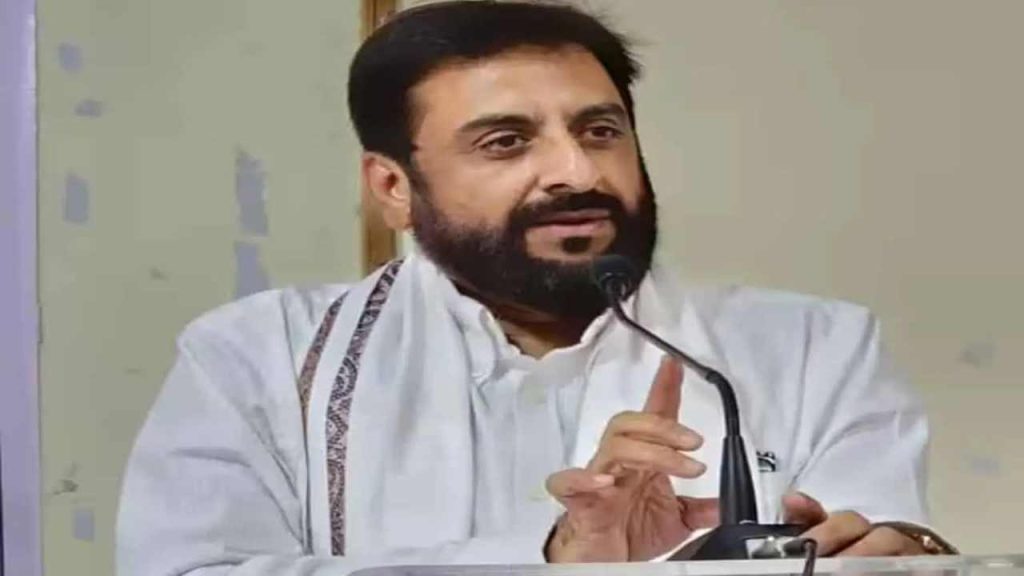
The issue took a sharper turn when Imtiaz Jalil addressed a public rally in Sambhaji nagar during the municipal council election campaign. Referring repeatedly to the hijab-controversy, Jalil accused the ruling establishments in Bihar and Uttar Pradesh of selectively applying constitutional values.
His speech quickly went viral, drawing national attention and reigniting debates across television studios and social media platforms. By invoking the hijab controversy, Jalil positioned AIMIM as a vocal defender of minority concerns.

Attack on Sanjay Nishad
Alongside Nitish Kumar, Imtiaz Jalil also launched a scathing attack on Uttar Pradesh government minister Sanjay Nishad. Linking his criticism to the hijab controversy, Jalil alleged that leaders like Nishad were silent or complicit when minority rights were questioned.
This direct confrontation highlighted how the hijab-controversy is no longer confined to one state or one party, but has become a cross-regional political talking point.
AIMIM Political Strategy
For AIMIM, raising the hijab controversy fits into a broader strategy of consolidating minority votes by emphasizing issues of identity and representation. Imtiaz Jalil’s statements were carefully crafted to resonate beyond Maharashtra, especially in states like Bihar and Uttar Pradesh.
Political analysts believe that by foregrounding the hijab controversy, AIMIM aims to challenge both regional parties and national giants, positioning itself as an uncompromising voice on minority issues.
Bihar’s Changing Political Climate
Bihar’s political climate has been particularly sensitive to the hijab-controversy, given its diverse social fabric. Student organizations, civil rights groups, and religious bodies have all weighed in, ensuring the issue remains alive in public discourse.
The ruling coalition’s response to the hijab controversy will likely influence future alliances and voter perceptions, especially ahead of upcoming elections.
Media and Social Media Amplification
Television debates and digital platforms have played a crucial role in amplifying the hijab controversy. Every political statement is dissected, every silence questioned, and every rally clip circulated widely.
Social media, in particular, has transformed the hijab-controversy into a constant presence, shaping opinions far beyond the immediate political arenas of Bihar and Maharashtra.
Voters and Identity Politics
For voters, the hijab controversy represents more than a policy debate. It touches emotions, identity, and perceived respect for cultural practices. Political parties are keenly aware of this emotional dimension and are crafting narratives accordingly.
In regions with significant minority populations, the handling of the hijab-controversy could become a decisive electoral factor.
Opposition’s Calculated Use
Opposition parties have strategically used the hijab controversy to corner ruling governments. By framing it as a constitutional and moral issue, they aim to expose what they describe as selective governance and double standards.
This calculated positioning ensures that the hijab controversy remains a live issue rather than fading away with time.
Broader National Implications
What makes the current situation significant is the national spread of the hijab controversy. From Bihar to Maharashtra and Uttar Pradesh, the issue has linked regional politics into a single narrative thread.
As leaders like Imtiaz Jalil continue to invoke the hijab controversy, it becomes clear that the debate is shaping political discourse ahead of larger electoral battles.
Constitutional Debate and Legal Dimensions
Beyond political speeches and election rallies, the hijab issue has also triggered serious constitutional debates. Legal experts argue that the hijab controversy raises important questions about the balance between individual freedom and institutional authority. Articles related to religious freedom, equality, and personal liberty are frequently cited whenever the issue resurfaces in political discourse.
In Bihar, legal circles have closely followed developments linked to the hijab controversy, especially as student groups and civil society organizations demand clarity from the state government. The absence of a firm policy stance has only intensified uncertainty, allowing political narratives to dominate over legal reasoning.
Student Voices and Grassroots Reactions
Students have emerged as one of the most vocal stakeholders in the hijab controversy. Across campuses, discussions, peaceful demonstrations, and debates have highlighted how young citizens perceive the issue. Many students argue that the controversy is less about attire and more about dignity, choice, and inclusion.
Grassroots reactions in Bihar suggest that the hijab controversy has resonated strongly among minority families, particularly women. Community leaders have repeatedly emphasized that political leaders must listen to those directly affected rather than turning the issue into an election slogan.
Role of Women in the Debate
Women’s voices have played a crucial role in shaping the narrative around the hijab controversy. Activists, educators, and students have shared personal stories that bring emotional depth to what is often reduced to political rhetoric. These narratives challenge the perception that the issue is driven only by political interests.
In public meetings and online forums, women have questioned why their choices become subjects of political debate during election seasons. Their participation has added moral weight to the hijab controversy, making it harder for political parties to dismiss it as a marginal issue.
Election Calculations and Polarization
Political analysts believe that the hijab controversy is being carefully timed and framed to influence voter behavior. In states like Bihar and Maharashtra, where electoral equations are sensitive, even symbolic issues can shift perceptions. Leaders raising the issue are aware of its emotional appeal and its potential to consolidate specific vote banks.
Imtiaz Jalil’s remarks in Sambhajinagar reflect this strategic use of the hijab controversy. By linking leaders from Bihar and Uttar Pradesh in a single narrative, he attempted to nationalize the issue and position his party as a consistent voice on minority concerns.
Inter-State Political Messaging
One striking feature of the current debate is how the hijab controversy has crossed state boundaries. Statements made in Maharashtra now influence political discussions in Bihar, while reactions in Uttar Pradesh feed back into national discourse. This inter-state messaging shows how regional elections are increasingly shaped by national-level identity debates.
Such interconnected politics ensure that the hijab controversy remains relevant for longer periods, rather than fading after a single election cycle.
Future Political Impact
Looking ahead, the hijab controversy is likely to remain a reference point in political campaigns, especially where minority votes play a decisive role. Parties may differ in tone—some choosing confrontation, others opting for cautious silence—but the issue will continue to influence public conversations.
Whether it leads to clearer policies or deeper divisions depends on how responsibly political leaders handle it. For now, the hijab controversy stands as a reminder of how social issues can rapidly evolve into powerful political tools in India’s democratic landscape.
Conclusion
The political heat generated by the hijab controversy shows no signs of cooling down. With senior leaders exchanging sharp words and voters paying close attention, the issue has firmly embedded itself in India’s contemporary political landscape. Whether it leads to policy clarity or deeper polarization remains to be seen, but its impact on Bihar and beyond is undeniable.
In summary, the hijab controversy, hijab controversy, hijab controversy, hijab controversy, hijab controversy continues to redefine political debates, alliances, and electoral strategies across states.
Read More latest news
Also Read What is A hijab

