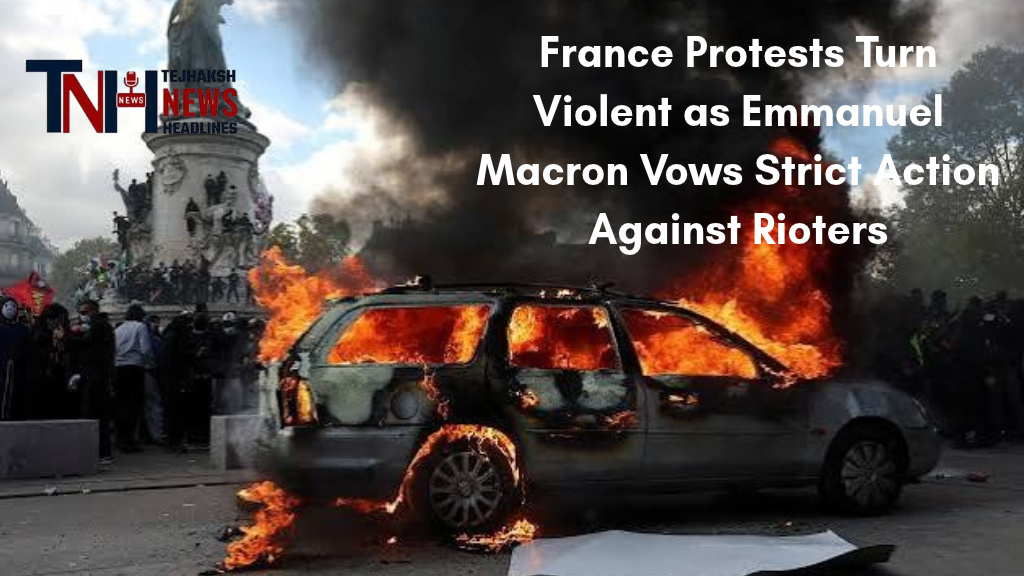
France Protests: France Faces Growing Unrest as Protests Escalate Into Violence
France has witnessed a fresh wave of nationwide unrest after demonstrations over rising living costs and deteriorating conditions in schools escalated into violent clashes, vandalism and widespread looting. President Emmanuel Macron has strongly condemned the violence and warned that those responsible for damaging public property and attempting to undermine the French Republic will face accountability.
The demonstrations brought together students, trade union members, activists and citizens concerned about the country’s economic pressures and the quality of public services. While many participants took to the streets to express legitimate grievances, violent incidents involving masked groups and alleged looters overshadowed peaceful rallies in several major cities.
In a televised address on Sunday, Macron acknowledged the public’s anger and sense of shame over the destruction. Macron declared that those responsible for looting must pay for their actions and that individuals attempting to destabilise the Republic would be held responsible.
His remarks reflected the government’s determination to restore public order as France faces mounting political tensions ahead of the next presidential election.
Macron Draws a Clear Line Between Peaceful Protest and Violence
President Macron emphasised that peaceful demonstrations and violent disorder must not be treated as the same thing. Citizens have the right to protest, raise concerns about government policies and demand improvements in their living conditions. However, he argued that these freedoms cannot be used to justify arson, attacks on public institutions or the destruction of businesses.
Macron blamed what he described as insurrectionist elements associated with radical far-left groups, along with criminal individuals who allegedly took advantage of the demonstrations to carry out acts of violence and theft.
The president also called on political leaders across the country to condemn the destruction rather than allow the unrest to deepen divisions within French society.
Macron instructed local authorities to coordinate with mayors and law enforcement agencies to improve the protection of public buildings, commercial establishments and other important infrastructure. Authorities were also given the option of restricting demonstrations where necessary to prevent further violence.
Historic Limoges City Hall Damaged by Fire
One of the most alarming incidents occurred in Limoges, a city in central France, where a historic 19th-century city hall was engulfed in flames during the unrest. The fire caused severe damage, with reports indicating that the building’s roof collapsed and the structure came close to being destroyed.
The incident raised serious concerns about the safety of public institutions and the growing intensity of the demonstrations. Local officials described the attack as particularly grave because people, including elected representatives and employees, were reportedly inside the building when the incident occurred.
Violence and property damage were also reported in other urban centres. In Marseille, protesters briefly entered the lobby of the city hall, while a police station was reportedly damaged. Lyon witnessed a fire at a tourist office, and several commercial districts experienced looting and vandalism.
These incidents demonstrated how demonstrations initially driven by economic and educational concerns had, in some locations, developed into a wider public-order crisis.
Paris Sees Clashes, Looting and Heavy Police Deployment
Paris remained one of the main centres of the unrest. The area around Place de la République witnessed clashes, fires and damage to public spaces as police attempted to control the situation.
After the main demonstrations, broken shop windows, scattered glass and damaged street infrastructure were visible in parts of the capital. Some groups reportedly attempted to set fire to bicycles and rubbish bins, prompting officers to use tear gas as tensions flared.
The destruction affected not only public property but also shops and businesses that depend on daily customer activity. Commercial areas in Paris and other cities, including Marseille, Lyon and Bordeaux, were among the places where looting was reported.
The violence also created difficulties for residents and visitors, many of whom found themselves facing road disruptions, damaged streets and a heavy police presence.
Although many demonstrators supported the underlying demands of the protest movement, some expressed disappointment that violent groups had overshadowed the original message.
Hundreds of Thousands Participate in Nationwide Demonstrations
The scale of the protests highlighted the depth of public frustration in France. Authorities estimated that approximately 550,000 people participated in demonstrations across the country, while organisers placed the figure closer to 800,000.
The gatherings drew support from labour unions, student organisations and activists seeking to mobilise public opposition to the rising cost of living and concerns about school conditions.
The protests also recalled the Yellow Vest movement that emerged in 2018, when large numbers of French citizens mobilised against economic pressures, social inequality and government policies they considered unfair.
As with earlier waves of unrest, the latest demonstrations exposed the challenge of separating largely peaceful public participation from violent actions by smaller groups.
The authorities reported a substantial number of arrests following the clashes. Figures published during the initial aftermath varied as operations continued, reflecting the scale of the police response and the evolving situation.
Government Faces Pressure Over Security and Police Tactics
The violence has placed France’s political leadership and security agencies under increasing scrutiny. While the government has promised to hold rioters accountable, questions have also emerged about how the demonstrations were managed and whether the authorities were adequately prepared for the escalation.
Reports of injuries during clashes have prompted investigations in some cases, including incidents involving police crowd-control equipment. These developments have intensified debate over the balance between maintaining public order and protecting the rights and safety of demonstrators.
Interior Minister Laurent Nuñez defended the principle of peaceful protest while condemning deliberate violence and attacks on businesses. He stressed that the freedom to demonstrate does not extend to organised destruction or the deliberate creation of disorder.
Local leaders have also called for discussions with the national government to address the scale of the damage and determine what additional support may be required by affected cities.
Political Divisions Deepen Ahead of the Presidential Election
The unrest has become a major political issue as France approaches its next presidential election. Leaders from different parts of the political spectrum have offered sharply contrasting explanations for the violence and criticised the government’s handling of the crisis.
Far-right leader Marine Le Pen attacked Macron’s administration, portraying it as weak and unable to respond effectively to the situation. On the other side, left-wing leader Jean-Luc Mélenchon criticised the government and argued that dissatisfaction among students and workers had been allowed to intensify.
At the same time, Mélenchon stated that support for the protest movement should not be interpreted as approval of looting or destruction.
The competing political responses illustrate the difficulty of addressing the unrest without deepening existing divisions. The government faces the urgent challenge of stabilising the situation and preventing further violence. For opposition parties, the protests have provided another opportunity to challenge Macron’s leadership and question his economic and social policies.
The crisis also raises a broader question about whether the political debate can focus on public concerns without being overwhelmed by accusations, confrontation and violence.
What the Protests Mean for France
The demonstrations have exposed several pressures facing French society, including the rising cost of living, dissatisfaction with public services and frustration among younger citizens over educational conditions.
For many participants, taking to the streets was a way to demand that political leaders respond more effectively to everyday problems. However, the destruction of businesses and public buildings risks weakening public support for those demands and imposing additional costs on already affected communities.
The government’s response will therefore need to address two separate but connected challenges: holding those responsible for criminal acts accountable and responding to the concerns that brought people onto the streets in the first place.
A response focused exclusively on security could leave the underlying grievances unresolved, while a failure to control violence could further damage public confidence and disrupt everyday life.
President Emmanuel Macron’s warning that those responsible for attacks on the French Republic will be held accountable marks a firm response to one of the country’s latest episodes of civil unrest. The protests began with concerns about living costs and school conditions but escalated into widespread clashes, looting and damage to public infrastructure in several cities.
As investigations continue and officials assess the destruction, France faces the difficult task of restoring calm while preserving the right to peaceful protest. The long-term impact of the protests will depend on whether authorities can maintain public order while addressing the economic difficulties, educational issues and wider dissatisfaction voiced by demonstrators.
The coming days will be important in determining whether the crisis subsides or develops into a more prolonged confrontation between the government and sections of French society.