
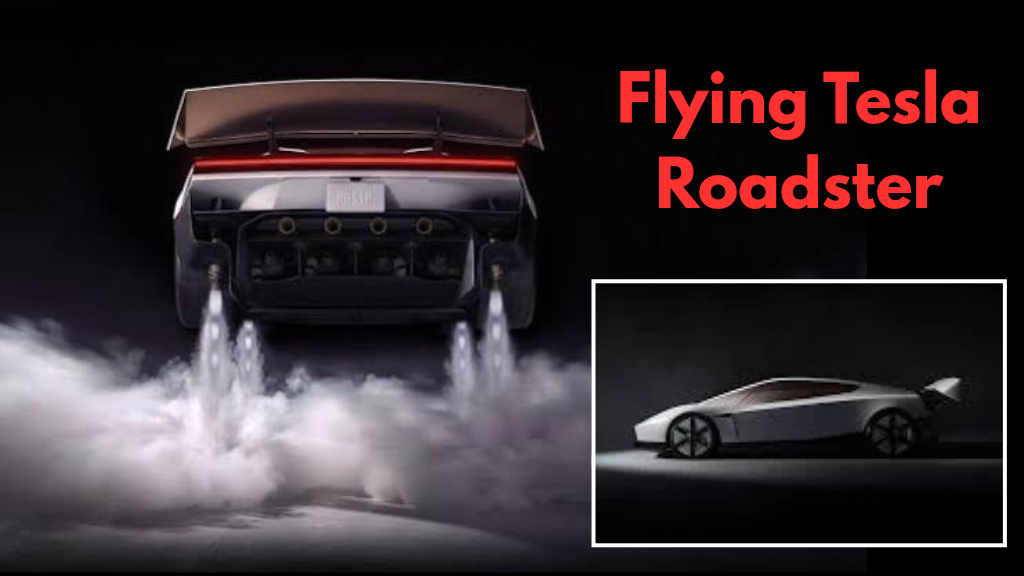
Elon Musk has once again captured global attention with a futuristic vision of automobile technology. Flying Tesla has demonstrated a redesigned Roadster performing spectacular mid-air stunts, bringing renewed attention to Musk’s long-standing idea of combining electric cars with rocket-inspired technology.
The concept first attracted widespread attention in 2018, when Musk discussed adding rocket thrusters to Tesla’s next-generation Roadster during an appearance on The Joe Rogan Experience. At the time, the proposal sounded unrealistic to many people. Now, a demonstration in Texas has brought that ambitious vision into the spotlight again.
However, the demonstration does not mean that flying tesla cars are ready for everyday use. Questions about safety, regulations and commercial availability remain.
Tesla Roadster Demonstrates Mid-Air Stunts
On October 15, 2026, Tesla showcased a redesigned Roadster at a SpaceX facility in McGregor, Texas. According to reports, the prototype drove up a curved ramp, travelled upside down along part of the structure and briefly launched into the air before landing on its wheels.
The demonstration featured rocket-inspired propulsion technology associated with Musk’s aerospace company, SpaceX. The vehicle was also shown performing dramatic manoeuvres that would be impossible for a conventional road car.
Musk subsequently shared a video of the demonstration on X, writing that the future does indeed have flying cars. The footage quickly attracted attention because it appeared to bring an idea he had discussed years earlier closer to reality.
Despite the impressive visuals, the demonstration took place under controlled conditions. It does not establish that the vehicle can fly over long distances or operate like an aircraft in ordinary conditions.
Elon Musk First Discussed Rocket Thrusters in 2018
The story goes back to 2018, when Musk appeared on The Joe Rogan Experience. During the conversation, he discussed the possibility of equipping the next-generation Tesla Roadster with rocket thrusters developed using SpaceX technology.
Joe Rogan responded with laughter and questioned why a car would need such a feature. Musk, however, continued to explain his idea of incorporating rocket-inspired propulsion into an electric sports car.
The concept was not limited to improving acceleration. Musk suggested that such technology could potentially allow the vehicle to lift off the ground or perform extraordinary manoeuvres.
At the time, the proposal appeared more like science fiction than a practical automotive feature. Nevertheless, Musk continued discussing the concept in subsequent years.
How Could a Flying Tesla Work?
Unlike conventional cars, which rely on their tyres for movement and traction, a vehicle using thrusters would generate additional force through a propulsion system.
Musk previously discussed using cold-gas thrusters, which produce thrust by releasing highly compressed gas. Unlike conventional rocket engines that burn propellant, a cold-gas system can generate thrust without combustion.
Such a system could potentially help a vehicle change direction or move away from a surface under carefully controlled conditions. However, making a car fly safely presents substantial engineering challenges, including stability, propulsion control, energy requirements and landing safety.
Tesla’s demonstration also involved a suction-based system designed to help the vehicle travel upside down along a specially constructed surface.
These features represent experimental engineering rather than proof that a practical flying car is ready for public use.
Musk Explained the Concept to Jay Leno in 2020
Musk continued discussing the Roadster’s unusual propulsion concept in 2020 during a conversation with car enthusiast Jay Leno.
He described how a compressed-air thruster system could be integrated into the vehicle, including a possible arrangement behind the licence plate.
The idea was to use aerospace-inspired technology to enhance the car’s performance beyond what conventional electric vehicles could achieve.
The latest demonstration has renewed interest in those earlier comments. However, the exact capabilities of a final production vehicle may differ from those displayed by a prototype.
When Will the New Tesla Roadster Enter Production?
Musk has indicated that the redesigned Tesla Roadster is expected to enter production in 2028. This timeline has generated interest among electric vehicle enthusiasts who have been waiting for the next-generation model.
However, a planned production date does not guarantee that every feature shown during a demonstration will be included in the final consumer version.
Several important questions remain unanswered, including how the propulsion system will be implemented, what safety requirements the vehicle will need to meet and whether its airborne capabilities will be available to ordinary customers.
The company will also need to address regulatory requirements before any flying-capable version can be operated legally in relevant locations.
Is Tesla Really Making a Flying Car?
The latest demonstration shows that Tesla is exploring capabilities beyond those of a traditional electric sports car. Nevertheless, the term “flying car” needs to be understood carefully.
The reported demonstration involved a brief airborne manoeuvre in a controlled environment. It did not demonstrate sustained flight comparable to that of an aircraft.
A commercially viable flying vehicle would require reliable flight controls, robust safety systems, suitable operating procedures and regulatory approval. It would also need to address practical concerns such as maintenance, operating costs and the risks associated with propulsion systems near people and other vehicles.
Until more technical details and independent testing become available, it is too early to conclude that the demonstrated vehicle will offer practical flying capabilities to everyday drivers.
Elon Musk’s latest Tesla Roadster demonstration has revived a vision that once seemed far-fetched. The idea of integrating rocket-inspired technology into an electric sports car has evolved from a conversation in 2018 into a dramatic public demonstration in 2026.
The planned 2028 production timeline offers a potential next milestone, but major questions about safety, legality and real-world usability remain.
For now, the demonstration represents an intriguing experiment at the intersection of automotive engineering and aerospace technology—not yet a replacement for conventional cars or aircraft.

