
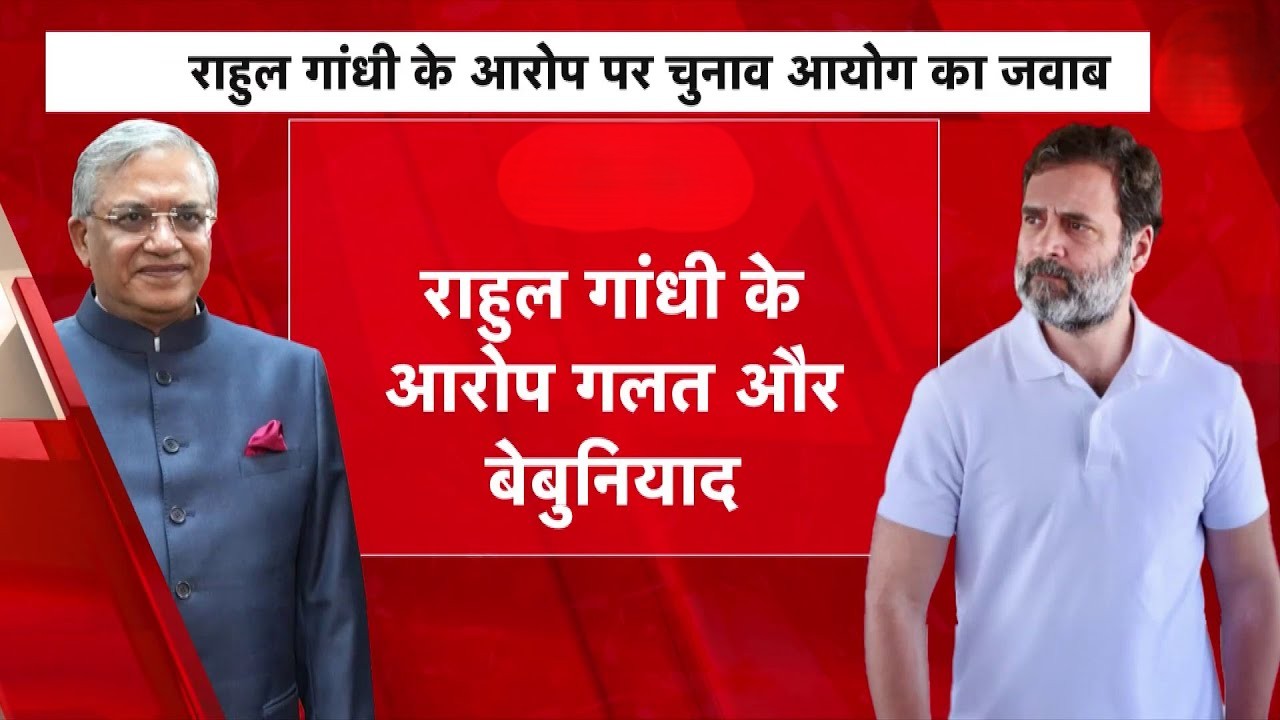
The Election Commission of India Rejects Rahul Gandhi’s Allegations: Clarifying That Votes Cannot Be Deleted Online
Introduction
The Election Commission of India rejected Rahul Gandhi’s allegations In the dynamic and often heated landscape of Indian politics, the issue of voter data and electoral integrity has repeatedly surfaced as a contentious debate. Recently, a political storm brewed when Congress leader Rahul Gandhi alleged that the Bharatiya Janata Party (BJP), with the help of government machinery, was attempting to manipulate voter lists and delete names of genuine voters. According to him, lakhs of voters, particularly from marginalized communities and opposition-supporting areas, were being struck off from electoral rolls.
In response to these claims, the Election Commission of India (ECI)—the constitutional body responsible for conducting free and fair elections in the country—issued a firm rejection. The ECI clarified that votes or voter entries cannot be deleted online by any political party, individual, or external entity. It further emphasized that voter list revisions follow a transparent, verifiable, and highly monitored process.
This blog takes a comprehensive look at the controversy, the Election Commission’s rebuttal, Rahul Gandhi’s allegations, and the broader implications for Indian democracy.
Rahul Gandhi’s Allegations
Rahul Gandhi has often raised concerns about the sanctity of India’s democratic process. This time, his criticism was directed at what he described as a “systematic attack on voters’ rights.”
Key points in his allegations:
- Targeted Deletions: Gandhi claimed that the names of specific communities—Dalits, minorities, and poorer sections of society—were being disproportionately removed from electoral rolls.
- Digital Manipulation: He hinted at the possibility of “online deletion of votes,” suggesting the existence of a centralized system that could tamper with the rolls.
- Political Bias: According to him, these actions were allegedly undertaken to benefit the ruling party in the upcoming elections.
- Weak Oversight: Gandhi argued that ordinary voters have little recourse once their names are deleted, often discovering it only on polling day.
His statements gained traction in opposition circles, sparking debates on whether India’s electoral process was under threat from digital manipulation and institutional capture.
The Election Commission’s Rebuttal
The ECI swiftly dismissed Rahul Gandhi’s claims, asserting that his allegations were baseless and misleading. The Commission underlined that the process of maintaining electoral rolls is completely offline in terms of critical decision-making and cannot be influenced by unauthorized online access.
Core points of the ECI’s clarification:
- Votes Cannot Be Deleted Online:
The Commission categorically stated that there is no provision or mechanism by which voter names can be deleted online. The electoral roll is not an open database where entries can be arbitrarily edited. - Robust Verification Process:
Voter list revision is a ground-level exercise carried out by Booth Level Officers (BLOs), supervised by District Election Officers and Chief Electoral Officers in each state. Multiple physical verifications are involved, including door-to-door visits. - Transparency and Public Scrutiny:
Draft rolls are published publicly, objections and claims are invited, and citizens are given ample opportunity to verify their details before the final list is frozen. - Legal Safeguards:
Every deletion must follow legal procedures under the Representation of the People Act, 1950, and be backed by documentary evidence. Arbitrary deletion is not possible. - Digital Tools Are Only Facilitative:
Online systems provided by the ECI, such as the NVSP (National Voter Service Portal), are only meant for voter registration, correction requests, and status checks. Final decisions rest with field officers after physical verification.
How Voter List Management Works in India
To fully understand the Commission’s response, it’s important to look at how voter rolls are maintained in India.
Step 1: Preparation of Draft Rolls
The ECI publishes draft rolls periodically, usually once a year. These rolls are made available both online and offline for citizens to check.
Step 2: Claims and Objections
Citizens can raise claims for inclusion, corrections, or objections to deletions. This stage ensures that no wrongful omission goes unnoticed.
Step 3: Ground-Level Verification
BLOs conduct door-to-door visits to verify voter details. For example, if someone has shifted residence or is deceased, their entry may be marked for deletion, but only after physical confirmation.
Step 4: Final Publication
Once objections are addressed, the final rolls are published and used for upcoming elections.

Step 5: Continuous Updating
Even outside revision cycles, voters can apply for inclusion, deletion, or corrections through forms such as Form 6 (inclusion), Form 7 (deletion), Form 8 (correction), etc.
This multi-layered, transparent process makes online deletion without due procedure practically impossible.
Why These Allegations Resonate
Even though the ECI’s rebuttal was clear, Rahul Gandhi’s allegations resonated with many citizens. Why?
- Past Incidents of Voter Deletion:
In previous elections, media reports surfaced of voters discovering their names missing from the list. In states like Telangana (2018), lakhs of voters complained of deletion without notice. - Digital Distrust:
With growing concerns about data privacy, hacking, and surveillance, citizens are more inclined to believe that online manipulation is possible. - Political Climate:
The trust deficit between opposition parties and the ruling BJP has led to heightened suspicion about institutions’ neutrality. - Ground Reality:
Many voters in rural and semi-urban areas still struggle to navigate the process of re-enrollment if their names are deleted. For them, the fear of disenfranchisement is real.
Election Commission’s Credibility at Stake
The Election Commission of India has historically been viewed as one of the most respected institutions of Indian democracy. However, in recent years, its impartiality has been questioned by various political parties.
- During the 2019 Lok Sabha elections, the opposition accused the ECI of favoring the ruling BJP in matters of campaign violations.
- In state elections, complaints about faulty EVMs and voter deletions have repeatedly surfaced.
While the Commission strongly defends its integrity, allegations like those from Rahul Gandhi add to the perception of vulnerability. This is why the ECI’s firm rejection is not only about addressing Gandhi’s remarks but also about reassuring the public.
Technology and Elections: A Double-Edged Sword
India’s electoral process has gradually incorporated technology—electronic voting machines (EVMs), voter apps, and online registration portals. While these innovations have increased accessibility and efficiency, they have also fueled fears of digital manipulation.
- Advantage: Speed, transparency, and wider reach.
- Risk: Suspicions of hacking, tampering, and mass manipulation.
The ECI maintains that critical systems like voter roll finalization and EVM functioning are completely insulated from online tampering, yet public trust often hinges on perception rather than technical details.
Political Reactions
The ECI’s clarification did not put an end to the controversy.
- Congress: Stood by Rahul Gandhi, reiterating that there are real cases of wrongful voter deletion.
- BJP: Accused Rahul Gandhi of spreading misinformation and undermining public confidence in democratic institutions.
- Regional Parties: Many opposition leaders echoed Gandhi’s concerns, while some demanded independent audits of voter rolls.
The matter thus remains a political flashpoint ahead of upcoming elections.

The Broader Debate: Voter Rights in India
At the heart of this issue lies the question: How safe are Indian voters from wrongful disenfranchisement?
Challenges in Ensuring Voter Rights:
- Migration: Millions of Indians migrate seasonally for work, often leading to duplication or deletion issues.
- Deaths and Errors: Delays in updating records sometimes lead to genuine voters being struck off.
- Lack of Awareness: Many citizens don’t verify their voter status until polling day.
- Bureaucratic Hurdles: The forms and procedures for re-enrollment can be complex for less-educated voters.
Possible Solutions:
- Greater awareness campaigns about voter list verification.
- SMS/email alerts to citizens before deletion.
- More robust grievance redressal systems.
- Independent audits of voter roll revisions.
Conclusion
The Election Commission of India’s rejection of Rahul Gandhi’s allegations marks another chapter in the tug-of-war between political narratives and institutional authority. While the ECI has assured citizens that votes cannot be deleted online, the debate highlights the importance of transparency, trust, and accountability in the electoral process.
For Indian democracy to thrive, both sides have responsibilities:
- The opposition must raise concerns responsibly, backed by evidence.
- The Election Commission must proactively address doubts and ensure that every citizen feels confident in the integrity of elections.
Read more latest news

