
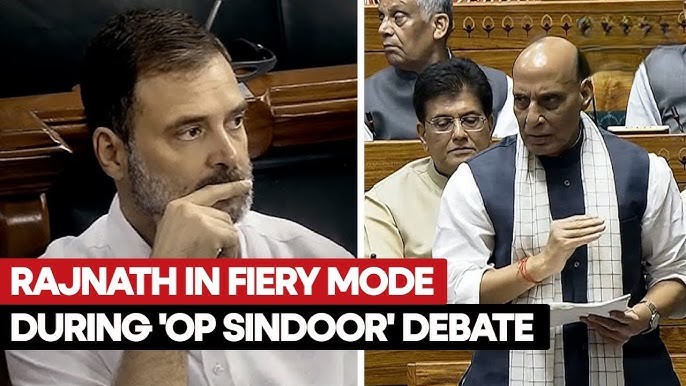
Rajnath Singh Targets Congress with Purvanchal Proverb in Rajya Sabha Over Operation Sindoor.
During a fiery discussion on Operation Sindoor in the Rajya Sabha, Defence Minister Rajnath Singh took a sharp jibe at the opposition, particularly the Congress party, using a biting Purvanchali proverb:
“Baap andhere mein mar gaya, beta ka naam Power House hai.”
(“The father died in darkness, and the son’s name is Power House.”)
The remark sent shockwaves across the Upper House as laughter, murmurs, and tension swept through the benches. Rajnath Singh was clearly pointing toward the Congress party’s historical failures, especially during its decades-long rule when critical defense and infrastructure projects were allegedly neglected. The irony embedded in the proverb was directed at the Congress leadership, especially Rahul Gandhi, who has been vocally critical of the Modi government’s military operations and defense spending.
Operation Sindoor, India’s recent strategic success against cross-border threats, became a showcase of BJP’s national security narrative. Rajnath Singh’s statement aimed to contrast the current government’s proactive defense stance with the Congress era’s indecisiveness.
Introduction: The Power of a Proverb in Politics
In Indian politics, proverbs and idioms have long served as powerful tools—not just for oratory flourish, but also as razor-sharp political commentary. One such moment unfolded in the Rajya Sabha during a discussion on Operation Sindoor, when Defence Minister Rajnath Singh quoted a striking Purvanchali proverb:
“Baap andhere mein mar gaya, beta ka naam Power House hai.”
The statement, humorous on the surface, was loaded with political depth. It mocked the discrepancy between legacy and rhetoric, implying that those now claiming leadership and vision come from a past filled with failure and darkness.
So who was Rajnath Singh hinting at? The answer points squarely to the Congress party, and more specifically, Rahul Gandhi, who has been at the forefront of criticizing the Modi government on defense, intelligence, and strategic planning.
🔍 Context: Operation Sindoor and Rajya Sabha Discussion
Operation Sindoor—a successful and strategic military operation executed earlier this year—was a central topic of debate in the Monsoon Session of Parliament. The operation, widely seen as a decisive blow to anti-national elements, was touted by the BJP as a reflection of the new India’s military preparedness and strategic clarity.
While the BJP celebrated the operation, members of the Congress and INDIA alliance questioned the timing, transparency, and even the intent of making such missions public.
This gave Rajnath Singh the perfect opening to contrast the boldness of the current administration with the hesitations of the past, and he did so using a culturally rich, locally familiar, and undeniably stinging proverb.
🧭 Decoding the Proverb: “Father died in darkness, son’s name is Power House”
This regional saying implies hypocrisy or inherited ignorance disguised as modern wisdom. Rajnath Singh used it to highlight the irony in how a political party (Congress), which allegedly did little for defense modernization during its long rule, now questions a government that has been actively building strategic infrastructure, promoting domestic manufacturing, and responding assertively to security threats.
Here’s how the symbolism plays out:
- “Baap andhere mein mar gaya” → Past Congress governments failed to modernize the military, didn’t take hard stances on Pakistan or China, and were blamed for corruption in defense deals.
- “Beta ka naam Power House hai” → Rahul Gandhi and present-day Congress leaders now act as if they are champions of national security and defense, despite the alleged failings of their predecessors.
🎯 Rajnath Singh’s Real Target: Rahul Gandhi?
Though Rajnath Singh didn’t take names, it was widely interpreted in Parliament and media that the “Power House” jibe was directed at Rahul Gandhi, who:
- Has repeatedly criticized Operation Sindoor, calling it politically motivated.
- Claimed the government uses military achievements as election propaganda.
- Accused the Modi government of endangering national security through diplomatic isolation.
Rajnath Singh’s sarcastic commentary was a rebuttal to what the BJP perceives as selective amnesia and empty rhetoric from Rahul Gandhi and the Congress party.
A senior BJP MP commented later:
“When Rajnath ji speaks, it may be in a simple tone, but the weight of truth hits hard. He said what the nation feels.”

🗣️ Reactions in Rajya Sabha
The moment Rajnath Singh delivered the line, the Rajya Sabha chamber reacted with a mix of laughter, outrage, and applause.
- BJP MPs cheered and thumped desks.
- Congress MPs protested, demanding the remark be expunged.
- Rajya Sabha Chairman had to intervene briefly to restore order.
Senior Congress leader Mallikarjun Kharge called the comment “uncalled for” and said:
“It is easy to make fun of legacy. But the real question is, how many soldiers have lost their lives in the last 10 years under this government?”
This counterpoint, though emotionally charged, failed to neutralize the political damage done by Rajnath’s rhetorical blow.
📜 The Legacy Argument – Congress vs BJP on Defense
Let’s break down the argument that underpins Rajnath Singh’s proverb:
Congress Era Criticisms:
- Delays in key military procurements (e.g., Rafale deal hanging for years).
- No coherent border infrastructure strategy.
- Corruption scandals like Bofors and AugustaWestland haunted the party.
- Diplomatic policy seen as “soft” on terrorism and Pakistan.
BJP’s Defense Achievements (as claimed):
- Completion and procurement of Rafale jets.
- Launch of Make in India in Defence.
- Surgical Strike (2016) and Balakot Air Strike (2019).
- Successful handling of China standoff in Ladakh.
- Infrastructure push near borders with Arunachal Pradesh and Ladakh.
- Operation Sindoor’s strategic execution.
By placing this contrast in the minds of the public and MPs using the proverb, Rajnath Singh successfully framed the narrative as a clash between action and hollow legacy.
🧠 The Psychology of Political Proverbs
Rajnath Singh’s choice of phrase was not spontaneous. In political communication, especially in a parliamentary setting, such proverbs serve multiple purposes:
- Simplify complex issues: Instead of lengthy policy comparisons, a single line conveys irony, truth, and critique.
- Connect with the masses: Proverbs like this resonate with rural and semi-urban voters familiar with the idiom.
- Defuse and dominate: Such remarks trigger laughter, divert the debate, and often leave the opposition without an effective comeback.
📰 Media and Public Reactions
News channels quickly picked up the story. Headlines like:
- “Rajnath Singh’s ‘Power House’ Jibe Stuns Rajya Sabha”
- “Who Was He Hinting At? Rajnath Singh’s Proverb Sparks Political Firestorm”
- “Rahul Gandhi the ‘Power House’? Debate Heats Up”
Twitter/X trended with hashtags like:
- #PowerHousePolitics
- #RajnathSinghRoars
- #OperationSindoorDebate
Public sentiment tilted heavily in BJP’s favor, with many users praising Rajnath Singh’s wit and straightforwardness.
🏛️ Parliament as Theatre: When Wit Meets Warfare
This event reminds us that Parliament is not just a place of policy—it is also a theatre of ideologies. Leaders like Rajnath Singh, who combine regional flavor, nationalism, and calculated sarcasm, manage to dominate the discourse.
In the age of viral politics, a one-liner sometimes has more impact than a 30-minute policy speech.
🔚 Conclusion: A Moment That Defines the Narrative
In the larger scheme of Indian politics, moments like Rajnath Singh’s “Power House” proverb shape perceptions far beyond Parliament. They become talking points on TV, memes on social media, and discussion points in chai shops and college canteens.
What Rajnath Singh accomplished with one line was not just a political attack—but a philosophical contrast: between inherited entitlement and earned credibility, between darkness and illumination.
In that Purvanchali proverb lies a larger truth—that legacy without merit is an illusion, and power without responsibility is dangerous.
And as India navigates a future where national security, political legacy, and public opinion converge, the question remains:
Will the Power House switch on when the country needs light—or will it only shine during speeches?
Read more latest news

