

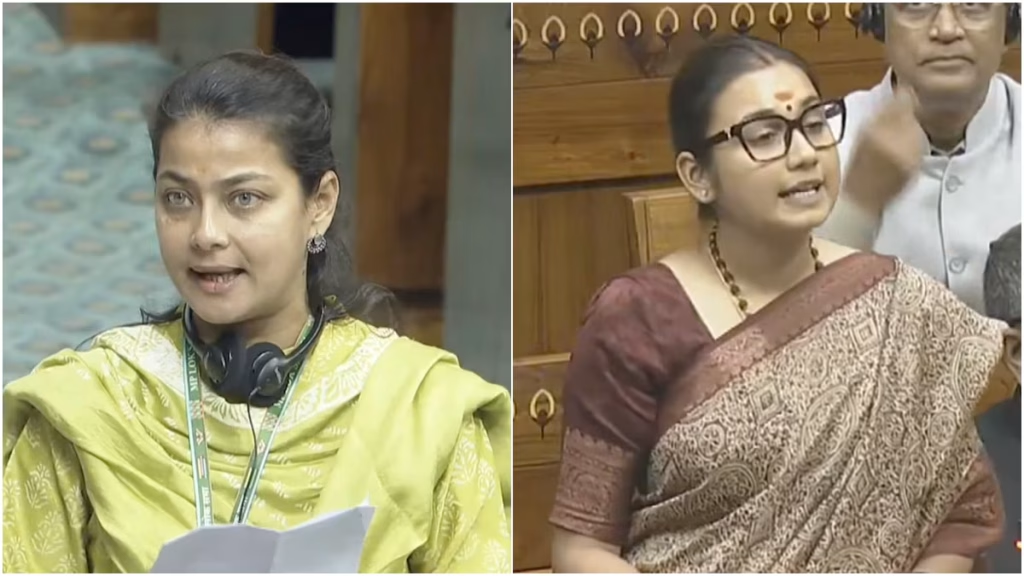
Congress MP Praniti Shinde asked In a powerful session of the Lok Sabha, Operation Sindoor became a central topic of discussion, sparking intense debate and political heat. Congress MP Praniti Shinde raised sharp questions regarding the transparency, planning, and execution of the operation. She demanded clarity on whether proper strategic approvals were obtained and sought details on the objectives, casualties, and future implications of the mission.
Operation Sindoor, recently revealed by Army Chief General Upendra Dwivedi on Kargil Vijay Diwas, was a covert military mission carried out along the Line of Control (LoC) to neutralize threats and reinforce border security. While the ruling party praised the bravery of Indian soldiers and called it a strategic success, Praniti Shinde accused the government of politicizing military actions and failing to brief Parliament transparently.
She questioned the lack of documentation and the secrecy surrounding budget allocations related to the operation. The government’s response, led by the Defence Minister, emphasized national security and the need for operational confidentiality. The fiery exchange has reignited a conversation about civilian oversight of military actions and the role of Parliament in democratic accountability.
1. Operation Sindoor: Overview & Genesis Praniti Shinde
Launched on May 7, 2025, Operation Sindoor was India’s retaliatory military strike in response to the Pahalgam terror attack on April 22, which took 26 lives. The government claimed the operation targeted nine terror hubs across Pakistan‑occupied Kashmir (PoJK) and Pakistan, and over 100 terrorists were neutralized. Following this, an understanding to cease hostilities was reportedly reached on May 10.
2. Debate Opens in Lok Sabha
On July 28, 2025, the Lok Sabha commenced a heated debate led by Defence Minister Rajnath Singh, who opened with a forceful presentation of Operation Sindoor’s objectives and outcomes. He insisted that India achieved its strategic goals without any loss of fighter jets or personnel, and called for the opposition to examine broader issues rather than technicalities.
3. Praniti Shinde’s Intervention: “Media Tamasha”
Cong MP Praniti Shinde (Solapur, Maharashtra) delivered a scathing critique. She called the operation a “tamasha”—a spectacle orchestrated for media attention rather than substantive national security outcomes. Shinde demanded answers:
- What were the actual tangible achievements?
- How many terrorists were captured or killed?
- Were any aircraft lost?
- What went wrong, and who is accountable?
She questioned the transparency and operational credibility of the mission.
Remarkably, the word “tamasha” was later expunged from the parliamentary record by the Speaker, highlighting the contentious tone of her remarks.
4. Opposition’s Broader Security Critique
Other opposition leaders amplified these concerns:
- Gaurav Gogoi (Congress) labeled the government a “buzdil sarkar” (cowardly), pressing that 100 days after the Pahalgam massacre, basic questions about infiltration and intelligence failures remained unanswered. He demanded clarity on how terrorists entered disguised in soldier uniforms.
- Asaduddin Owaisi (AIMIM) took issue with the inconsistency in India’s stance toward Pakistan—criticizing continued cricket games despite severed diplomatic ties following the terror attack—and called on the government to involve victims’ families in sensitive dialogue.
- TMC MPs like Derek O’Brien and Kakoli Ghosh Dastidar pressed for simultaneous discussion on Operation Sindoor and the Special Intensive Revision (SIR) in Bihar, warning that ignoring the latter threatens democratic fundamentals across the nation.
5. Government’s Response & Damage Control
The ruling alliance pushed back sharply:
- Rajnath Singh dismissed the opposition’s framing, stating that questions about aircraft losses did not reflect national sentiment. He reiterated that terrorist infrastructure was dismantled, none of India’s personnel were harmed, and Operation Sindoor emerged victorious. He also warned that the operation would be resumed if needed.
- External Affairs Minister S. Jaishankar reaffirmed that there was no foreign mediation, dismissing former U.S. President Trump’s claims. He underscored India’s diplomatic achievements—notably the UNSC’s strong condemnation and international listing of The Resistance Front (TRF) as a global terror group.
- Home Minister Amit Shah added that joint security operations, named Operation Mahadev, had started removing terror elements linked to Pahalgam attackers on the ground in J&K, which he cited as continuing proof of the government’s resolve.
On the floor, BJP and LJP MPs delivered strongly worded defenses—one declaring “This is new India… we don’t light candles, we eliminate enemies.”
6. Praniti Shinde’s Assertions & Election Angle
Shinde further argued that Operation Sindoor was being wielded as a pre‑election campaign tool, diverting public attention and possibly influencing voter sentiment in favor of the ruling party. She questioned why national security had become political theatre.
7. Institutional and Political Implications
- The expunction of her language signaled parliamentary sensitivity to criticism, especially with national security at stake.
- The debate also laid bare fissures over ECI governance, voter rights, and overlapping campaign issues like SIR in Bihar, forcing opposition parties to broaden their strategy.
- The session turned highly polarized—opposition demands greater transparency, while the government reasserted operational success and strategic strength.
8. Key Questions Raised by Praniti Shinde
- What were the specific results of Operation Sindoor—terrorists arrested, infrastructure destroyed?
- Were any fighter jets or personnel lost?
- Why was there no clarity even after several weeks?
- Who took responsibility for planning or intelligence failures?
- Was public messaging designed to influence electoral outcomes?
9. Broader Context: Pahalgam Attack & India–Pakistan Relations
Operation Sindoor followed the Pahalgam terror attack, blamed on TRF with alleged Pakistani backing. India sought global backing, resulting in UNSC condemnation and TRF’s terrorist designation.
Trump’s claims of mediating ceasefire were firmly refuted by Jaishankar and Rajnath, asserting India led the decisions.
Criticism over intelligence lapses—such as terrorists entering in uniforms—also raised concerns about national readiness.
10. Moving Forward: What May Happen
- The government may issue detailed disclosures or status reports to Parliament on Operation Sindoor and any follow-up operations.
- An independent Parliamentary Select Committee or SIT update may emerge following ongoing SIT scrutiny over controversial statements and actions.
- Opposition is likely to press SIR alongside Operation Sindoor in future debates, framing national security and democratic rights as linked.
- Election season dynamics may hinge on how voters respond to the narrative: national pride vs. demand for accountability.
- .
🧾 Conclusion
Praniti Shinde’s bold intervention in the Lok Sabha—calling Operation Sindoor a “media tamasha”—injected a provocative spark into what the government painted as a strategic national success. Between her demands for real-time clarity and ministers’ unapologetic defense, the debate underscored an intense political polarization: transparency vs. triumph, accountability vs. assertion.
As Parliament progresses, the operation remains a litmus test. It asks whether India’s democratic institutions can hold national action to public scrutiny—or whether national pride still trumps parliamentary accountability.
Read more latest news

