
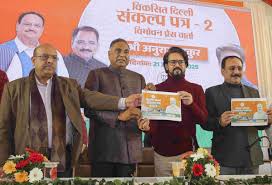
BJP Manifesto Vows Free ‘KG-to-PG’ Education, Insurance for Auto-Taxi Drivers in 2nd Delhi Poll Manifesto
BJP Manifesto With the Delhi Assembly elections fast approaching, the Bharatiya Janata Party (BJP) has released its second manifesto, promising transformative changes for the residents of the capital. The manifesto highlights two cornerstone initiatives: free education from kindergarten to postgraduate levels and comprehensive insurance coverage for auto and taxi drivers. The document is part of the BJP’s broader strategy to challenge the Aam Aadmi Party (AAP), which has ruled Delhi for nearly a decade.
This comprehensive analysis explores the promises made, their potential impact, and the larger political narrative shaping the electoral battle in Delhi.
BJP Manifesto Key Highlights of the BJP’s Second Manifesto
1. Free ‘KG-to-PG’ Education for All
The BJP has pledged to make education accessible to all, from kindergarten to postgraduate levels, under its ambitious “KG-to-PG” program.
- Universal Access: The program aims to cover students from economically weaker sections (EWS) and middle-income families.
- Infrastructure Development: Promises include modernizing government schools, building new colleges, and establishing vocational training centers.
- Focus on Quality: The manifesto emphasizes improving teacher training, introducing digital classrooms, and aligning curriculum with global standards.
2. Insurance for Auto and Taxi Drivers
Recognizing the vital role of auto and taxi drivers in Delhi’s transport ecosystem, the BJP has promised comprehensive insurance coverage.
- Health Insurance: A health insurance scheme with a coverage limit of ₹5 lakh per family under the Ayushman Bharat program.
- Accident Insurance: Additional accident insurance of ₹2 lakh for all registered drivers.
- Pension Benefits: Introduction of a pension scheme to ensure financial security post-retirement.
3. Employment Generation
- Skill Development: Establishment of skill training centers for youth, particularly in technology and green energy sectors.
- Job Creation: Collaboration with industries to generate 10 lakh jobs over the next five years.
4. Women Empowerment
- Safety Measures: Installation of more CCTV cameras and deployment of women security personnel in public spaces.
- Financial Assistance: Interest-free loans for women entrepreneurs under the “Nari Shakti” initiative.
5. Pollution Control Measures
- Green Delhi Mission: Expansion of green belts, promotion of electric vehicles, and incentives for solar energy adoption.
- Yamuna Revival Plan: Focused efforts to clean and rejuvenate the Yamuna river.
6. Housing and Urban Development
- Affordable Housing: Accelerating the implementation of the Pradhan Mantri Awas Yojana to ensure housing for all by 2028.
- Regularization of Unauthorized Colonies: Providing ownership rights to residents in such areas.
7. Water and Electricity
- Water Supply: Ensuring uninterrupted, clean drinking water through investments in desalination plants and rainwater harvesting.
- Electricity Tariff Reduction: Promising to lower electricity tariffs while ensuring reliable supply.
BJP Manifesto Analysis of the Key Promises
1. KG-to-PG Education: A Game-Changer?
The “KG-to-PG” promise is ambitious and positions education as a primary focus.
- Feasibility: Implementing free education across all levels will require significant budgetary allocations. The BJP has proposed public-private partnerships to bridge funding gaps.
- Criticism: Critics argue that similar promises in other states have faced challenges in execution, particularly in maintaining quality.
2. Insurance for Auto and Taxi Drivers
The auto and taxi driver community is a significant voter base in Delhi.
- Impact: Comprehensive insurance could alleviate financial burdens for drivers, especially during medical emergencies.
- Challenges: Ensuring universal registration and preventing misuse of the scheme will be key hurdles.
3. Employment and Skill Development
The promise to generate 10 lakh jobs is ambitious but aligns with the BJP’s national focus on employment.
- Viability: Success depends on effective collaboration with industries and alignment with Delhi’s economic strengths, such as IT and hospitality.
4. Pollution Control
Delhi’s pollution crisis has been a focal point in past elections.
- Potential Impact: The proposed measures, such as promoting electric vehicles and cleaning the Yamuna, are long-term solutions but require stringent implementation.
BJP Manifesto Comparison with AAP’s Governance Model
The BJP’s manifesto takes direct aim at the AAP’s governance model, particularly its focus on education, healthcare, and subsidies.
- Education: While AAP has improved infrastructure in government schools, the BJP aims to expand access across all educational levels.
- Healthcare: The BJP’s insurance promise seeks to counter AAP’s “mohalla clinics,” positioning itself as a provider of universal health coverage.
BJP Manifesto Public Reactions
1. Support for Education and Insurance Initiatives
- Parents: Welcomed the focus on free education, particularly for middle-income families.
- Auto and Taxi Drivers: Expressed cautious optimism about the proposed insurance schemes.
2. Criticism from Opposition
- AAP Leaders: Accused the BJP of making unrealistic promises without a clear roadmap for implementation.
- Economic Experts: Highlighted the potential fiscal strain of free education and widespread subsidies.
BJP Manifesto Economic Implications
1. Fiscal Impact
- Cost of Education: Free education across all levels could cost the government thousands of crores annually.
- Insurance Subsidies: Expanding health and accident insurance would require careful financial planning to avoid burdening state finances.
2. Stimulating Growth
- Increased investment in education and skill development could drive long-term economic growth by creating a more skilled workforce.
BJP Manifesto Expert Opinions
Education Specialists
- “Expanding free education to the postgraduate level is ambitious but could face challenges in execution, particularly in ensuring quality,” said Dr. Anita Rao, an education policy expert.
Economists
- “While these promises are attractive, their implementation will depend on how well the BJP can balance subsidies with revenue generation,” noted economist Raghav Bansal.
BJP Manifesto Political Implications
1. Targeting Key Demographics
The BJP’s manifesto focuses on urban middle-class families, auto and taxi drivers, and youth — demographics that could sway the election in their favor.
2. Competition with AAP
The manifesto seeks to challenge AAP’s dominance by addressing issues like education and healthcare, areas where AAP has traditionally enjoyed an edge.
BJP Manifesto Challenges and Risks
1. Implementation Hurdles
- Budget Constraints: Implementing such expansive programs without raising taxes or cutting other expenditures will be challenging.
- Bureaucratic Resistance: Ensuring smooth execution will require systemic reforms and efficient governance.
2. Public Skepticism
Voters may view these promises as election rhetoric unless backed by detailed action plans.
Conclusion
BJP Manifesto The BJP’s second manifesto for Delhi promises a transformative vision centered on education, welfare, and infrastructure. By targeting key voter groups and focusing on pressing issues like pollution, employment, and urban development, the party aims to position itself as a credible alternative to the AAP.
However, the success of these promises depends on their feasibility, funding, and execution. As the election date approaches, the manifesto has added to the political discourse, making the battle for Delhi more intense and dynamic than ever.
Let me know if you’d like additional analysis or detailed sections!
Read more Latest News

