

Code of Conduct Violation in Vaishali? Pappu Yadav’s Visit to Flood Victims Sparks Political Debate During Bihar Assembly Elections 2025.
Introduction: When Compassion Meets Controversy Bihar Assembly elections
In the middle of the 2025 Bihar Assembly elections, a storm of controversy erupted in Vaishali district when Madhepura MP Rajesh Ranjan, popularly known as Pappu Yadav, visited flood-affected villages and distributed financial aid worth ₹5 lakh to around 80 families. While many hailed his gesture as an act of humanity, election officials soon flagged the visit as a potential violation of the Model Code of Conduct (MCC), which is currently in force during the election period.
This incident has reignited the age-old debate about the fine line between social service and political influence during election time. Was Pappu Yadav simply responding to human suffering, or was it an attempt to sway voters in the midst of a tightly contested election? The answer depends on where one stands in Bihar’s deeply complex political landscape.
The Incident: A Flood, A Leader, and A Gesture Bihar Assembly elections
On a humid October afternoon, Vaishali district was still reeling from heavy monsoon rains that had submerged several low-lying villages. Families were struggling for shelter, food, and basic amenities. In the middle of this distress, Pappu Yadav arrived unannounced, carrying relief materials and envelopes of cash assistance.
Reports suggest that the MP distributed approximately ₹5 lakh in total, providing ₹6,000 to ₹7,000 to each of the 80 families worst affected by the floodwaters. Along with the financial help, his team also distributed food packets, blankets, and essential medicines.
Speaking to the media, Yadav reportedly said,
“When people are drowning, I cannot wait for political permission to act. If humanity becomes a violation, then let it be so.”
His words resonated with many who saw his actions as selfless and compassionate. However, soon after the visit, district election authorities took note of the event, prompting a formal inquiry.
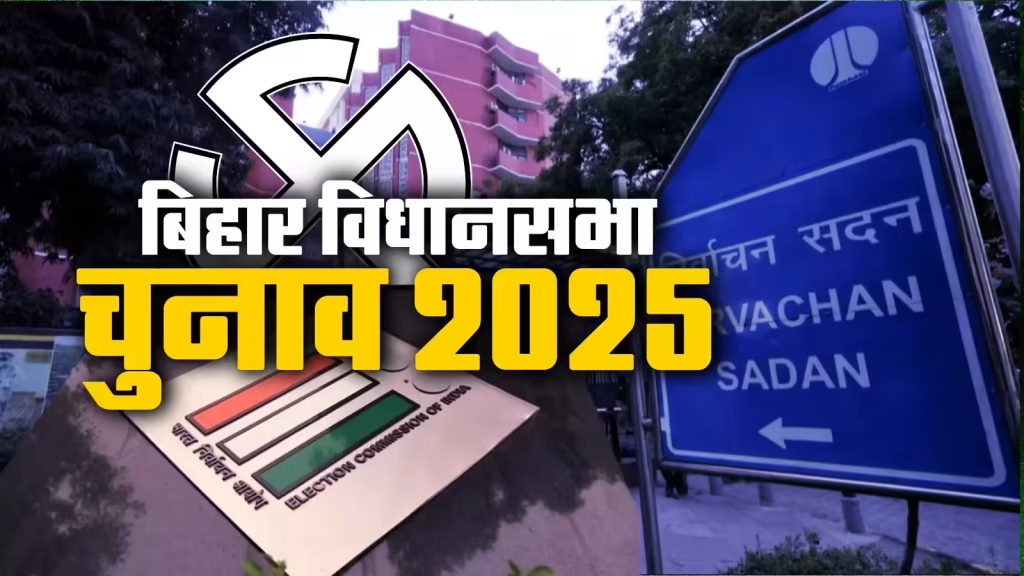
Bihar Assembly elections Election Commission’s Response: MCC and the Law
The Model Code of Conduct (MCC) is a set of guidelines issued by the Election Commission of India (ECI) to ensure that elections are conducted in a free, fair, and impartial manner. Once the election schedule is announced, the MCC prohibits any act that could influence voters — including cash distribution, announcements of welfare measures, or promises of development projects.
According to officials, Pappu Yadav’s relief activity was reported by local election observers, who considered it a direct violation of the MCC.
A senior election officer from Vaishali commented:
“We have received reports that cash was distributed by a sitting MP. Even if the intention was humanitarian, such actions can be construed as influencing voters. An inquiry is underway.”
If found guilty, Yadav could face a notice, censure, or even disqualification from contesting future elections, depending on the severity of the violation.
Political Ripples: Allies Defend, Opponents Attack
As news of the alleged code violation spread, political reactions came swiftly from all sides.
1. Opposition Targets Pappu Yadav
Leaders from rival parties such as the JD(U) and BJP accused Pappu Yadav of using flood relief as a political stunt. JD(U) spokesperson Sanjay Kumar said: (Bihar Assembly elections)
“Relief work should be done through official channels. Distributing cash personally in the middle of elections is a blatant attempt to buy sympathy.”
Similarly, BJP’s local unit demanded immediate action by the Election Commission, calling Yadav’s act “a calculated move to influence voters in flood-hit areas.”
2. Pappu Yadav’s Defense
In response, Yadav remained defiant.
“If helping the poor is a crime, I will continue to commit it. My politics has always been for the people, not for power. I didn’t distribute money for votes — I distributed it to save lives.”
He emphasized that his visit was not an election campaign but a humanitarian outreach. His supporters echoed this sentiment on social media, trending hashtags like #HumanityNotPolitics and #PappuForPeople.
3. Neutral Observers React
Political analysts, however, offered mixed opinions. Some argued that intent doesn’t negate impact — even genuine help can create a perception of favoritism during elections. Others said the Election Commission should evolve clearer guidelines to distinguish humanitarian relief from electoral malpractice (Bihar Assembly elections).
A Pattern or a One-Off? Yadav’s Political Style
Pappu Yadav is known across Bihar for his maverick and populist style. He often bypasses bureaucratic channels, engaging directly with people during crises — be it floods, hospital shortages, or public protests. His social work initiatives, including the Yadav Foundation’s health camps and emergency relief drives, have earned him strong grassroots following (Bihar Assembly elections).
However, critics argue that Yadav’s activism often blurs the boundary between charitable action and political showmanship. This is not the first time he has courted controversy. During the 2020 Bihar elections, similar allegations were raised when he distributed COVID relief materials during the campaign period (Bihar Assembly elections).
For many voters, though, his approach symbolizes authentic leadership — a rare quality in Bihar’s politics, which is often dominated by rhetoric rather than action.
Ground Reality: Floods, Poverty, and People’s Pain (Bihar Assembly elections)
To truly understand the incident, one must see beyond the political headlines and into the harsh reality of flood-prone Bihar.
Every year, monsoon rains cause rivers like the Gandak, Kosi, and Bagmati to overflow, submerging thousands of acres of farmland. Villages in Vaishali, Muzaffarpur, and Darbhanga suffer repeated displacement, with homes destroyed and crops ruined.
For many of these villagers, government relief arrives too late — or not at all. Bureaucratic red tape and political blame games often delay aid. In such situations, leaders like Pappu Yadav — who physically show up and offer immediate help — become symbols of hope.
A villager from Hajipur told local reporters:
“Pappu Yadav came when nobody else did. Whether it’s elections or not, hunger doesn’t wait. We are grateful to him.”
Such sentiments, though genuine, are exactly what make the Election Commission wary — gratitude can easily turn into electoral influence.
The Moral Dilemma: Where to Draw the Line?
The Pappu Yadav case has reignited a moral and legal question that India’s democracy continues to grapple with — can humanity be paused for elections?
The Model Code of Conduct exists for good reason: to prevent vote-buying, manipulation, and misuse of public resources. Yet, it can also unintentionally discourage genuine acts of charity.
Legal experts suggest a middle ground — requiring leaders to channel relief through official disaster management authorities during election periods. This ensures transparency while allowing humanitarian work to continue.
Professor Ramesh Thakur, a political scientist from Patna University, explained:
“Elections should not stop empathy. But when an elected representative personally hands out money, the perception of political benefit becomes unavoidable. The system must evolve to separate compassion from campaign.”
Media and Public Perception: Divided Voices (Bihar Assembly elections)
Social media amplified the debate around Yadav’s actions. On platforms like X (formerly Twitter) and Facebook, two distinct narratives emerged:
- One side praised him as a “leader of the masses” who doesn’t wait for government orders to act.
- The other criticized him, arguing that such populism undermines institutional mechanisms and electoral fairness.
Mainstream media outlets also picked up the story, with nightly debates framing it as a “battle between morality and law.”
TV anchors asked:
“Should the Election Commission punish a man for helping the needy?”
“Or should leaders respect the law even when humanity calls?”
The answers, as always in Indian politics, remain deeply divided.
Wider Implications: Lessons for Political Culture (Bihar Assembly elections)
Beyond the controversy itself, the incident sheds light on the evolving nature of Indian electoral politics.
- Personal branding and direct outreach have become central to a leader’s image. Acts like relief distribution, even when altruistic, strengthen emotional connection with voters.
- Election laws are struggling to keep up with this new form of politics — where empathy and influence overlap.
- Media visibility and viral content amplify every gesture, turning local relief efforts into statewide talking points.
The Bihar Election Commission’s handling of this case could set a precedent for future elections, determining how much freedom public representatives have to act during humanitarian crises.
Voices from the Ground: What the People Say (Bihar Assembly elections)
In the flood-ravaged hamlets of Vaishali, the debate over MCC violations means little compared to the struggle for survival.
Rita Devi, a widow who received ₹6,000 from Yadav’s team, said tearfully:
“He gave us money to rebuild our hut. I don’t care about elections — I care that someone remembered us.”
But not everyone was as forgiving. A schoolteacher from the same village remarked:
“Politicians remember us only during disasters. They come with cameras and cash, then disappear. We need long-term solutions, not just handouts.”
These contrasting voices highlight the deep trust deficit between voters and the political class — a reality that continues to shape Bihar’s democracy.
The Road Ahead: Investigation and Accountability
As of now, the Election Commission has reportedly sought a detailed report from the Vaishali district administration. Yadav may be asked to submit an explanation of his actions and clarify whether the money came from personal funds or a political source.
If found to be an MCC violation, he could face penalties ranging from a warning to disqualification or even criminal proceedings, depending on the gravity and intent established by the inquiry.
However, given Bihar’s history of complex political narratives, it is likely that Yadav will use this episode to further project himself as a people’s leader wronged by the system — a narrative that has often worked in his favor.

Conclusion: Between Law and Humanity
The case of Pappu Yadav’s visit to flood victims in Vaishali is not merely about a code of conduct violation — it is a mirror reflecting India’s moral dilemma between law, empathy, and politics.
While the Election Commission must ensure that elections remain free from undue influence, it must also acknowledge that human suffering cannot be scheduled around electoral timetables.
Pappu Yadav’s act — whether seen as political opportunism or genuine compassion — forces us to ask deeper questions:
- Can humanity be punished if it coincides with an election?
- Are our laws flexible enough to accommodate conscience?
- And most importantly, when people are drowning — do we wait for permission to help?
As Bihar inches closer to polling day, the image of Pappu Yadav wading through floodwaters handing cash to villagers will linger — a symbol of both defiance and empathy, a reminder that in the battle between politics and people, the lines are never truly clear.
Read more latest news

