

Ayushman Bharat India’s ‘Biggest Scam’: Arvind Kejriwal Hails SC Stay
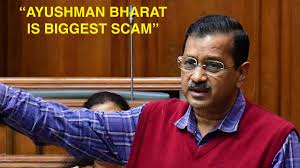
Delhi Chief Minister Arvind Kejriwal, known for his fiery rhetoric and confrontational politics, has once again ignited a political storm by labeling the Ayushman Bharat health insurance scheme as India’s “biggest scam.” His comments came in the wake of the Supreme Court’s decision to stay the central government’s directive to include the scheme in Delhi, a ruling Kejriwal described as a “victory for truth and accountability.”
This development has triggered intense political debates, with both supporters and critics dissecting the merits and pitfalls of Ayushman Bharat, as well as the implications of the Supreme Court’s intervention.
Ayushman Bharat: A Brief Overview
Ayushman Bharat, formally known as the Pradhan Mantri Jan Arogya Yojana (PM-JAY), is a flagship healthcare scheme launched by the Narendra Modi government in 2018. Touted as the world’s largest government-funded healthcare program, it aims to provide health insurance coverage of up to ₹5 lakh per family annually to over 50 crore beneficiaries.
The scheme primarily targets economically vulnerable sections, covering costs for secondary and tertiary care hospitalization across a network of public and private hospitals.
Key Features:
- Wide Coverage: Over 1,400 medical packages for diseases, surgeries, and treatments.
- Cashless & Paperless: Beneficiaries can avail services without out-of-pocket expenses.
- Public-Private Partnership: Involves both government and private hospitals to deliver healthcare services.
Despite its ambitious goals, Ayushman Bharat has faced criticism for alleged corruption, inefficiencies, and exclusionary practices.
Kejriwal’s Allegations
Arvind Kejriwal, leader of the Aam Aadmi Party (AAP), has consistently resisted implementing Ayushman Bharat in Delhi, citing the existence of the state’s own healthcare initiatives such as the Mohalla Clinics and Delhi government hospitals.
Core of His Criticism:
- Corruption Allegations: Kejriwal referred to the scheme as a “scam,” accusing private hospitals of inflating bills and siphoning off public funds.
- Exclusionary Framework: He argued that Ayushman Bharat’s focus on Below Poverty Line (BPL) families leaves out a significant portion of the middle and lower-middle-class population.
- Redundancy in Delhi: Kejriwal contends that Delhi residents already enjoy free healthcare services under state-run initiatives, rendering Ayushman Bharat unnecessary.
- Privatization Concerns: According to Kejriwal, the scheme prioritizes private hospitals over strengthening public healthcare infrastructure, creating a profit-driven system.
Supreme Court’s Stay
The Supreme Court recently stayed the Centre’s directive requiring the Delhi government to integrate Ayushman Bharat into its healthcare ecosystem. The stay was issued after the Delhi government challenged the directive, arguing that health is a state subject and that the Centre’s interference violates constitutional principles.
Legal Context:
- Health as a State Subject: Under the Indian Constitution, public health and sanitation fall under the purview of state governments.
- Cooperative Federalism: While schemes like Ayushman Bharat operate on a federal model, the imposition of directives on states without their consent has often led to disputes.
The apex court’s decision has been hailed by the Delhi government as a vindication of its stance, with Kejriwal asserting that the judgment upholds the autonomy of state governments.
AAP’s Healthcare Model vs. Ayushman Bharat
AAP’s healthcare model, centered around Mohalla Clinics and free treatment in state-run hospitals, has been a cornerstone of its governance narrative.
Key Features of Delhi’s Healthcare Model:
- Mohalla Clinics: Neighborhood clinics providing free consultations, medicines, and diagnostic tests.
- Free Treatment in Hospitals: No-cost treatment for all residents, including surgeries and advanced medical procedures.
- Budget Allocation: Delhi allocates a significant portion of its budget to health, focusing on public healthcare infrastructure.
Kejriwal has often compared this model with Ayushman Bharat, arguing that Delhi’s approach is more inclusive and efficient.
Reactions to Kejriwal’s Statement
BJP’s Response
The Bharatiya Janata Party (BJP) slammed Kejriwal’s comments, accusing him of misleading the public and obstructing access to better healthcare for Delhi residents. BJP leaders argued that Ayushman Bharat complements state schemes, offering additional coverage to vulnerable populations.
Union Health Minister Mansukh Mandaviya stated:
“Kejriwal’s opposition to Ayushman Bharat is purely political. Delhi residents are being denied access to a transformative healthcare program due to his ego and narrow-minded politics.”
Public Opinion
The public response to Kejriwal’s allegations has been mixed:
- Supporters: Many Delhi residents have lauded the state’s healthcare model, pointing to the success of Mohalla Clinics and free hospital services.
- Critics: Others argue that Ayushman Bharat could fill gaps in Delhi’s healthcare system, particularly for those requiring specialized treatments unavailable in state facilities.
Ayushman Bharat: Successes and Challenges
Achievements:
- Expanded Access: Millions of beneficiaries across India have received free treatment under the scheme.
- Private Sector Inclusion: The partnership with private hospitals has expanded healthcare access in underserved areas.
- Digital Integration: The scheme has introduced technological innovations, such as the Health ID, to streamline services.
Criticisms:
- Fraudulent Claims: Reports of hospitals inflating bills or conducting unnecessary procedures to claim insurance have tarnished the scheme’s reputation.
- Low Hospital Participation: In some states, private hospitals have opted out, citing delays in payments and low package rates.
- Exclusion Errors: Many eligible beneficiaries remain excluded due to data inaccuracies or administrative hurdles.
Political Implications
The clash over Ayushman Bharat reflects deeper political undercurrents:
- Federalism vs. Centralization: The dispute highlights ongoing tensions between the Centre and states over jurisdictional boundaries.
- Healthcare as a Political Weapon: Both the BJP and AAP have used healthcare as a key plank to showcase their governance models and win voter support.
- Elections: With upcoming elections in Delhi, the Ayushman Bharat controversy is likely to be a major talking point, with both sides using it to sway public opinion.
Way Forward
The Ayushman Bharat controversy raises important questions about the future of healthcare in India:
- Balancing Central and State Roles: A more collaborative approach is needed to integrate central and state schemes without undermining federal principles.
- Strengthening Public Healthcare: While insurance schemes can expand access, long-term improvements require investment in public healthcare infrastructure.
- Transparency and Accountability: Mechanisms to prevent fraud and ensure proper utilization of funds are critical to the success of any healthcare program.
Conclusion
Arvind Kejriwal’s labeling of Ayushman Bharat as India’s “biggest scam” and his celebration of the Supreme Court’s stay have reignited debates over the efficacy and ethics of healthcare schemes in India. While both AAP and BJP tout their respective models as superior, the ultimate goal should be to ensure accessible, affordable, and quality healthcare for all Indians.
As the political dust settles, the real challenge lies in transcending partisan divides to build a healthcare system that serves the nation’s diverse and growing needs.
Read More Latest News

