
Atishi’s Arrest Imminent? Arvind Kejriwal’s Explosive Claim and the Political Firestorm
Act 1: The Announcement
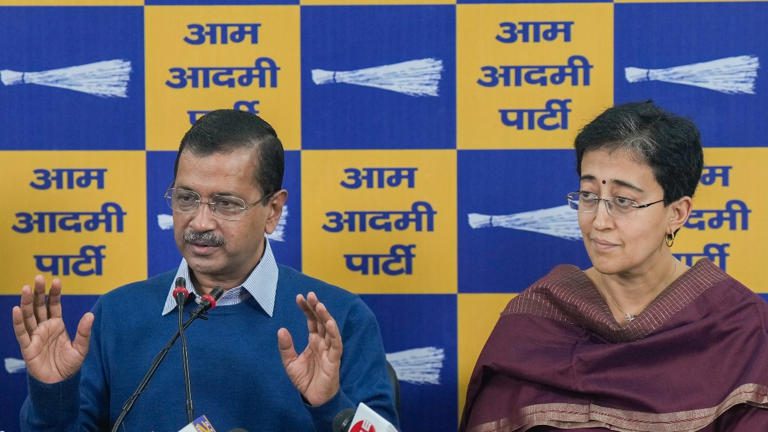
The air was thick with anticipation as Delhi Chief Minister Arvind Kejriwal took the stage for his impromptu press conference. The media scrambled to capture his words, their cameras flashing incessantly. Known for his candid statements and dramatic political maneuvers, Kejriwal’s sudden address had sent ripples through the political corridors.
“They’re coming for Atishi,” Kejriwal began, his voice steady but laced with urgency. “In a few days, perhaps even hours, she will be arrested in a completely fabricated case. This is an attack on democracy and on our fight for the people of Delhi.”
Atishi Marlena, an Aam Aadmi Party (AAP) leader and Delhi’s Education Minister, had become a prominent figure in Indian politics, celebrated for her work on educational reforms and grassroots activism. The possibility of her arrest sent shockwaves through the ranks of AAP and beyond.
Kejriwal’s claim wasn’t devoid of specifics. He alleged that the central government, wielding its investigative agencies as political tools, had fabricated charges to undermine AAP’s governance and reformist agenda.
“This is not just about Atishi,” he continued. “This is about silencing those who dare to challenge the status quo. But we will not back down.”
Act 2: The Backdrop
Atishi’s tenure as Education Minister had earned her praise and criticism in equal measure. Under her leadership, Delhi’s government schools underwent a dramatic transformation, with improved infrastructure, teacher training programs, and innovative curriculums. Her flagship project, the Happiness Curriculum, gained international recognition for its emphasis on mental well-being and life skills.
But such reforms also garnered detractors. Opposition parties accused AAP of grandstanding and alleged financial irregularities in school construction projects. Atishi had consistently denied these accusations, calling them politically motivated distractions.
Kejriwal’s press conference was not the first hint of impending trouble. Over the past few weeks, there had been murmurs of investigations into Atishi’s office. Anonymous sources claimed that documents related to government contracts were being scrutinized. The Chief Minister’s statement confirmed what many within AAP feared: Atishi was the next target.
Act 3: Reactions Erupt

The political fallout was immediate. AAP’s top leaders rallied around Atishi, denouncing what they called a “witch hunt.” Deputy Chief Minister Manish Sisodia called an emergency meeting to strategize. The hashtag #StandWithAtishi began trending on social media, with supporters sharing stories of her impact on education.
Atishi, for her part, remained composed. Addressing a gathering of teachers and parents the same evening, she said, “If standing up for better education means I’ll be arrested, so be it. Our work speaks for itself, and no fabricated case can erase that.”
Opposition parties responded with a mix of skepticism and schadenfreude. Leaders from the Bharatiya Janata Party (BJP) dismissed Kejriwal’s claim as “political theater” designed to divert attention from alleged irregularities.
“If Atishi is innocent, why is AAP so afraid of an investigation?” questioned a senior BJP spokesperson. “Let the law take its course.”
Act 4: The Alleged Case
Details of the alleged case against Atishi began to surface. According to sources, the charges revolved around discrepancies in the allocation of funds for school infrastructure projects. Investigative agencies alleged that contracts were awarded to firms with close ties to AAP leaders, bypassing due process.
AAP countered these claims with evidence of transparent bidding processes and independent audits. “These agencies are working on orders from above,” said a senior AAP leader. “Their job is to manufacture evidence, not uncover the truth.”
The timing of the allegations also raised eyebrows. AAP had been making significant inroads in states beyond Delhi, positioning itself as a credible alternative to national parties. Critics argued that the central government saw Atishi’s growing influence as a threat and sought to derail her momentum.
Act 5: Public Outcry
Civil society groups and activists joined the fray, condemning what they saw as a disturbing trend of using investigative agencies to target opposition leaders. Prominent figures from academia, the arts, and business signed an open letter expressing solidarity with Atishi.
International media picked up the story, framing it as part of a broader narrative about India’s shrinking democratic space. Editorials in leading newspapers called for an independent inquiry into the allegations, emphasizing the need to protect public servants from politically motivated attacks.
Meanwhile, protests erupted across Delhi. AAP supporters staged sit-ins outside investigative agency offices, holding placards that read, “Education is not a crime” and “Hands off Atishi.” The mood was defiant but tense, with the possibility of clashes looming large.
Act 6: Atishi’s Statement
In a televised address, Atishi spoke directly to the people of Delhi. Her tone was firm but emotional. “I have dedicated my life to improving the lives of our children. If that makes me a target, I wear it as a badge of honor. But I assure you, I have done nothing wrong. The truth will prevail.”
Her statement struck a chord with many. Parents of government school students called into radio shows to share how Atishi’s policies had changed their children’s lives. Teachers praised her accessibility and commitment to education.
Act 7: The Arrest
The moment Kejriwal had warned about arrived two days later. Atishi was taken into custody by the Central Bureau of Investigation (CBI) from her official residence. The arrest was conducted under heavy security, with media cameras capturing every moment.
AAP leaders denounced the move as an “undeclared emergency.” Kejriwal tweeted, “Atishi’s arrest is a dark day for democracy. But this will not break our resolve. The fight continues.”
Act 8: The Aftermath
The arrest galvanized AAP’s supporters, sparking larger protests across the capital. Kejriwal and other senior leaders announced a march to Parliament, demanding Atishi’s immediate release and a judicial probe into the allegations.
Legal experts weighed in, with some arguing that the charges against Atishi were flimsy and unlikely to hold up in court. Others pointed out the broader implications for Indian democracy if opposition leaders could be arrested without substantial evidence.
Act 9: A Turning Point?
As Atishi’s legal team prepared to fight the charges, her arrest became a rallying cry for opposition parties across the country. Regional leaders who had been at odds with AAP offered their support, recognizing the shared threat of central overreach.
For Atishi, the ordeal marked a new chapter in her political career. Far from silencing her, the arrest amplified her voice, turning her into a symbol of resistance against authoritarianism.
Epilogue: The Road Ahead
As Delhi’s streets buzzed with chants of solidarity, Atishi’s supporters vowed to continue her work in education and governance.
Kejriwal, reflecting on the events, summed it up: “They may arrest our leaders, but they cannot arrest our ideas. The fight for a better India goes on.”
Read more Latest News

