
Bulldozers on the Poor: Atishi Accuses BJP of Demolitions Without Alternatives in Delhi
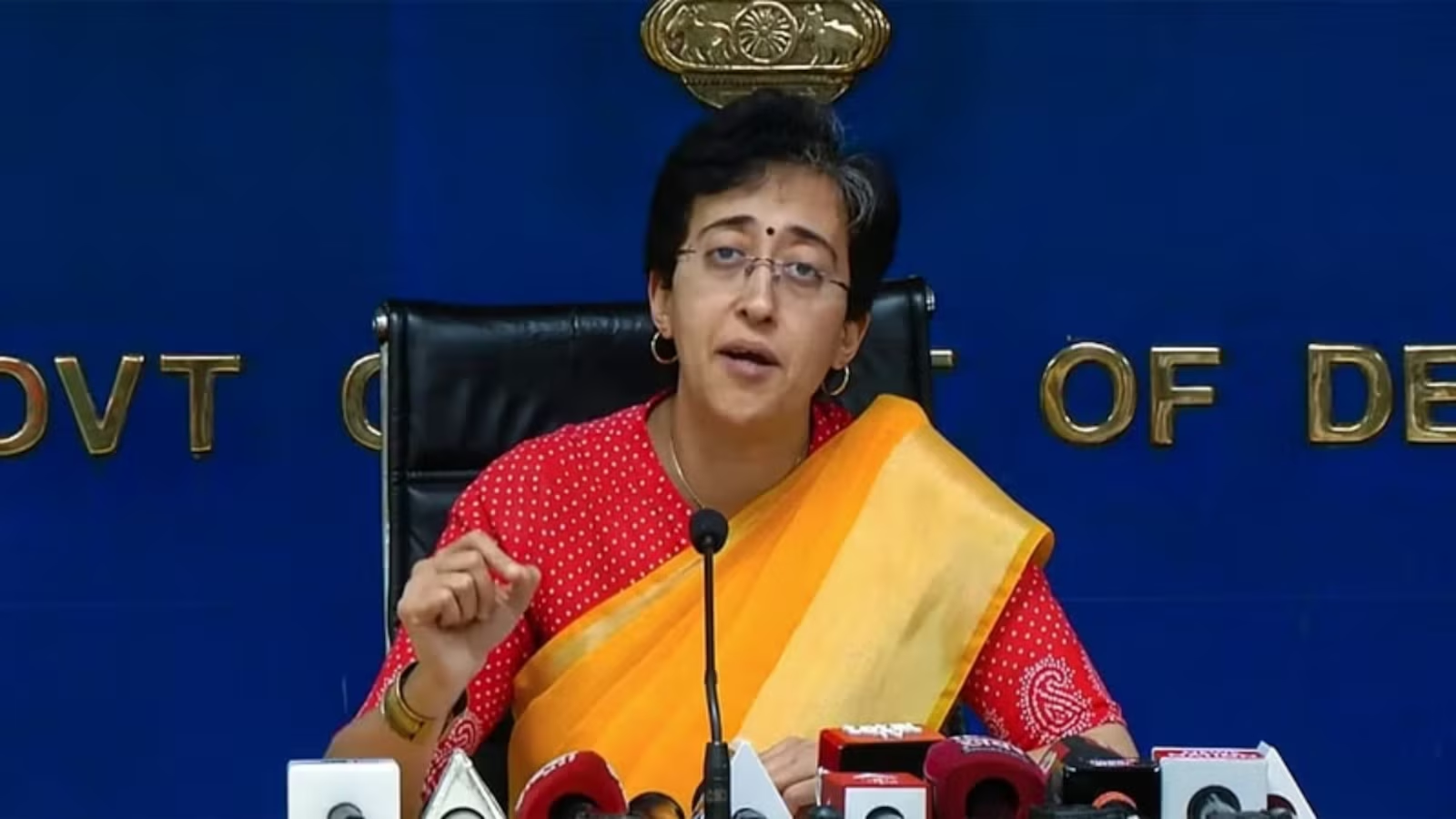
In a sharp political attack, Atishi Aam Aadmi Party (AAP) leader and Leader of Opposition in the Delhi Assembly, Atishi, has accused the BJP-led government of targeting the urban poor through ruthless demolition drives. Addressing the media, Atishi alleged that in several areas of Delhi, bulldozers razed homes of poor residents without offering any alternative rehabilitation or housing solution. These demolitions, she claimed, expose the anti-poor mindset of the ruling party, which is pushing the marginalized to the brink of homelessness under the guise of development and encroachment clearance. As political tempers rise and the voices of the affected grow louder, the issue has sparked a renewed debate over housing rights, urban planning, and the priorities of the government.
Introduction: A Controversial Demolition Drive Sparks Political Storm
In a dramatic escalation of political tensions in the capital, Atishi Marlena, a prominent leader of the Aam Aadmi Party (AAP) and the Leader of Opposition in the Delhi Assembly, has strongly criticized the Bharatiya Janata Party (BJP)-led administration for carrying out mass demolitions in low-income settlements without providing any alternative housing. Speaking to the media and from the floor of the Delhi Assembly, Atishi accused the government of showing “zero empathy” towards the poor and claimed that bulldozers have become a tool of oppression rather than justice.
Her statement comes amid growing reports of demolitions in various unauthorized colonies and slum clusters across Delhi—areas that have housed poor families for generations. With bulldozers razing homes and leaving families destitute, questions are being raised about the legality, timing, and morality of such actions.
Background: The Ongoing Demolition Drives in Delhi
The capital city of India, with its booming population and swelling urbanization, has long been a hotspot for unauthorized settlements. According to government estimates, nearly 30% of Delhi’s population lives in slums or unauthorized colonies. These settlements often lack proper paperwork but have existed for decades, forming the backbone of the city’s labor force—from domestic workers and security guards to rickshaw pullers and construction laborers.
In the name of anti-encroachment drives, the BJP-led municipal bodies in Delhi have initiated a wave of demolitions. The South Delhi Municipal Corporation (SDMC), North MCD, and East MCD—once under BJP control—have been targeting what they term as “illegal encroachments” on public land. However, AAP leaders allege that these actions disproportionately affect the poor while turning a blind eye to illegal constructions by the rich and influential.
Atishi’s Allegations: “No Alternative, Only Destruction”
Addressing the media, Atishi said:
“In Trilokpuri, Khichripur, and Seelampur, bulldozers arrived unannounced. Poor families who had been living there for decades woke up to find their homes being razed to the ground. Not a single official offered a resettlement plan or temporary shelter. Is this the model of governance the BJP wants to showcase?”
She further added that the BJP’s actions betray their “anti-poor mindset” and questioned whether the rule of law was being selectively applied:
“Why are only the poor being targeted? Why aren’t illegal farmhouses or commercial complexes owned by the elite being demolished with the same urgency?”

Real People, Real Losses: Stories from the Ground
Sangeeta Devi – Trilokpuri
Sangeeta, a widow and mother of three, had lived in Trilokpuri’s Block 27 slum for over 15 years. On a humid July morning, bulldozers arrived with police protection and began demolishing homes.
“They didn’t give us even 10 minutes to collect our belongings. My kids lost their schoolbooks, our ID papers are buried under the rubble,” she said, sobbing.
Mohammad Yunus – Seelampur
Yunus, a daily wage worker, claims he had submitted documents to the municipal corporation years ago.
“If my home was illegal, why didn’t they say anything all these years? Why now, during the monsoon?”
Such stories echo across the capital, forming the human face of what is otherwise being called an “administrative decision.”
Political Backlash: AAP vs. BJP Escalates
Atishi’s allegations have reignited the AAP vs. BJP feud in Delhi politics. While the BJP governs at the center and controlled the Delhi municipal corporations until recently, the AAP leads the state government. These demolitions have exposed the fault lines between both sides.
AAP’s Stand:
- AAP leaders, including Atishi and Saurabh Bhardwaj, argue that while illegal encroachments must be dealt with, it should not come at the cost of human dignity.
- The Delhi Urban Shelter Improvement Board (DUSIB), under the Delhi government, claims it has been kept in the dark about these demolitions.
- AAP has demanded a legal audit of all demolition orders issued in the past six months.
BJP’s Response:
In response to Atishi’s accusations, BJp leaders have maintained that:
- Demolitions are carried out in compliance with court orders.
- Unauthorized constructions on government land must be cleared for infrastructure development.
- The AAP government itself has not offered any concrete rehabilitation plan.
BJP Delhi chief Virendra Sachdeva said:
“AAP is playing politics. These demolitions are being carried out as per legal norms. It is rich of AAP to criticize when they have failed to provide affordable housing for the poor.”

Legal and Human Rights Angle: Where Do the Poor Stand?
Legal experts and human rights activists argue that even if the land is unauthorized, the government has a constitutional responsibility to provide shelter or at least alternative arrangements.
Supreme Court Guidelines
In multiple rulings, the Supreme Court has directed that no eviction should be carried out without notice and due process. Furthermore, the court has emphasized rehabilitation, especially when large groups are involved.
National Human Rights Commission (NHRC)
The NHRC has in the past issued advisories against forceful evictions during extreme weather, exams, or pandemics. With Delhi currently in the middle of the monsoon season, questions are being raised about the timing of these demolitions.
The Issue of Selective Enforcement
One of the strongest points made by Atishi and other critics is the issue of selective enforcement.
- Why are powerful encroachers spared while the poor are targeted?
- Why aren’t illegal banquet halls, high-rise extensions, and unauthorized shopping complexes subjected to the same bulldozer justice?
AAP leaders have even alleged that BJP leaders themselves are complicit in large-scale unauthorized construction, which goes unchecked.
Impact on Children and Women
The worst-hit victims of these demolitions are always children and women.
- Children lose access to education as books, uniforms, and certificates are destroyed.
- Women, especially single mothers and widows, lose the security of home and access to basic sanitation.
- With families living under flyovers or in makeshift tents, the risk of disease and exploitation increases.
Social workers report a rise in malnutrition and school dropouts in areas hit by demolitions.
Social Media Reactions: Outrage and Sympathy
Atishi’s speech and videos of bulldozers demolishing homes have gone viral, triggering emotional reactions across social media platforms.
- #BulldozerPolitics trended on X (formerly Twitter) for over 48 hours.
- Influencers and journalists shared ground reports showing poor families salvaging what remained of their homes.
- Youth-led Instagram pages questioned the silence of the central leadership on humanitarian grounds.
Policy Recommendations from Civil Society
Several NGOs and urban planning experts have stepped forward with policy suggestions:
- Create a Unified Rehabilitation Policy
All municipal and state agencies must adhere to a single framework ensuring alternative housing before eviction. - Pre-Eviction Survey
Conduct proper surveys to ensure those living for over 10 years are not abruptly evicted. - School Certificate Protection
Local authorities must retrieve and safeguard school records and ID documents during demolitions. - Stop Evictions During Monsoon or Winters
Ensure seasonal conditions are considered before initiating any large-scale demolition drive. - Public Hearings and Legal Aid
Citizens should be given access to legal aid and a public platform to present their grievances.
What Lies Ahead?
Atishi has announced plans to move the Delhi High Court if the demolitions continue without rehabilitation measures. She has also called for a special session of the Delhi Assembly to debate the issue.
Meanwhile, with Delhi gearing up for the municipal by-elections and the 2026 state elections looming, this issue is likely to become a key electoral flashpoint.
Conclusion: The Cost of “Development”
The debate over demolitions in Delhi touches on a fundamental question: Who is the city being developed for?
Atishi’s accusations, backed by visual evidence and citizen testimonies, force the public to reckon with an uncomfortable truth—India’s capital is being shaped in a way that seems to push the poor out of sight. The BJP’s emphasis on law and order must be balanced with empathy and social responsibility.
Governing a city like Delhi is no easy task, and unauthorized colonies present a legal challenge. But governance must be humane. Bulldozers cannot be the first response to complex human settlements. As political parties spar and social media burns, lakhs of Delhi’s poor wait in tents and under tarpaulins, wondering if they will ever belong to the city they helped build.
Read More latest news

