Union Home Minister Amit Shah Inspected the Flood-Affected Area in Jammu
Introduction
Amit Shah, Natural disasters test the resilience of a nation and the efficiency of its leadership. India, being a diverse country with varied geography, faces floods every year—particularly in the monsoon season. Jammu and Kashmir, with its hilly terrain and sensitive ecology, is one such region where heavy rains often trigger flash floods, landslides, and devastation. Against this backdrop, Union Home Minister Amit Shah’s inspection of the flood-affected areas in Jammu is not only an administrative exercise but also a strong message of assurance to the people that the central government stands firmly with them in times of crisis.
This blog takes an in-depth look at Amit Shah’s visit, the current situation in Jammu, the relief measures undertaken, the challenges ahead, and the broader political and humanitarian significance of such high-level visits.
Flood Situation in Jammu: An Overview
The recent spell of torrential rains wreaked havoc in several districts of Jammu. Rivers such as the Tawi and Chenab swelled beyond danger levels, submerging low-lying areas. Many villages were cut off, agricultural fields washed away, and infrastructure including bridges, roads, and electricity lines severely damaged.
Several families were forced to evacuate, taking shelter in temporary relief camps set up by the administration. Schools and community centers were converted into shelters, while the National Disaster Response Force (NDRF) and State Disaster Response Force (SDRF) were deployed to conduct rescue operations.
The scale of devastation was such that the state government immediately sought central assistance. In this context, Amit Shah’s decision to visit the flood-affected zones was a reassurance that the Union Government was fully aware of the ground reality.
Amit Shah’s Visit: A Symbol of Leadership
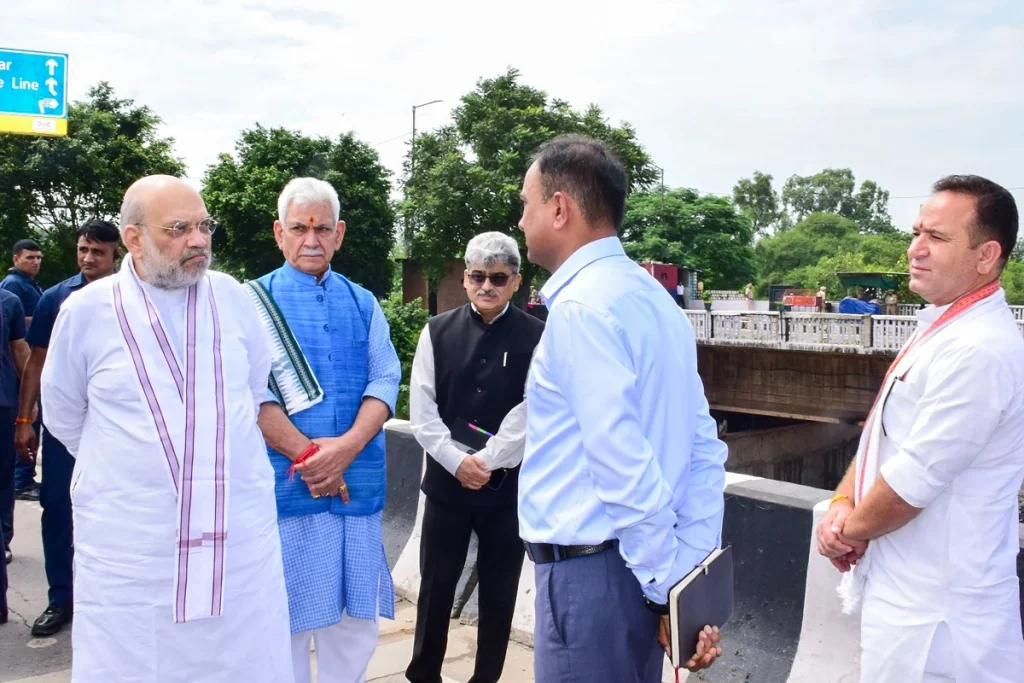
Amit Shah reached Jammu soon after the worst of the flooding had subsided. His itinerary included aerial surveys, on-ground inspections, and direct interactions with affected families.
- Aerial Survey – From a helicopter, Shah observed the damage to river embankments, farmlands, and residential clusters. The aerial perspective gave him a clear picture of how widespread the flooding was.
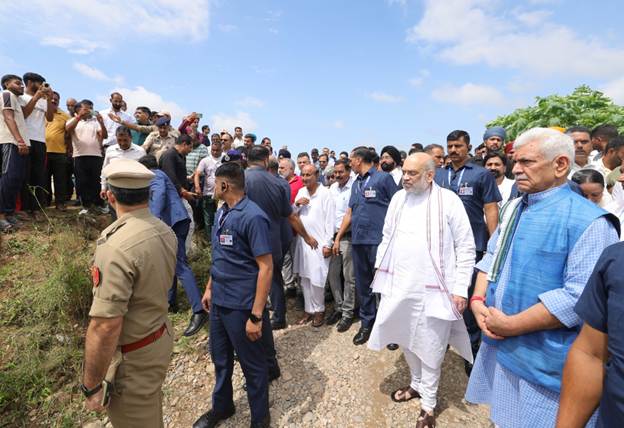
- Ground Interaction – He walked through affected villages, interacted with victims, and listened to their stories. Many residents expressed concerns about loss of property, livestock, and crops.
- Relief Camps – Amit Shah visited relief camps to check on the facilities being provided—food, drinking water, sanitation, medical aid, and schooling for displaced children.
- Administrative Review Meeting – Shah held a high-level review meeting with officials from the Union Home Ministry, the Jammu and Kashmir administration, Army officers, and NDRF commandants. He emphasized quick rehabilitation, transparent compensation, and long-term flood-prevention measures.
Assurance from the Union Government
During his address, Amit Shah made it clear that the safety and rehabilitation of people in Jammu was a top priority. He assured:
- Immediate financial assistance for families who lost their homes.
- Compensation for farmers whose crops were destroyed.
- Special funds for rebuilding roads and bridges.
- Medical teams and mobile health vans to tackle the risk of waterborne diseases.
- Central monitoring to ensure that every penny of relief funds reaches the intended beneficiaries.
Shah reiterated Prime Minister Narendra Modi’s commitment that “no citizen of India will be left behind in times of disaster.”
Human Stories: Pain, Survival, and Hope
The true impact of floods can only be understood through the stories of common people. In several villages near the Tawi river, families narrated how they had to leave their homes in the middle of the night when water levels rose suddenly. Livestock, which many depend on for livelihood, were washed away.
In one camp, children shared how they missed going to school but felt safe because food and shelter were provided. Women expressed concerns about sanitation facilities, while farmers worried about losing their only season’s harvest.
Amit Shah’s personal interaction with these families gave them a sense of being heard at the highest level of governance. Many villagers said they felt hopeful that compensation and rehabilitation would happen faster after his visit.
Challenges of Flood Management in Jammu
While relief and rescue are immediate priorities, Shah also highlighted the long-term challenges of managing floods in Jammu and Kashmir:
- Topography – The mountainous terrain causes rivers to swell quickly during heavy rainfall, leaving little time for evacuation.
- Deforestation and Urbanization – Human interference in the fragile Himalayan ecosystem has made the region more prone to landslides and flash floods.
- Aging Infrastructure – Many flood protection embankments and bridges are outdated and unable to withstand extreme weather.
- Climate Change – Unpredictable weather patterns are intensifying rainfall in short bursts, leading to disasters.
- Border Sensitivity – Being close to the Line of Control (LoC), disaster management in Jammu has an additional security dimension.
Government’s Multi-Pronged Strategy
In his review meeting, Amit Shah emphasized a multi-layered flood management strategy:
- Strengthening Forecasting Systems – Better weather predictions and early warning systems for villages.
- Upgrading Infrastructure – Modern embankments, flood canals, and bridges designed to handle extreme rainfall.
- Community Preparedness – Training villagers in disaster response and creating local volunteer groups.
- Technology Integration – Use of drones, satellite imagery, and real-time monitoring for rescue operations.
- Coordination Between Agencies – Army, NDRF, police, and civil administration working in synergy.
Political and Social Significance
Amit Shah’s visit is not just administrative—it also carries strong political and emotional value.
- Reassurance of Central Support – At a time when people feel vulnerable, seeing the Union Home Minister on the ground is a morale booster.
- Message of Inclusiveness – By directly interacting with flood victims, Shah reinforced the idea that every region and community matters to the Union Government.
- Strengthening Trust in Governance – Such visits counter allegations that governments are distant or indifferent during crises.
- Regional Stability – Jammu, being a sensitive border region, requires consistent attention from the Centre to prevent alienation of people.
Voices from the Ground
Local leaders, NGOs, and civil society groups welcomed Amit Shah’s visit. Many felt that such high-level attention would ensure faster release of funds and greater accountability.
Volunteers working in relief camps highlighted the need for:
- More medical staff to prevent post-flood epidemics.
- Special care for women, children, and elderly in camps.
- Rehabilitation packages that cover not just houses but also livelihoods.
Long-Term Vision for Flood-Resilient Jammu
Shah’s inspection is expected to pave the way for a comprehensive flood management plan for Jammu and Kashmir. This may include:
- River Rechanneling Projects – To control water flow and prevent sudden flooding.
- Green Belt Development – Planting trees to reduce soil erosion and act as natural barriers.
- Smart Urban Planning – Preventing construction on flood plains and vulnerable slopes.
- Insurance Schemes – Affordable insurance for farmers and households in flood-prone areas.
- Regular Drills – Annual mock drills for citizens to build disaster readiness.
Conclusion
Union Home Minister Amit Shah’s inspection of the flood-affected areas in Jammu is not merely a routine visit—it is a powerful gesture of solidarity, responsibility, and leadership. While immediate relief is underway, the bigger challenge lies in making Jammu flood-resilient in the future.
Such high-level attention also reflects a changing approach in Indian governance: moving beyond reactive relief towards proactive disaster preparedness. For the people of Jammu, Amit Shah’s words and actions have offered hope that their voices matter, their struggles are recognized, and their rehabilitation will be prioritized.
Natural disasters may strike without warning, but the strength of leadership and the resilience of people ensure that recovery is possible. Amit Shah’s visit symbolizes this very spirit of India—where unity, support, and compassion guide the nation in its toughest times.
Read more latest news