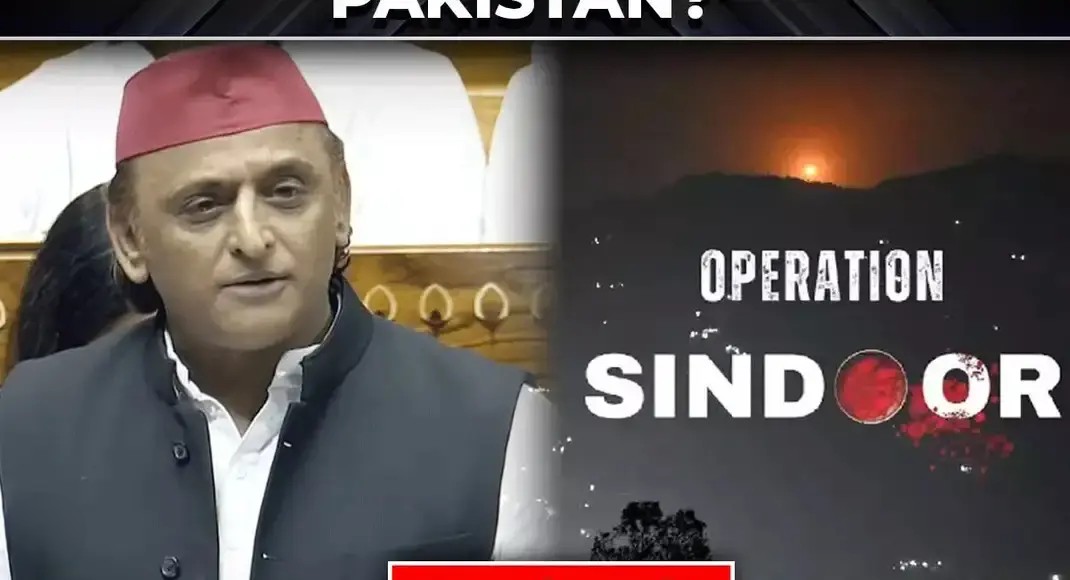
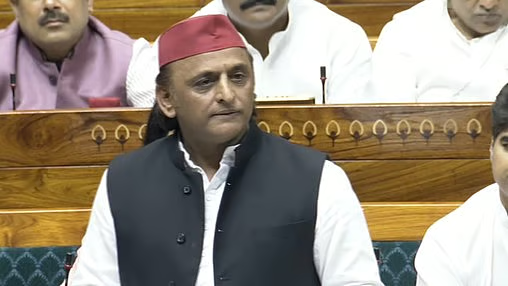
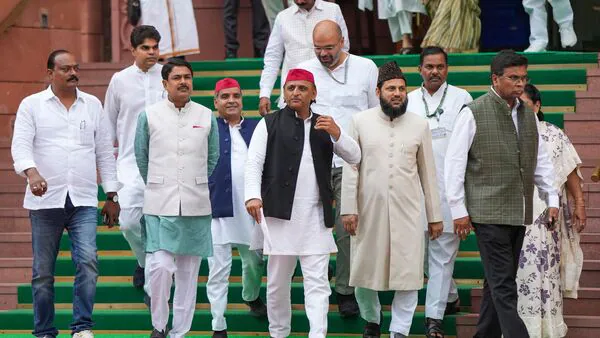
During the recent Lok Sabha discussion on Operation Sindoor, Samajwadi Party chief and MP Akhilesh Yadav launched a scathing attack on the central government, questioning the logic behind the sudden ceasefire with Pakistan. He argued that the operation was halted prematurely and that India missed an opportunity to send a stronger message to Pakistan after the deadly Pahalgam terrorist attack, which claimed 26 lives. Akhilesh asked whether the ceasefire was truly India’s decision or imposed due to international pressure, especially pointing out that former US President Donald Trump first announced it on social media before India officially did.
Akhilesh further challenged the government on intelligence lapses and said, “The real enemy is not just Pakistan, but also China,” demanding more transparency on incursions along the eastern border. He emphasized that while the army’s bravery is unquestionable, political leaders should not hide behind it. His bold remarks sparked a heated response from BJP leaders, especially Home Minister Amit Shah and PM Modi, who insisted the ceasefire was India’s sovereign call.
This debate has reignited discussions on national security, foreign diplomacy, and the role of political optics in military operations.
1. Context: Operation Sindoor & the India‑Pakistan Ceasefire
In response to the Pahalgam terror attack on April 22, which killed 26 people, India launched Operation Sindoor early May 2025. Military strikes targeted terror infrastructure in Pakistan and Pakistan‑occupied Kashmir (PoK). India soon observed a ceasefire, triggering a parliamentary storm. While the government hailed it as a strategic success, opposition leaders—including Akhilesh Yadav—questioned its timing and rationale.
2. Akhilesh Yadav Enters the Debate
During a marathon Lok Sabha debate on Operation Sindoor, Samajwadi Party chief Akhilesh Yadav delivered a sharp critique of the government’s handling of ceasefire decisions and national security strategy. His intervention emerged as the most provocative among dissenting voices.
3. Central Themes of Confrontation
🔹 Why Ceasefire So Soon?
Akhilesh called the ceasefire premature, suggesting it undercut India’s leverage. He argued it was a missed opportunity to deliver a more powerful blow to terrorism:
“Could’ve taught Pakistan a lesson” and questioned, “Under whose pressure did India announce it?”.
🔹 American Mediation & ‘Deep Friendships’
Akhilesh attacked the government’s approach, mocking that the ceasefire was announced not by India’s ministry, but via Donald Trump, saying:
“We thought India would announce it, but instead, our ‘friend’ Trump did it.”.
He implied India’s diplomatic autonomy was being sacrificed in favor of political optics.
🔹 Intelligence Failures & Strategic Oversight
He blamed the government for intelligence lapse that made the Pahalgam attack possible, calling it symbolic of broader security governance failure. He demanded accountability:
“Who will own this failure?”.
🔹 Bigger Threat: China, Not Just Pakistan
Akhilesh reframed the conflict, arguing that china posed a far greater long-term threat than Pakistan, especially economically and territorially. He demanded answers on eastern border encroachments and urged policy recalibration away from trade with China toward self-reliance
4. Opposition Positioning: Sovereignty vs. Symbolism
While expressing support for Indian Armed Forces, Akhilesh’s address questioned government motives:
Praised the Indian Army’s bravery while demanding political leaders stop “wrapping themselves in the flag.”
Criticized the use of Operation Sindoor as a media spectacle rather than effective policy.
Called for consistency: “Peace is essential, but sovereignty can’t be compromised.”
5. Government’s Counter-Arguments
In response:
PM Modi asserted cessation of hostilities was a sovereign decision, unaffected by foreign pressure:
“Ceasefire completely India’s call, no mediation.”.
Defence Minister Rajnath Singh emphasized that Operation Sindoor had achieved its objectives irrespective of minor losses, and reframed opposition criticisms as undermining national morale.
Home Minister Amit Shah defended intelligence and diplomatic restraint, declaring government would not yield to terror or nuclear threats.
Other opposition voices, including Rahul Gandhi and Priyanka Gandhi, also questioned diplomatic coherence and intelligence preparedness
6. Political & Strategic Implications
🛡 National Security Narrative
Akhilesh challenged the BJP’s security-first narrative, demanding nuanced discussion beyond nationalistic slogans and premature détente.
⚖️ Sovereignty vs. Diplomacy
His emphasis on sovereignty contested government framing of trust in US mediation as foreign validation.
💡 Opposition Unity
He aligned his criticism with broader INDIA bloc messaging—blending defence accountability with electoral positioning ahead of forthcoming elections.
🗳 Electoral Resonance
The speech reinforced SP’s identity as principled yet nationalist – appealing to both grassroots voters and national security-minded constituents.
7. The Debate’s Aftermath
While Akhilesh joined other opposition leaders in support of the armed forces, his stance sharpened the debate’s tone:
Questioning media-driven military optics.
Demanding clarity on India’s “deep friendship” with global leaders.
Elevating concerns over China’s strategic encroachments.
His remarks sparked a broader discourse on how governments balance diplomacy, sovereignty, and electoral strategy.
8. Broader Geopolitical Impacts
Countries like UK, Russia, Saudi Arabia and the UN welcomed the ceasefire. But Akhilesh’s remarks signal unease with perceived diplomatic compromises.
Akhilesh’s demands for eastern border data and calls to reduce economic dependencies echo growing discourse on self-reliance and border security.
9. Key Questions Raised
Was the ceasefire government‑led or mediated externally?
Did India trade away strategic gains by halting operations so soon?
Why has no political figure accepted responsibility for the Pahalgam security failure?
Are China-India tensions being underplayed in political discourse?
Will Parliament now demand classified briefings for intelligence and cross-border operations?
🔚 Conclusion
Akhilesh Yadav’s assertive intervention during the Lok Sabha debate elevated the ceasefire issue from mere operational outcome to a test of democratic accountability and sovereignty. He signalled that national security deserves more than ceremonial rhetoric—the public demands explanation, responsibility, and policy foresight.
The exchange reopened debate on India’s strategic posture, signaling that future operation disclosures must pass parliamentary muster, not just electoral optics. Whether the government recalibrates its approach or doubles down on nationalist messaging remains a vital question in India’s evolving political landscape.