
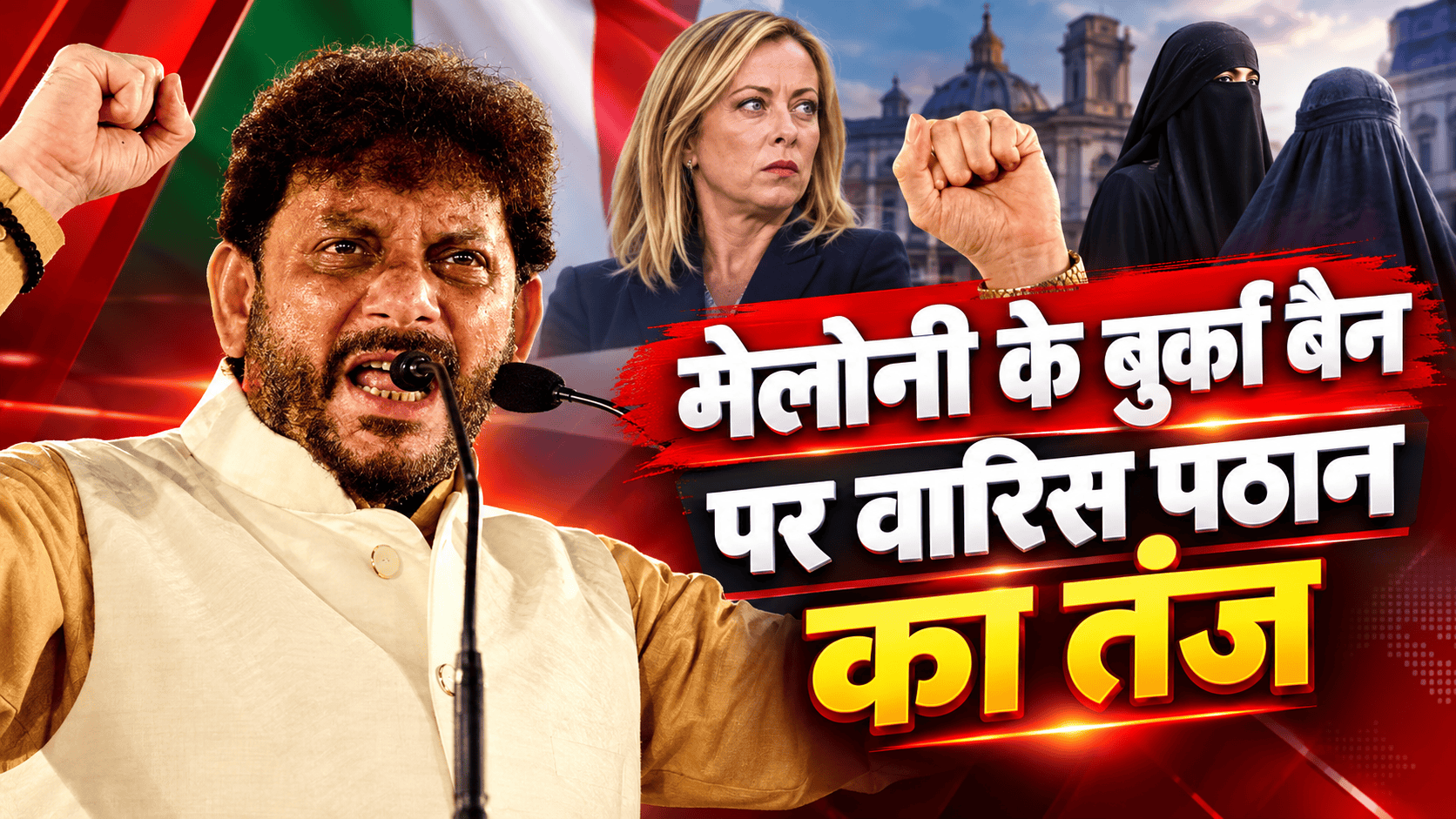
Waris Pathan Takes Dig at Meloni Over Italy’s Burqa Ban, Links Move to PM Modi
The debate over restrictions on Islamic face coverings in Italy has triggered a political reaction in India, with AIMIM national spokesperson Waris Pathan taking a sharp dig at Italian Prime Minister Giorgia Meloni. Pathan linked Meloni’s proposed restrictions to her political association with Prime Minister Narendra Modi and referred to the widely discussed “Melodi” nickname associated with the two leaders.
The remarks were made during Pathan’s visit to Jaipur, where he was responding to questions about the Italian government’s announcement regarding restrictions on burqa and niqab in schools. According to reports, AIMIM national spokesperson Waris Pathan used the issue to criticize what he described as the influence of Prime Minister Modi’s politics on Meloni.
What Giorgia Meloni Has Announced
The controversy began after Giorgia Meloni announced that her government was preparing measures that would prohibit the wearing of burqa and niqab in schools. She made the announcement on September 20, 2026, during an event organized by the youth wing of her Brothers of Italy party.
According to Italy’s ANSA news agency, the proposed measure would introduce a legal restriction on burqa and hijab in schools, alongside measures concerning the number of foreign students in classrooms and Italian-language learning for certain foreign parents.
Other reports, including Reuters and Associated Press, have described the proposal more specifically as a ban on face coverings such as burqas and niqabs in schools. The proposal is part of a wider package focused on integration, language and education.
AIMIM national spokesperson Waris Pathan, however, focused his response on the political implications of the decision rather than the details of Italian education policy.
Waris Pathan’s “Melodi” Remark
Speaking in Jaipur, AIMIM national spokesperson Waris Pathan reportedly referred to the meetings and public chemistry between Prime Minister Narendra Modi and Giorgia Meloni. He used the word “Melodi,” a term that became popular on social media following Modi and Meloni’s public appearances together.


Pathan’s comment was framed as sarcasm. He suggested that when Modi met Meloni and the two were associated with the “Melodi” phrase, Modi might have told her about his own political actions involving Indian Muslims. He then connected that imagined conversation to Meloni’s decision concerning Islamic clothing in Italian schools.
The AIMIM national spokesperson said, in substance, that Modi could have told Meloni about actions he claimed had been taken against Muslims in India, including allegations concerning mosques and madrasas. Pathan then sarcastically suggested that this could have influenced Meloni’s decision.
It is important to distinguish this political remark from established facts. There is no evidence in the reports that Prime Minister Modi instructed Meloni to introduce the proposed Italian school restrictions. Pathan’s statement represents his political interpretation of the issue.
Italy Proposal Is Focused on Schools
The Italian government’s announcement is broader than only the question of religious clothing. Meloni also announced plans concerning the proportion of foreign students in classrooms and Italian-language requirements for some foreign parents whose children experience serious integration difficulties.
Meloni presented the measures as part of her government’s approach to integration, education and Italian cultural identity. She argued that students should be able to attend school without their faces being covered and emphasized the importance of learning the Italian language and respecting Italian rules.
AIMIM national spokesperson Waris Pathan’s reaction comes amid an international debate over the balance between religious expression, individual freedom, public institutions and government regulations.
The issue has also attracted attention because European countries have adopted different rules regarding face coverings. Some countries have introduced restrictions in public places, while others have limited them to particular institutions or circumstances.
Political Reaction in India
For Indian politics, the issue has an additional dimension because of the relationship between Modi and Meloni. The two leaders have met on several international occasions, and their public interactions have received considerable attention in India and abroad.
AIMIM national spokesperson Waris Pathan used this diplomatic relationship as the basis for his criticism. His statement was clearly presented as political commentary rather than as a factual explanation of why the Italian government introduced its proposed policy.
The remarks also fit into AIMIM’s broader political discourse on questions concerning Muslims, religious freedom and government policies affecting minority communities.
AIMIM national spokesperson Waris Pathan has previously commented on a range of political and social issues, and his statements frequently generate discussion because of his direct style of political communication.
Why the Italy Decision Has Become Controversial
The proposed restrictions raise questions about religious freedom and the role of religious clothing in public education. Supporters of such restrictions generally frame face-covering rules around communication, integration, security or equality, while critics can raise concerns about individual religious expression and the potential impact on Muslim communities.
In the current Italian proposal, the government has linked the policy to its wider integration agenda. Meloni has argued that schools should remain spaces where students can participate openly and learn Italian culture and language.
The proposal has not yet become equivalent to a completed nationwide law. Reports indicate that the government still needs to take the measure through the relevant legislative process. The Associated Press specifically noted that parliamentary approval would be required for the measure to become law.
This distinction is important when discussing the issue as a news story because headlines describing an immediate nationwide ban can obscure the fact that the announced measure is a proposed government action requiring further legal steps.

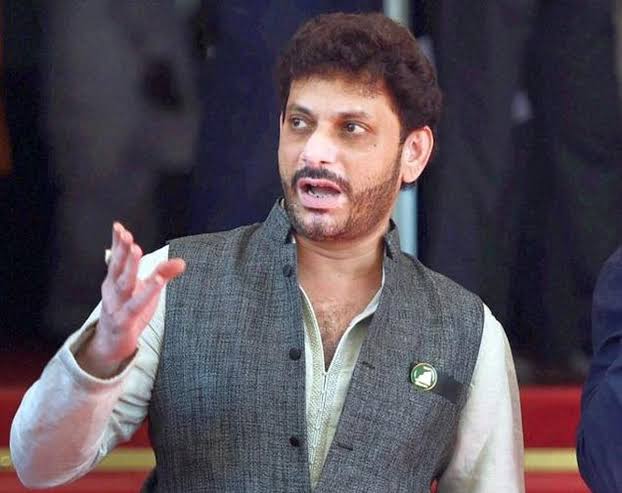
Waris Pathan Connects Domestic and International Politics
AIMIM national spokesperson Waris Pathan’s remarks demonstrate how international policy decisions can quickly become part of domestic political debates in India. Rather than discussing the Italian proposal solely as a European policy question, Pathan connected it to the political relationship between Modi and Meloni.
His “Melodi” reference was intended as a sarcastic political comment. AIMIM national spokesperson Waris Pathan suggested that the relationship between the two leaders had some connection with Meloni’s decision, but the available reporting does not establish such a connection.
The comments have therefore added an Indian political dimension to an issue that originated in Italy’s education and integration debate.
Broader Debate Over Religious Clothing
The discussion surrounding the proposed Italian restrictions is part of a much larger international debate. Governments in different countries have taken different approaches to religious clothing, particularly garments that cover the face.
Questions surrounding burqa, niqab and hijab can involve several distinct issues. The burqa and niqab cover the face to varying degrees, while a hijab generally leaves the face visible. Therefore, reporting should distinguish between these garments rather than treating all forms of Muslim head or face covering as identical.
In this context, AIMIM national spokesperson Waris Pathan’s reaction focused on the political symbolism of the Italian decision and its perceived connection with Indian politics.
The controversy is likely to continue as Italy moves forward with the proposed legislation and as political leaders in India respond to developments.
Conclusion
The dispute involving AIMIM national spokesperson Waris Pathan and Giorgia Meloni has brought together Italian education policy, religious clothing, India-Italy diplomatic relations and Indian political debate.
AIMIM national spokesperson Waris Pathan has attributed Meloni’s move to the influence of Prime Minister Narendra Modi, using the “Melodi” reference to make his point. However, this remains Pathan’s political claim, and available reports do not provide evidence that Modi influenced the Italian government’s decision.
Meanwhile, the Italian government has presented its proposed restrictions as part of a broader education and integration policy. The measure concerning burqa and niqab in schools still faces the relevant legislative process.
As the proposal develops, the debate is expected to continue around religious expression, integration, education, individual freedom and the role of government regulation. AIMIM national spokesperson Waris Pathan’s remarks have ensured that the Italian controversy has also become part of India’s domestic political conversation.
Read more latest news

