

Owaisi’s Gesture at a Public Event: The “I Love Mohammad” Picture Controversy
Introduction
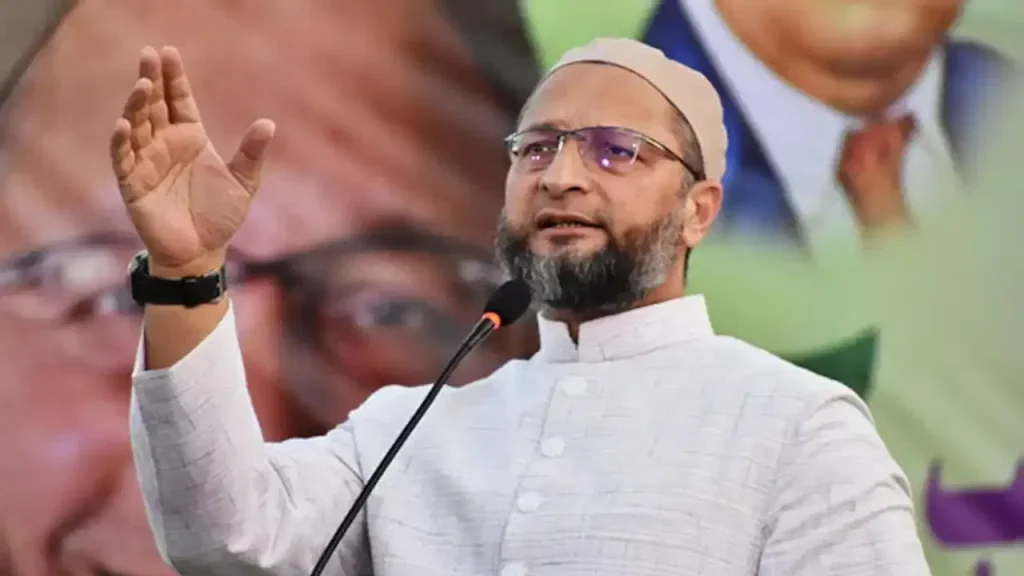
AIMIM chief Owaisi In Indian politics, symbolism often carries as much weight as speeches, policies, and manifestos. Leaders are constantly under public scrutiny, and every gesture, expression, or reaction can spark a debate across the nation. A recent incident involving All India Majlis-e-Ittehadul Muslimeen (AIMIM) chief Asaduddin Owaisi has become a talking point in both political and religious circles.
During a public event, Owaisi was presented with a picture carrying the words “I Love Mohammad” written on it. Initially, he accepted the picture with appreciation, but moments later, he noticed that his own photograph had been displayed alongside the Gumbad-e-Khizra (the Green Dome of Masjid-e-Nabawi in Madinah, Saudi Arabia)—a sacred Islamic symbol associated with Prophet Muhammad’s mosque. Upon seeing this, Owaisi immediately instructed that his photograph be covered, ensuring no overlap between his image and the revered Islamic landmark.
This single act—spontaneous, yet deeply symbolic—has triggered a wide-ranging debate on political humility, religious sentiment, and the thin line between devotion and personality cults.
The Incident in Detail
At the event, supporters offered Owaisi a framed picture with the message “I Love Mohammad” written boldly on it. Such displays are common at gatherings where leaders are felicitated, as attendees often blend politics with emotion, culture, and faith.
However, the design of this particular artwork caught Owaisi’s sharp eye. Alongside the holy Green Dome (Gumbad-e-Khizra), known worldwide as one of the holiest Islamic symbols, the picture also carried Owaisi’s own photograph.
For Owaisi, this was more than just an aesthetic mistake—it was a matter of principle. By quickly asking organizers to cover his image, he made a clear distinction between the sacred and the political. He ensured that no visual impression suggested an equivalence between his persona and the Prophet’s revered mosque.
Why the Gumbad-e-Khizra Holds Immense Significance
To understand the sensitivity of the moment, one must first recognize the emotional and spiritual importance of the Gumbad-e-Khizra (Green Dome).
- It is the dome above Prophet Muhammad’s tomb in Madinah, one of the holiest sites for Muslims worldwide.
- Millions of Muslims send their salutations and prayers to the Prophet facing this landmark.
- Any visual association with it is considered sacred, and linking a political figure with it can be seen as inappropriate or disrespectful.
Thus, Owaisi’s act of separating his picture from the Green Dome was not just about optics but about preserving religious sanctity.

Owaisi’s Immediate Response: A Statement of Boundaries
By instructing organizers to cover his image, Owaisi demonstrated a keen awareness of how personal branding must never overshadow religious devotion. His action conveyed three messages:
- Respect for Religious Symbols: He clarified that no individual leader—however popular—can be placed in parallel with Prophet Muhammad or the sacred sites of Islam.
- Humility in Leadership: Instead of basking in the adulation of supporters, he chose to set boundaries, rejecting the merging of his identity with that of faith.
- Political Maturity: In a country where mixing religion and politics often leads to controversies, his quick correction prevented any accusations of self-glorification at the cost of religious reverence.
Public Reaction: Social Media Storm
The incident spread rapidly across social media platforms.
- Supporters praised Owaisi’s decision, calling it an example of genuine respect for Islam and humility in leadership.
- Critics argued that the incident reflected the dangers of personality cults, where followers sometimes elevate leaders dangerously close to religious icons.
- Some political opponents mocked the episode, claiming it was a “drama to gain publicity.”
Hashtags like #OwaisiRespect #GumbadEKhadra #ILoveMohammad trended online, as people debated the fine line between faith and politics.
Personality Cult vs. Religious Reverence
One of the most important debates sparked by this incident is about personality cults in Indian politics. Across parties, it is common for supporters to display images of leaders alongside religious deities, holy sites, or even national symbols.
For example:
- In some states, political rallies carry posters equating leaders with gods or saints.
- During elections, campaign songs and banners often blur the line between devotion to faith and loyalty to a politician.
Owaisi’s act becomes significant here—it was a rejection of such cult-building tactics. By ensuring his photo was covered, he reaffirmed that no political figure should share visual space with sacred Islamic imagery.
Religious Sensitivity in Indian Politics
India’s politics is deeply intertwined with religion. Leaders are often expected to embody cultural or spiritual values to resonate with the masses. However, this also brings the risk of religious appropriation or offense.
- Hindu politicians have been criticized for comparing themselves to gods.
- Muslim leaders face scrutiny if they are perceived to use Islamic symbols for political gain.
- Christian or Sikh politicians too have had to clarify their boundaries between politics and faith.
Owaisi’s choice reflects an awareness of these sensitivities, especially as AIMIM positions itself as a party safeguarding minority rights while respecting Islamic values.
Owaisi’s Broader Political Persona
This incident also fits into Owaisi’s broader political image:
- He has always presented himself as a constitutional politician, often invoking legal and democratic frameworks rather than religious sloganeering in his speeches.
- At the same time, he openly identifies with Muslim concerns, making him a strong voice for the community.
- By distancing his image from the Gumbad-e-Khizra, he reinforced his role as a politician, not a spiritual figure.
This distinction is crucial because, in the eyes of his supporters, Owaisi already commands immense respect. The incident reaffirms that he does not seek to cross the boundary into religious sanctity.
Symbolism in Leadership
Symbolic acts often define leaders more than speeches. Gandhi’s spinning wheel, Nehru’s rose, Vajpayee’s poetry, or Modi’s temple visits—all have become part of their identity.
Owaisi’s act of covering his photo carries a similar symbolic weight. It says:
- “I am a leader of people, but I am not to be equated with holy figures.”
- “My respect for Prophet Muhammad and Islamic symbols is greater than my own image.”
This simple yet powerful gesture may echo with his followers for years as an example of principled politics.
Critics’ Perspective: Was It Damage Control?
While many praised Owaisi, critics were not convinced.
- Some argued that his acceptance of the picture at first shows he was comfortable with the adulation until he realized the potential controversy.
- Others accused him of performative humility, suggesting that the entire episode was a staged display to earn goodwill.
- Political rivals claimed it was part of Owaisi’s image management strategy ahead of upcoming elections.
Whether genuine or strategic, the fact remains that Owaisi acted swiftly to prevent escalation—something many leaders fail to do.
Impact on AIMIM’s Political Narrative
For AIMIM, which is often accused of practicing identity politics, this incident provided a chance to reshape its image.
- It showed that the party’s leader prioritizes religious reverence over personal glorification.
- It gave supporters a positive story to rally around, strengthening Owaisi’s moral authority.
- It differentiated AIMIM from other parties where personality cults are encouraged without limits.
In a political landscape often dominated by larger national parties, such symbolic moments help AIMIM cement its niche appeal.
Broader Lessons for Indian Politics
The controversy offers important lessons:
- Respect Religious Boundaries: Leaders must ensure that their image is never placed alongside religious symbols in ways that could be misinterpreted.
- Reject Personality Cults: True leadership lies in humility, not in allowing oneself to be elevated to divine status.
- Symbolism Matters: Even small gestures can have large implications in shaping public trust.
- Public Vigilance: Citizens, too, must recognize the dangers of blind hero-worship in politics.
Historical Parallels
India’s political history has seen similar moments:
- Mahatma Gandhi repeatedly rejected titles like “Mahatma” or “saint,” insisting he was a common man.
- Dr. B.R. Ambedkar often resisted deification, focusing instead on rational thought and social reform.
- Atal Bihari Vajpayee once stopped party workers from placing his picture next to Hindu deities at a rally.
Owaisi’s decision, therefore, resonates with this tradition of political leaders rejecting excessive adulation.
Conclusion
The incident involving AIMIM chief Asaduddin Owaisi and the “I Love Mohammad” picture may seem small in scale, but its implications are vast. By asking organizers to cover his own image when it appeared alongside the Gumbad-e-Khizra, Owaisi demonstrated humility, religious sensitivity, and political awareness.
In a country where personality cults often overshadow democratic values, this gesture served as a reminder that leaders must know where to draw the line. It not only protected religious sanctity but also enhanced Owaisi’s image as a politician who respects boundaries between faith and personal politics.
Ultimately, the episode is less about controversy and more about principle: the principle that no leader, however popular, should ever be conflated with sacred religious symbols. In doing so, Owaisi set a precedent that many in Indian politics would do well to follow.
Read More latest news

