

AK-203 “Lion”: Indian Army Unveils Stunning Video of the Made-in-Amethi Rifle Revolutionising Infantry Power.
The Indian Army has officially showcased a breathtaking new video of its latest infantry weapon—the AK-203 rifle, proudly nicknamed “Lion.” Manufactured in Amethi with 70% Indian steel, the AK-203 marks one of the biggest leaps in India’s small-arms modernisation program. By the end of 2025, the Army will receive 75,000 new rifles, gradually replacing the ageing INSAS rifles that served for over two decades.
The video released by the Indian Army not only demonstrates the rifle’s power but also highlights India’s growing defence manufacturing capabilities under the broader vision of Aatmanirbhar Bharat. The rifle represents precision, reliability, speed, and modern combat readiness—qualities essential for a 21st-century infantry force.
This 3000-word blog explores the origin, features, advantages, tactical relevance, and impact of the AK-203 rifle “Lion,” and how it is poised to transform the Indian Army’s battlefield capabilities.
A New Chapter in Indian Small-Arms Modernisation
For decades, India relied heavily on imported rifles or outdated indigenous models. The INSAS, introduced in the 1990s, served the Army through multiple conflicts but showed its limitations—jamming in tough weather, inconsistent firing, and lack of modular design.
The induction of the AK-203 “Lion” finally bridges this gap.
The Indian Army’s newly released video emphasises not just the rifle’s ruggedness but its symbolic value—India is now manufacturing one of the world’s most reliable assault rifles on its own soil, that too with 70% locally sourced steel.
The AK-203 is not merely a weapon; it is a statement of India’s defence self-reliance.
The Amethi Connection: A Strategic Manufacturing Hub
The AK-203 rifle is produced at the Indo-Russian Rifles Private Limited (IRRPL) plant in Korwa, Amethi. This Indo-Russian joint venture was set up specifically to help India localise and produce the world-famous Kalashnikov series while integrating Indian materials and Indian quality standards.
Over the past few years, the Amethi plant has scaled production efficiently, and today, most components—including the barrel, bolt carrier, receiver, and trigger mechanism—use 70% Indian steel.
The facility is expected to reach full production efficiency by 2025, aligning with the Government’s plan to supply 75,000 AK-203 rifles and gradually expand capacity.
This project has turned Amethi into a major defence industrial hub—generating jobs, building local expertise, and contributing to India’s growing defence export potential.

Why the Rifle Is Nicknamed “Lion”
The Indian Army affectionately calls the AK-203 rifle “Lion”—a name that captures its strength, reliability, and battlefield dominance. The nickname reflects:
- Powerful 7.62×39 mm round
- Rugged performance in extreme weather
- Solid steel construction
- High durability and low maintenance
- Legendary Kalashnikov reliability
Just like a lion is respected in the wild, this weapon commands respect on the battlefield.
The Army’s newly released video reinforces this symbolism by showing soldiers firing the rifle through mud, water, cold, dust, and harsh terrain—proving why it deserves the name.
AK-203: A Modern Kalashnikov With Indian DNA
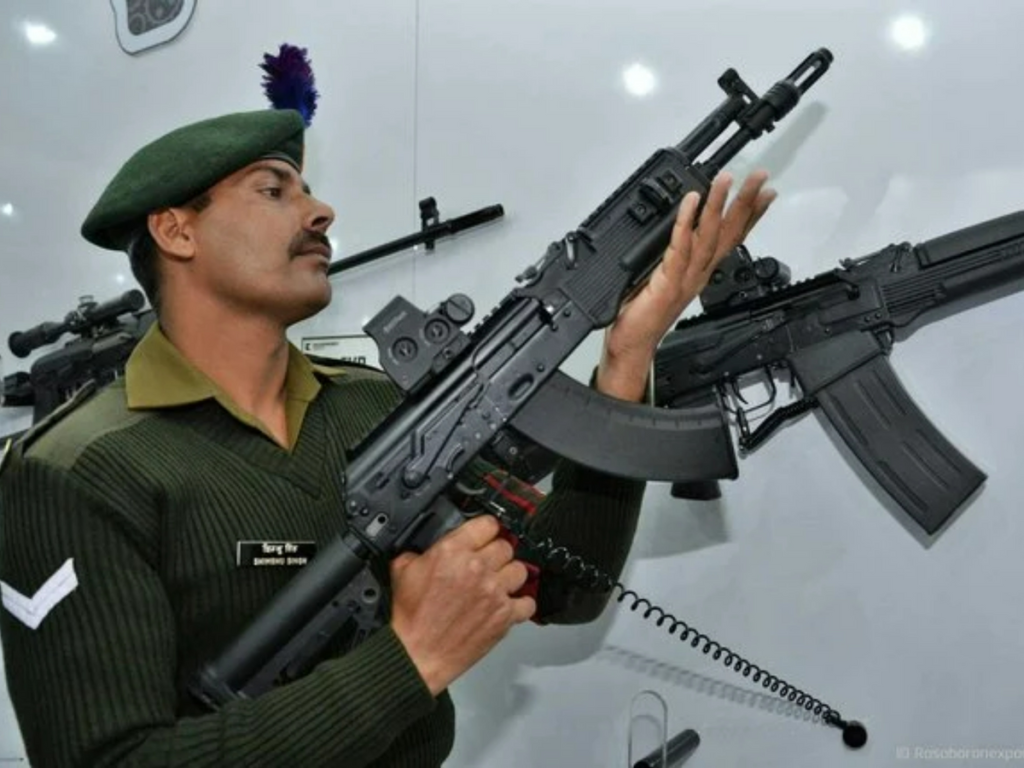
The AK-203 is an advanced version of the classic AK series, designed to meet modern combat needs. It offers all the strengths of Kalashnikov rifles—simplicity, reliability, ruggedness—while integrating advanced features suitable for 21st-century warfare.
Key Features of the AK-203 “Lion”
- 7.62×39 mm powerful bullet
- Plastic forend and folding buttstock
- Picatinny and side rails for optics
- Ergonomic pistol grip and design
- 30-round standard magazine
- Automatic and semi-automatic firing modes
- Lighter, smoother trigger mechanism
- Enhanced corrosion resistance
The rifle successfully blends heritage with innovation, becoming a true modern infantry weapon.
Firepower: The 7.62 mm Punch
The most significant upgrade from INSAS is the jump from 5.56 mm to 7.62 mm ammunition. A 7.62×39 mm round:
- Delivers more stopping power
- Penetrates through barriers more effectively
- Offers better lethality in close-range battles
- Performs well even in forest and mountainous terrain
The Indian Army’s operational requirements—with engagements often happening in rough terrain—make the 7.62 mm round ideal.
This power is clearly visible in the Army’s video, where the rifle tears through targets effortlessly.
High Rate of Fire: Speed Matters in Modern Combat
The AK-203 boasts a rate of fire of around 700 rounds per minute.
This makes it:
- Ideal for close-quarter battles (CQB)
- Effective in counter-terror operations
- Suitable for infantry assault roles
- Reliable during intense firefights
Combined with its recoil management system, the rifle allows faster target acquisition and quick firing response.
A Rifle Built for All Weather Conditions
One of the biggest advantages highlighted in the Army’s video is the AK-203’s all-terrain reliability. The rifle can function in:
- Extreme Himalayan cold
- Hot desert temperatures
- Monsoon humidity
- Dust storms
- Mud and water exposure
Kalashnikov rifles are legendary for working even after being submerged in water or rolled in sand. The AK-203 continues that legacy and enhances it with modern materials and precision manufacturing from Amethi.
In high-altitude regions, where INSAS often jammed, the AK-203 “Lion” promises uninterrupted performance.
Ergonomic and Soldier-Friendly Design
The Indian Army’s new video shows soldiers comfortable firing the weapon in different positions. The design includes:
- A foldable and adjustable buttstock
- Improved grip texture
- Balanced weight distribution
- Reduced recoil kick
- Better optical mounting support
These features make the rifle highly effective for soldiers during long hours of patrolling or intensive counter-terror missions.
Modularity: Customisable for Every Mission
Unlike INSAS, which offered limited modifications, the AK-203 is highly modular. Soldiers can attach:
- Red-dot sights
- Holographic sights
- Night-vision devices
- Scopes for long-range accuracy
- Tactical lights
- Laser designators
- Under-barrel grenade launchers
The Picatinny rail system ensures that the rifle can be adapted based on mission type and battlefield environment.
Replacing INSAS: End of a Long Journey
The INSAS rifles, though revolutionary at the time of their introduction, eventually fell short for modern warfare. Issues faced included:
- Jamming in low temperature
- Burst-mode malfunctions
- Magazine cracks
- Limited stopping power
- Incompatibility with modern battle optics
The AK-203 solves all these problems and brings in global-standard quality.
By the end of 2025, the Indian Army will receive 75,000 AK-203 rifles, marking a major milestone in phasing out the INSAS completely.
How the AK-203 Improves Infantry Combat
The rifle fundamentally transforms infantry operations in multiple ways:
1. Better Lethality
7.62 mm rounds ensure more decisive impact.
2. Improved Accuracy
Rail-mounted optics enhance target precision.
3. Faster Response
High rate of fire helps dominate close-range encounters.
4. Greater Reliability
Built to withstand extreme conditions with low maintenance.
5. Enhanced Soldier Confidence
Rifle consistency increases battlefield morale.
Visual Impact: The Indian Army’s Stunning Video
The Army’s video release plays a crucial role in public awareness and national pride. The visuals highlight:
- The rifle firing in slow motion
- Ballistic impact on targets
- Dust and mud resistance
- Soldiers handling the rifle with ease
- High-speed bursts demonstrating stability
The video is designed not only for demonstration but also for showcasing India’s defence capabilities to the world.
The branding of the rifle as “Lion” is portrayed through fierce, powerful cinematic shots—instilling national pride.
Strategic Importance: Strengthening India’s Infantry Backbone
In modern warfare, the strength of infantry is measured heavily by the firearm they carry. The AK-203 brings India at par with global standards in small-arms capabilities.
This rifle strengthens India’s:
- Counter-terror operations in Kashmir
- Border patrol in Ladakh and Arunachal
- Jungle warfare in the Northeast
- Desert operations in Rajasthan
- Urban close-quarters combat
With 75,000 rifles arriving by 2025, tactical consistency among units will improve significantly.
Economic and Strategic Value of Indigenous Production
Manufacturing the rifle in Amethi adds multiple advantages:
1. Reduced dependence on imports
No more delays due to foreign procurement.
2. Lower cost per rifle
Local manufacturing reduces expenses.
3. Indian job creation
Thousands of skilled and semi-skilled workers benefit.
4. Development of defence industrial ecosystem
Boosts metallurgy, machining, electronics, and assembly sectors.
5. Potential for exports
India could supply AK-203 rifles to friendly nations in the future.
Aatmanirbhar Bharat: Strengthening National Security
The AK-203 project fits perfectly into the national vision of self-reliance. Using 70% Indian steel ensures domestic material integration, while Indian engineers now possess expertise in precision rifle manufacturing.
This adds to India’s already growing list of indigenous defence achievements:
- INS Vikrant
- Tejas fighter jet
- Pinaka rocket system
- S-400 indigenous components
- BrahMos (co-developed)
- K9-Vajra
- Arjun MBT upgrades
The AK-203 “Lion” proudly joins this list.
Expected Future Upgrades
As manufacturing continues, India may introduce future improvements such as:
- Lighter composite materials
- Improved recoil dampening
- Smart optics integration
- Electronic fire-control systems
- Tactical suppressor options
The Amethi facility gives India the freedom to innovate and iterate without foreign dependence.
Why Soldiers Prefer the AK-203 Over INSAS
Based on battlefield feedback from test units, soldiers appreciate:
- Smooth firing
- Very low jamming
- Superior humidity resistance
- More lethal bullet power
- Better handling during quick movement
- Foldable design for vehicles and helicopters
- Easy cleaning and maintenance
These qualities directly impact combat efficiency and survival.
Comparison Table: AK-203 vs INSAS
| Feature | AK-203 “Lion” | INSAS |
|---|---|---|
| Calibre | 7.62×39 mm | 5.56×45 mm |
| Rate of Fire | ~700 rpm | ~600 rpm |
| Weather Reliability | High | Moderate |
| Modular Optics | Yes | Limited |
| Maintenance | Easy | Moderate |
| Lethality | Higher | Lower |
| Design | Modern ergonomic | Traditional |
The AK-203 surpasses INSAS in nearly every area.
Role in Future Conflicts
India faces multidimensional security challenges—border conflicts, terrorism, hybrid warfare, and infiltration attempts. A reliable infantry rifle is essential for:
- Mountain warfare troops
- Special Forces
- Quick Reaction Teams (QRTs)
- Counter-insurgency operations
- Border Security Forces
The AK-203 ensures Indian soldiers enter any conflict with confidence and superior firepower.
Global Standing: India Joins Elite Rifle-Manufacturing Nations
Countries that manufacture their own modern rifles include:
- USA (M4, M16)
- Russia (AK series)
- Israel (Tavor, Galil)
- Germany (G36, HK416)
- China (QBZ series)
By producing the AK-203, India joins this elite club.
The use of 70% Indian steel further strengthens India’s industrial reputation.
Conclusion: AK-203 ‘Lion’ Marks a New Era for the Indian Army
The Indian Army’s video of the AK-203 “Lion” isn’t just a display of firepower—it marks a historic shift in India’s defence strength.
With:
- 75,000 rifles arriving by 2025
- 70% Indian steel composition
- Superior 7.62 mm firepower
- High reliability in all terrains
- Modern modular design
- Manufacturing in Amethi
India has finally arrived at a new frontier of small-arms excellence.
The AK-203 is more than a weapon.
Read More latest news

