
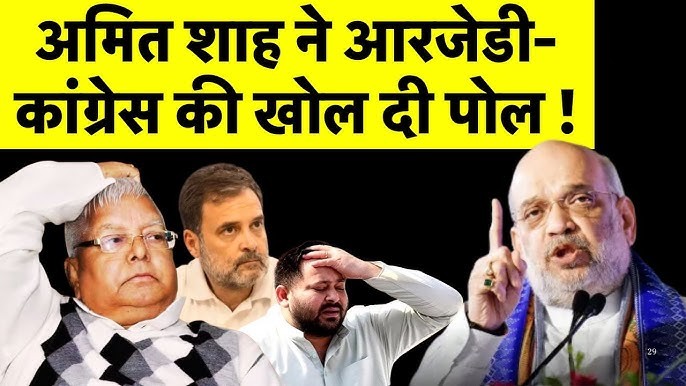
Amit Shah’s Exclusive Interview Before Bihar Elections: “If RJD Wins, Jungle Raj Will Return”
elections in Bihar, Amit Shah spoke exclusively As Bihar gears up for its first phase of assembly elections, the political temperature in the state has reached a boiling point. Every party — be it the ruling NDA or the opposition Mahagathbandhan led by the Rashtriya Janata Dal (RJD) — is leaving no stone unturned to win over the voters. In this charged atmosphere, Union Home Minister Amit Shah gave an exclusive interview to, where he launched a scathing attack on the RJD and its leadership. Shah’s words were sharp and clear: “The RJD has an ideology of holding lathi-charge rallies and they operate on that ideology. If they win the elections, jungle raj will surely come.”
This statement, coming from one of the BJP’s top strategists, has not only set the tone for the NDA campaign in Bihar but also rekindled the old political debate around “Jungle Raj” — a term synonymous with the RJD’s rule in the 1990s.
The Context: Bihar’s Political Landscape Before the Elections
Bihar has always been a politically sensitive and high-stakes state for all major parties. With over 243 assembly seats, its elections are often considered a semi-final for national politics. The state’s political history is deeply intertwined with caste, social justice, development, and governance issues.
As the first phase of elections approaches, the main battle lines are drawn between the BJP-JD(U)-LJP (Ram Vilas Paswan faction) alliance on one side and the RJD-Congress-Left alliance on the other. Nitish Kumar, leading the NDA from the front as Chief Minister, faces the twin challenge of anti-incumbency and the resurgence of the RJD under Tejashwi Yadav.
It is in this setting that Amit Shah’s interview gains political importance. By targeting RJD and invoking the fear of “Jungle Raj,” Shah seeks to remind the people of Bihar of the lawlessness and misgovernance that allegedly prevailed during the RJD’s earlier tenure.
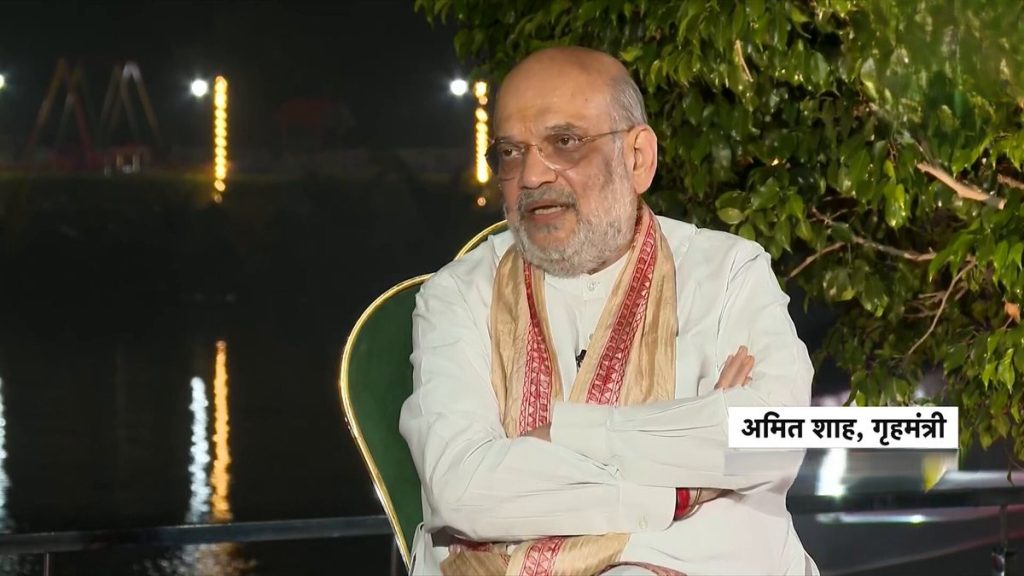
Amit Shah’s Attack on RJD: “They Believe in Lathi Raj”
During his exclusive conversation with, Amit Shah left no ambiguity in his words. When asked about the possibility of RJD’s return, he said:
“The RJD’s ideology is built on intimidation, caste politics, and lathi-charge rallies. They have always believed in politics of fear, not development. If they come back to power, Bihar will again slip into Jungle Raj.”
This remark is not just a political jibe — it’s a carefully crafted message meant to appeal to Bihar’s middle class, traders, farmers, and youth, who fear instability. The “Jungle Raj” term has been a powerful electoral weapon for the BJP and JD(U), symbolizing an era where kidnapping, extortion, and crime were rampant.
For the NDA, contrasting the governance of Nitish Kumar with that of Lalu Prasad Yadav’s regime is a tried-and-tested strategy. Amit Shah’s words, therefore, were intended to consolidate the perception that only the NDA can ensure peace, order, and progress.
The “Jungle Raj” Narrative: A Political Weapon That Still Works
The term Jungle Raj became widely used in Bihar’s political lexicon during the late 1990s and early 2000s. It described a period marked by lawlessness, corruption, and caste-based violence, especially during Lalu Prasad Yadav’s 15-year rule (1990–2005).
For many in Bihar, those years symbolize instability — frequent kidnappings of businessmen, poor infrastructure, and a collapsing education system. Even after two decades, this narrative remains politically potent. Every election, the BJP and JD(U) revive it, reminding voters of what they claim to have rescued the state from.
Amit Shah, as one of the BJP’s master campaigners, knows the emotional resonance of this term. By calling RJD’s ideology “lathi-charge rallies,” he invoked a vivid image of chaos and mob politics, contrasting it with the NDA’s claims of governance, roads, electricity, and social welfare.
BJP’s Campaign Theme: Development vs Disorder
Amit Shah’s statement also reflects the BJP’s larger campaign theme in Bihar — “Vikas aur Vishwas” (Development and Trust). Under Nitish Kumar’s governance, the NDA claims to have transformed Bihar from a lawless state into a state of opportunity. Roads, electricity, and improved law enforcement have become central talking points in their campaign.
In contrast, the RJD’s campaign, led by Tejashwi Yadav, focuses on unemployment, inflation, and farmers’ distress. However, Amit Shah and other BJP leaders are trying to shift the narrative — from economic concerns to the fear of losing peace and order.
Shah’s message is clear: a vote for RJD means returning to an era where Bihar was synonymous with lawlessness, while a vote for the NDA means stability and progress.
RJD’s Response: “BJP is Scared of People’s Power”
The RJD, on the other hand, has not taken Shah’s remarks lightly. Within hours of the interview’s broadcast, RJD spokespersons hit back, accusing the BJP of using “fear tactics” instead of talking about real issues.
Tejashwi Yadav, addressing a rally in Gaya, said:
“Amit Shah and BJP are afraid because they know the youth of Bihar have made up their mind. They are talking about Jungle Raj because they have no answer to unemployment, poverty, and rising prices. Let them talk about governance; we’ll talk about people’s issues.”
This counterattack shows that while Amit Shah’s “Jungle Raj” comment might energize the NDA’s traditional base, it also risks alienating young voters who are more focused on jobs and economic development.
The Strategy Behind Shah’s Timing
Amit Shah’s choice to give this interview just before the first phase of voting is no coincidence. Timing in political communication is everything — and this statement was strategically released to shape the final days of campaigning.
By invoking the fear of instability, Shah aimed to consolidate undecided voters who might have been dissatisfied with Nitish Kumar’s performance but are wary of RJD’s return. The BJP’s calculation is that many such voters — particularly from urban and upper-caste backgrounds — will choose stability over change.
The exclusive interview also ensured massive media coverage. Clips from his interview were repeatedly aired on news channels, spreading the BJP’s message beyond Bihar and reinforcing its national narrative of “law and order first.”
Bihar’s First Phase: What’s at Stake
The first phase of the Bihar assembly elections is often the tone-setter for the rest of the contest. Covering several key regions including Aurangabad, Gaya, Nawada, Jamui, and Kaimur, this phase includes both urban and rural constituencies, each with its own socio-political complexities.
These areas have a mix of caste groups — Yadavs, Dalits, Kushwahas, Bhumihars, and Muslims — making them a microcosm of Bihar’s larger politics. For the BJP and JD(U), holding ground here is crucial, while for RJD, gaining momentum in these seats could create a wave effect for the remaining phases.
Amit Shah’s statement, therefore, is not just rhetoric — it’s part of a well-calculated strategy to shape the psychological battlefield before the ballots are cast.
Amit Shah’s Broader Message: Governance Over Populism
In his interview, Amit Shah didn’t just criticize the RJD; he also projected the BJP as a party of governance and accountability. He highlighted how the NDA government under PM Modi and CM Nitish Kumar had worked to improve infrastructure, provide free ration, build toilets under Swachh Bharat Abhiyan, and implement welfare schemes like PM Awas Yojana.
Shah said:
“Bihar is no longer the same state it was in the 90s. Today, every village has electricity, roads connect districts, and law enforcement is stronger than ever. This is the difference between BJP’s governance model and RJD’s model of chaos.”
The statement was meant to reinforce the contrast — that the NDA represents order, while the RJD represents disorder.
Political Reactions Across the Spectrum
Amit Shah’s remarks triggered widespread reactions across political lines. While BJP leaders praised his boldness, opposition parties accused him of “fearmongering.”
JD(U) leaders, including Nitish Kumar’s close aides, welcomed Shah’s comments, saying that people should not forget the dark days of Bihar’s past. BJP state president Samrat Choudhary said, “Amit Shah has spoken the truth — the people of Bihar know what happens when RJD comes to power.”
On the other side, Congress and Left allies defended RJD. Congress spokesperson Pawan Khera said, “When Amit Shah has no answers on unemployment or inflation, he plays the same broken record of Jungle Raj. Bihar deserves better politics.”
The exchange of statements added fuel to an already heated campaign environment.
Media and Public Reaction
Media houses and social platforms buzzed with reactions after Shah’s statement aired. Hashtags like #JungleRaj and #AmitShahInBihar trended on X (formerly Twitter). News debates dissected every word, comparing the RJD’s record to that of the current government.
Public opinion, however, seemed divided. While older voters resonated with Shah’s warnings about the return of “Jungle Raj,” younger voters wanted the debate to move beyond the past. Many youth voices online argued that Bihar’s future should not be held hostage to the 1990s narrative.
Still, even critics acknowledged Shah’s communication skills. The way he framed the issue — not as an attack on a person, but on an ideology — gave his statement a powerful moral tone.
The Battle for Bihar’s Soul: Law vs Livelihood
At the heart of this political confrontation lies a deeper question: What kind of Bihar do people want?
For the BJP and NDA, the campaign revolves around law, order, and continuity. They claim that only their alliance can keep Bihar on the path of growth and prevent chaos. For the RJD, the election is about livelihood and change — arguing that despite peace, people are struggling with unemployment, poverty, and migration.
Amit Shah’s “Jungle Raj” remark thus symbolizes more than an election punchline; it reflects two competing visions of Bihar’s future.
The Importance of the “Fear Factor” in Bihar Politics
Fear — of crime, of instability, of losing progress — has always played a crucial role in Bihar’s elections. Political analysts often note that “negative memory” from the RJD’s era still influences many voters.
By reviving that fear just days before polling, Amit Shah effectively shifted the emotional tone of the campaign. His message appealed especially to women voters, who have often been the most vocal about safety and law enforcement issues.
At the same time, BJP strategists hope that even if Nitish Kumar faces anti-incumbency, Shah’s strong words will rally the BJP’s core base, ensuring that the NDA remains competitive in all regions.
Amit Shah’s Role as BJP’s Chief Strategist
It’s important to note that Amit Shah is not just another campaigner — he’s the BJP’s principal political architect. His statements are always deliberate, calibrated to influence both narrative and numbers.
In previous elections — from Uttar Pradesh to Gujarat — Shah has used fear of lawlessness and corruption as central campaign planks. In Bihar, where RJD’s legacy still divides opinion, this approach fits perfectly within BJP’s communication playbook.
Political observers believe that this interview was also designed to energize party workers at the grassroots level. When the central leadership takes a clear, strong position, it motivates booth-level workers to campaign with confidence and clarity.
Tejashwi Yadav’s Challenge: Changing the Perception
For Tejashwi Yadav, Amit Shah’s comments pose a serious image challenge. Despite his growing popularity among young voters, he still struggles to completely separate himself from the RJD’s old “Jungle Raj” baggage.
Tejashwi has tried to rebrand the RJD as a “youth-driven, development-oriented” party. His speeches often focus on jobs and governance rather than caste or legacy politics. However, statements like Shah’s make it difficult for him to escape the shadows of his father’s rule.
To counter this, Tejashwi’s campaign team has launched videos showcasing RJD’s new agenda — smart cities, employment guarantees, and digital growth. Whether these efforts are enough to neutralize the NDA’s narrative remains to be seen.
The Voter’s Dilemma: Past vs Future
As Bihar’s voters head to the polls, they face a dilemma that transcends party lines — should they vote based on past experiences or future promises?
Amit Shah’s message appeals to memory — reminding people of a difficult past. Tejashwi’s message appeals to aspiration — promising a better future. Both narratives are powerful in their own way.
The older generation, scarred by the 1990s, may lean toward stability. The younger generation, seeking opportunities, may be more open to change. This generational divide will likely determine the outcome of the elections.
Conclusion: A Defining Moment in Bihar Politics
Amit Shah’s exclusive interview has reignited one of Bihar’s oldest political debates. By asserting that “RJD believes in lathi-charge rallies” and warning that “Jungle Raj will return if they win,” Shah has brought law and order back to the center of the political conversation.
Whether this narrative will translate into votes remains uncertain. But what is clear is that his words have set the agenda for the final stretch of the Bihar elections. The BJP hopes that fear of instability will outweigh anger over local issues, while the RJD believes that the hunger for change will overpower fear of the past.
As the ballots are prepared and the campaign dust settles, Bihar once again stands at a crossroads — between Jungle Raj and Vikas Raj, between memory and aspiration, between fear and hope.
Only the people’s verdict will decide which path the state chooses this time.
read more latest news

