
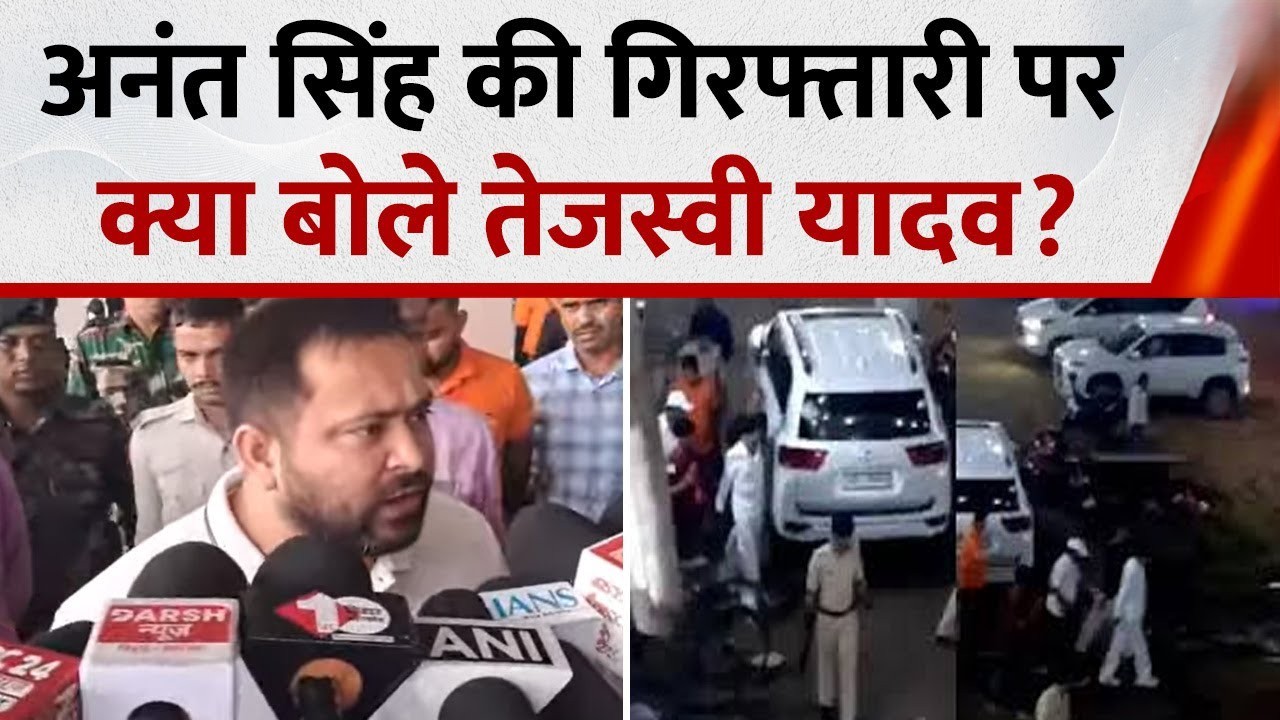
Tejashwi Yadav Reacts to the Arrest of JDU Candidate Anant Singh: “A Situation of Jungle Raj Continues to Prevail in Bihar”
Introduction: A New Storm in Bihar’s Political Landscape
Tejashwi said on the arrest of JDU candidate As Bihar’s election campaign gains momentum, a political storm has erupted over the arrest of Janata Dal (United) leader and candidate Anant Singh, who was taken into custody amid allegations of criminal activity. The arrest has once again opened old wounds in Bihar’s turbulent political history.
Reacting sharply to the development, Rashtriya Janata Dal (RJD) leader and former Deputy Chief Minister Tejashwi Yadav launched a blistering attack on the Nitish Kumar-led NDA government, declaring that “a situation of jungle raj continues to prevail in Bihar.”
Tejashwi’s remarks have reignited a fierce political debate — with the opposition accusing the government of selective action and political vendetta, while the ruling coalition defends its decision as a move toward “law and order.”
The controversy surrounding Anant Singh’s arrest has now become a flashpoint in Bihar’s already heated election atmosphere.
The Arrest That Sparked a Political Firestorm
Anant Singh, often referred to as “Chhote Sarkar”, is one of Bihar’s most controversial and influential political figures. Known for his larger-than-life personality, Singh has been both feared and admired in the political circles of the state, particularly in the Mokama region of Patna district, where he commands a strong local base.
Recently, a special team of Bihar Police conducted a late-night operation and arrested Singh from his residence in connection with a case involving illegal weapons and other criminal charges. The arrest came at a politically sensitive time — just weeks before the Bihar Assembly elections.
The move sparked immediate reactions across the political spectrum. Supporters of Singh accused the government of targeting him due to his growing influence and his complex relationship with both the JD(U) and the RJD, while others hailed the arrest as a sign that no one is above the law.
Tejashwi Yadav’s Strong Reaction: “Bihar Is Still in Jungle Raj”
Addressing a press conference in Patna the next morning, Tejashwi Yadav did not hold back his criticism. He said:

“The BJP-JD(U) government keeps talking about ending jungle raj, but look around — a situation of jungle raj still prevails in Bihar. People are being arrested, cases are being manipulated, and those in power decide who goes to jail and who walks free.”
Tejashwi argued that the arrest was politically motivated and that law enforcement in Bihar is being used as a tool to suppress dissent. He further said:
“Nitish Kumar talks about good governance, but today Bihar is witnessing governance by fear. When law becomes a weapon for politics, justice disappears.”
The RJD leader accused the government of hypocrisy — claiming that it turns a blind eye to corruption and crimes involving its own members but acts swiftly when it comes to silencing opponents or influential figures who refuse to toe the party line.
Who Is Anant Singh? The ‘Don’ Turned Politician
To understand the gravity of the situation, it’s important to look at who Anant Singh is and why his arrest carries such weight in Bihar politics.
Anant Singh began his political career as a close aide of Chief Minister Nitish Kumar. Over the years, he became a formidable power broker in central Bihar, especially in Mokama, where his influence remains unparalleled. His reputation as a bahubali (strongman) made him both feared by rivals and respected by followers.
Singh was elected multiple times as MLA from Mokama, initially as a JD(U) candidate. However, his relationship with the party soured over time, leading him to contest as an independent candidate in 2015 — a seat he won comfortably, proving his personal clout.
In 2020, he returned to the JD(U) fold, but his image remained controversial. His name has been linked to several criminal cases, including allegations of possession of illegal arms and involvement in violent incidents. Despite this, he continues to maintain significant political influence.
Political Overtones: Selective Action or Real Reform?
The timing of Anant Singh’s arrest has raised eyebrows across Bihar. With elections approaching, opposition leaders have alleged that the Nitish Kumar government is attempting to send a message — that no dissent within the NDA fold will be tolerated.
Tejashwi Yadav’s comments reflect this sentiment.
He said:
“When the elections are near, suddenly cases are revived. Why was there no action before? The government picks and chooses who to punish and who to protect. This is not governance, this is manipulation.”
Political analysts see this as part of a larger trend in Bihar politics, where arrests and investigations often intensify ahead of elections. For many, the question is not about whether Anant Singh is innocent or guilty — but about why his arrest was timed now.

Nitish Kumar’s Silence and the JD(U)’s Defense
Interestingly, Chief Minister Nitish Kumar has remained largely silent on the issue, choosing not to comment directly on Tejashwi’s allegations. However, JD(U) spokespersons have defended the government’s move, saying that Bihar’s law and order system operates independently.
JD(U) leader Neeraj Kumar responded sharply to Tejashwi’s statement, saying:
“Tejashwi Yadav should first look at the history of his own party before talking about jungle raj. Under the RJD regime, Bihar suffered its darkest days. We are trying to bring transparency and accountability, but the RJD cannot digest it.”
The JD(U) maintained that the arrest of Anant Singh was purely a law enforcement decision, not a political one. According to party insiders, Nitish Kumar wanted to send a message that no one, regardless of political status, is above the law.
The Ghost of ‘Jungle Raj’ and the Battle of Narratives
The term “Jungle Raj” has long been a political weapon in Bihar’s discourse. Coined during the RJD’s rule in the 1990s, it refers to a period when crime, corruption, and lawlessness were perceived to be at their peak. For decades, the NDA has used the term to attack Lalu Prasad Yadav and his family, claiming that the RJD brought chaos to Bihar.
Now, in a dramatic twist, Tejashwi Yadav has turned the same accusation back at Nitish Kumar’s government.
He said:
“They used to call us ‘Jungle Raj’. But today, people are living in fear, criminals roam free, and the government arrests political rivals. Isn’t this the real jungle raj?”
By flipping the narrative, Tejashwi is attempting to paint Nitish’s administration as hypocritical and authoritarian — a strategy that seems to be resonating with sections of the youth and opposition voters.
Public Reactions: Divided Sentiments Across Bihar
The arrest of Anant Singh and Tejashwi’s comments have created a divided atmosphere in Bihar’s political circles and among the public. In Mokama, Singh’s supporters protested, demanding his release and alleging that the charges are fabricated. Many locals see him as a Robin Hood-like figure — someone who helped the poor and stood up to powerful interests.
On the other hand, civil society groups and reformists argue that the law must take its course, regardless of a person’s political stature.
One activist from Patna remarked:
“It’s good to see that the law is catching up with those who think they are untouchable. Bihar needs clean politics, not muscle power.”
Yet, Tejashwi Yadav’s remarks have found traction among young voters disillusioned by what they see as selective governance and rising unemployment.
The Larger Political Context: NDA vs. RJD
Tejashwi’s statement on Anant Singh’s arrest is not an isolated reaction — it’s part of a broader political strategy. With elections nearing, the RJD leader is working to frame the narrative around law and order, corruption, and governance failure under Nitish Kumar.
Meanwhile, the NDA is highlighting its achievements — improved roads, electrification, health infrastructure, and women’s empowerment schemes. However, internal tensions within the JD(U) and the BJP’s growing dominance in state politics have left the alliance vulnerable to opposition attacks.
For Tejashwi, the Anant Singh episode is an opportunity to question Nitish Kumar’s credibility and reclaim the political space RJD once dominated.
Media Coverage and Political Optics
Television channels and newspapers across Bihar have given wall-to-wall coverage to the story. The visuals of Anant Singh being escorted by police have gone viral on social media, creating both outrage and sympathy.
Tejashwi Yadav has capitalized on this momentum by giving interviews, holding rallies, and framing the issue as symbolic of a “failed state.”
Political commentators note that Tejashwi’s ability to seize such moments and amplify them into statewide narratives reflects his growing maturity as a politician. Unlike earlier years, his tone is more assertive and confident, signaling a potential resurgence of the RJD as Bihar’s primary opposition force.
Tejashwi’s Broader Message: Governance for the People
While reacting to Anant Singh’s arrest, Tejashwi Yadav also broadened his criticism to include issues of unemployment, inflation, farmer distress, and migration.
He said:
“The government can arrest leaders, but can it arrest unemployment? Can it arrest corruption? Can it stop people from migrating out of Bihar for survival?”
He accused the NDA of failing to deliver on its promises and said the people of Bihar deserve a government that governs for the people, not for political survival.
His speech resonated strongly in youth rallies across Patna, Gaya, and Darbhanga, where thousands gathered to listen to him. His slogan, “Naya Bihar, Nayi Soch,” (New Bihar, New Thinking) continues to gain momentum.
The Political Fallout: Will This Help or Hurt the NDA?
The big question now is: how will Anant Singh’s arrest and Tejashwi’s “jungle raj” remark impact Bihar’s political dynamics?
Some analysts believe the move could backfire on the NDA. In regions where Singh has loyal support, particularly in Mokama and neighboring constituencies, there’s anger over what’s being seen as political humiliation. These sentiments could translate into anti-government votes.
However, others argue that Nitish Kumar’s decision reinforces his image as a leader committed to law and order — a stance that could appeal to urban and middle-class voters who value stability over personality politics.
Either way, the episode has added a fresh layer of complexity to Bihar’s election landscape.
Conclusion: The Battle for Bihar’s Political Soul
Tejashwi Yadav’s remark — “A situation of jungle raj continues to prevail in Bihar” — has once again made law and order the central talking point in Bihar’s politics. Whether it’s a genuine concern or a strategic narrative, the statement has revived public debate about justice, governance, and accountability.
As the election approaches, Bihar finds itself at a crossroads: between the promises of stability made by Nitish Kumar and the call for change led by Tejashwi Yadav.
Anant Singh’s arrest may just be one event, but it has opened a window into the larger story of Bihar’s democracy — a story of power, politics, and people yearning for fairness.
Whether voters will believe Tejashwi’s claim that “jungle raj” still exists or side with Nitish’s insistence on law and order will ultimately be decided at the ballot box.
For now, one thing is clear — the political battleground of Bihar has been reignited, and the fight for its future is far from over.
read more latest news

