
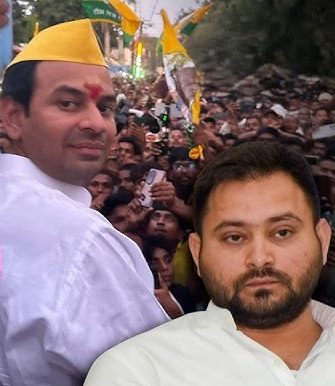
Amid the Election Fever in Bihar: Tej Pratap Yadav Lashes Out at Questions on Tejashwi, Says “Our Focus is on the People and Employment”
Introduction: The Heat of Bihar Politics Returns
Janshakti Janata Dal chief Tej Pratap Yadav As Bihar enters yet another politically charged election season, every statement, gesture, and appearance by the state’s major political figures has started making headlines. Amid this intensifying atmosphere, Janshakti Janata Dal (JJD) chief Tej Pratap Yadav has once again captured the spotlight — not for his usual political flamboyance, but for a fiery exchange with reporters over questions related to his younger brother and RJD leader, Tejashwi Yadav.
When asked about his brother’s political strategy and the ongoing campaign led by the Rashtriya Janata Dal (RJD), Tej Pratap snapped, saying,
“Why are you asking me questions about Tejashwi? Our focus is on the people and employment.”
His statement — short but sharp — not only reflects a certain strain within the Yadav political family, but also highlights how issues like unemployment, inflation, and governance have started dominating the discourse as voters prepare to decide Bihar’s future.
This blog takes a deep look into the political meaning, family dynamics, voter sentiments, and larger implications of Tej Pratap’s comment during this election fever.
Bihar: A State in Constant Political Motion Janshakti Janata Dal
Politics in Bihar is unlike anywhere else in India — deeply emotional, caste-sensitive, and unpredictable. Over the past decade, the state has witnessed constant realignments, with Nitish Kumar switching alliances between the BJP and the RJD-led Mahagathbandhan multiple times, and leaders frequently reshaping their positions to adapt to new equations.
In this complex environment, the Yadav brothers — Janshakti Janata Dal Tejashwi and Tej Pratap — remain central figures due to their lineage as sons of RJD supremo and former Chief Minister Lalu Prasad Yadav.
Tejashwi Yadav, currently the face of RJD and Leader of the Opposition in the Bihar Assembly, has established himself as a credible and ambitious young leader. Tej Pratap, on the other hand, has often walked a more unconventional path — seen as emotional, outspoken, and spiritually inclined, at times creating controversy within and outside his party circles.
Against this backdrop, Tej Pratap’s reaction to questions about Tejashwi adds another intriguing chapter to Bihar’s vibrant political narrative.
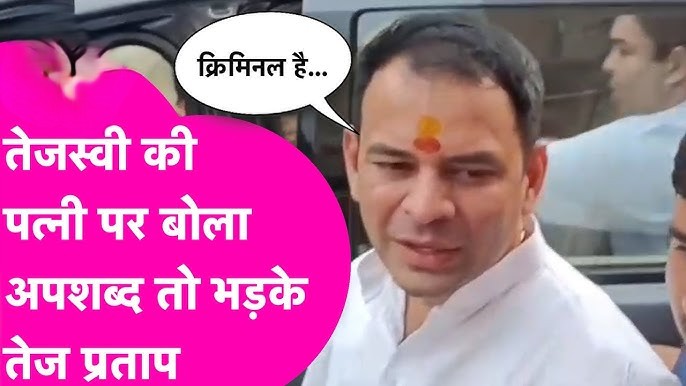
The Incident: Tej Pratap’s Sharp Response
During a campaign stop in the run-up to the Bihar elections, reporters gathered around Tej Pratap Yadav to ask about the RJD’s election strategy and the performance of his younger brother, Tejashwi, who has been spearheading opposition attacks against the NDA government.
However, instead of engaging on that topic, Tej Pratap cut the question short with visible irritation:
“Why are you asking me questions about Tejashwi? Our focus is on the people and employment.”
This single line went viral across social media and news channels, triggering widespread speculation about the relationship between the Yadav brothers, the strategy of the Janshakti Janata Dal, and the possible undercurrents within the Mahagathbandhan.
While some interpreted it as a sign of political tension, others saw it as Tej Pratap’s attempt to reposition himself as an independent political force — someone no longer content with living in his younger brother’s shadow.
Janshakti Janata Dal Who is Tej Pratap Yadav Today?
Tej Pratap Yadav, the elder son of Lalu Prasad Yadav and Rabri Devi, entered politics in 2015 when he contested and won from Mahua constituency in Vaishali district. That year, the Grand Alliance — comprising the RJD, JDU, and Congress — swept to power in Bihar, and Tej Pratap was appointed Minister for Health, Environment, and Forest in Nitish Kumar’s cabinet.
However, his political career has since been marked by fluctuations. Often making headlines for his religious pursuits, unfiltered statements, and frequent clashes with party workers, Tej Pratap has carved an image that is more spiritual and less administrative.
Yet, in recent years, he has tried to reshape that perception. After floating the Janshakti Janata Dal, Tej Pratap began emphasizing issues such as youth employment, education, and rural development, portraying himself as a leader of the people rather than just a member of the Lalu legacy.
His latest statement — rejecting questions about Tejashwi and focusing on “people and employment” — aligns with that renewed image.
Tejashwi Yadav: The Political Heir in the Spotlight Janshakti Janata Dal
In contrast, Tejashwi Yadav, often hailed as Lalu’s political successor, continues to dominate the RJD narrative. His leadership during the 2020 Bihar Assembly elections, where RJD emerged as the single largest party, proved his ability to connect with young voters and working-class citizens.
Tejashwi’s campaigns often revolve around two key promises:
- Jobs for Bihar’s youth (he famously pledged 10 lakh government jobs).
- Improved governance and social justice.
However, being the face of opposition also makes Tejashwi a constant subject of criticism — not only from rivals in the NDA but sometimes from within his own extended political family.
Tej Pratap’s public distancing, therefore, comes at a sensitive time, especially when unity among opposition forces is crucial in countering Nitish Kumar’s JDU-BJP-led alliance.
Sibling Rivalry or Strategic Rebranding?
Tej Pratap’s reaction raises a fundamental question — is this another episode in the long-standing sibling rivalry between the Yadav brothers, or is it part of a larger political rebranding strategy?
Over the years, Tej Pratap and Tejashwi’s relationship has oscillated between public warmth and visible friction. Tej Pratap has at times accused some RJD leaders of “sidelining” him, even alleging conspiracies within the party to favor Tejashwi. In contrast, Tejashwi has generally maintained a calm and diplomatic stance, refraining from responding publicly Janshakti Janata Dal .
But in 2025, as Bihar’s election season heats up, Tej Pratap appears keen to establish his own identity — distinct from both RJD and his younger brother’s leadership.
By saying, “Our focus is on the people and employment,” he sought to redirect the media’s attention away from family matters to core issues affecting Bihar’s citizens — unemployment, poverty, and youth migration Janshakti Janata Dal .
This could be a smart political move: positioning himself as a people’s leader, not a family-dependent politician.
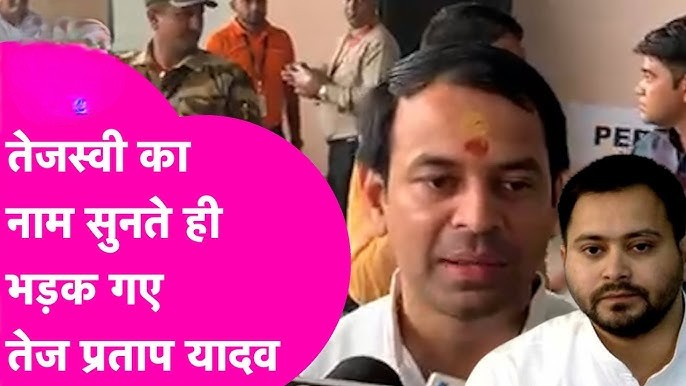
The Core Message: “Focus on People and Employment” Janshakti Janata Dal
Despite the controversy, Tej Pratap’s statement carries a powerful political message. Bihar remains one of India’s poorest states, and unemployment is its single biggest challenge.
According to the Centre for Monitoring Indian Economy (CMIE), Bihar’s unemployment rate has hovered between 14–16%, with youth unemployment reaching even higher figures. Lakhs of Bihari youths migrate every year to Delhi, Mumbai, and Gujarat in search of better opportunities.
By emphasizing “employment” and “the people,” Tej Pratap effectively tapped into a sentiment that resonates with almost every household in Bihar.
Let’s unpack what he may have intended to convey through that message:
- Rejecting Personal Politics: He doesn’t want to be defined by his brother’s or father’s political identity.
- Highlighting Governance Issues: The real debate, he implies, should be about jobs, development, and economic growth — not family dynamics.
- Connecting with the Common Citizen: His words attempt to appeal directly to youth and lower-income voters frustrated with years of stagnation.
In this sense, Tej Pratap’s statement, though emotionally charged, might have more strategic depth than it initially appeared.
Employment and Migration: Bihar’s Unresolved Crisis Janshakti Janata Dal
To understand the potency of Tej Pratap’s focus on “employment,” one must look at Bihar’s economic landscape.
- Migration Dependence: A staggering 35–40% of Bihar’s working-age population migrates seasonally for labor.
- Agrarian Pressure: Over 70% of the population still depends on agriculture, yet productivity remains low.
- Industrial Backwardness: Despite multiple policy announcements, Bihar lacks a strong industrial base, limiting job creation.
- Education-Employment Gap: Millions of graduates from Bihar’s universities find no jobs in the state, leading to frustration and brain drain.
Every election, these issues dominate manifestos, but meaningful change remains elusive. So, when Tej Pratap insists that his “focus is on employment,” he is speaking directly to one of Bihar’s most painful realities.
The Political Landscape: NDA vs Opposition
In the 2025 Bihar elections, the political battlefield is once again crowded:
- The NDA alliance led by Chief Minister Nitish Kumar and the BJP continues to bank on governance stability, infrastructure projects, and women’s empowerment schemes.
- The Mahagathbandhan, with RJD, Congress, and Left parties, pitches social justice and youth employment as central themes.
- Smaller outfits like the Janshakti Janata Dal, VIP, and HAM are trying to carve space for themselves amid the two dominant blocs.
In this context, Tej Pratap’s JJD has adopted a grassroots campaign strategy — door-to-door outreach, village sabhas, and public speeches focusing on youth aspirations rather than elite politics.
His emphasis on “employment” positions him closer to the younger demographic that feels ignored by traditional power structures.
Reactions from Political Circles Janshakti Janata Dal
Tej Pratap’s comment drew a mix of amusement, criticism, and analysis from across the political spectrum.
- RJD insiders reportedly downplayed the remark, calling it “Tej Pratap’s personal expression” and insisting there was “no rift” within the Yadav family.
- JDU and BJP leaders, however, seized the opportunity to highlight alleged divisions within the opposition. BJP spokespersons mocked, saying, “The Yadav family is busy fighting each other while Nitish Kumar is busy working.”
- Political analysts interpreted the remark as a reflection of Tej Pratap’s frustration with constant comparisons to Tejashwi.
However, what most agreed upon was that the core issue he raised — employment — remains deeply relevant.
Media Reaction and Public Discourse Janshakti Janata Dal
The incident trended widely on social media under hashtags like Janshakti Janata Dal #TejPratapYadav, #BiharElection2025, and #TejashwiYadav.
While memes and jokes circulated about sibling rivalry, many users, especially young voters, resonated with the “focus on employment” line.
A youth from Gaya commented on X (formerly Twitter):
“Whatever the political drama, Tej Pratap is right — politicians should talk about jobs, not each other.”
The episode, in effect, reignited the public conversation about Bihar’s employment crisis, shifting focus — even if momentarily — from personality politics to real issues.
The Family Equation Janshakti Janata Dal: Public Image vs Private Reality
It’s no secret that the Yadav family’s internal dynamics have often spilled into public view. From Lalu Prasad’s legal troubles to differences between the siblings, media has frequently speculated about divisions within the family.
Yet, those who know the family closely insist that despite disagreements, the bond between Tejashwi and Tej Pratap remains emotionally intact.
Lalu Prasad Yadav himself, known for his humor and political acumen, has often played the role of peacemaker, reminding both sons to “work for the people first.”
Therefore, Tej Pratap’s irritation at being questioned about Tejashwi could be more about media fatigue than actual hostility — an assertion of personal space rather than family disunity.
A Deeper Meaning Janshakti Janata Dal : The Evolution of Tej Pratap Yadav
Over time, Tej Pratap has evolved from being seen as the “eccentric elder brother” to a leader striving to find his political individuality. His lifestyle — from temple visits to spiritual retreats — may seem unconventional for a politician, but it appeals to a section of Bihar’s youth who see authenticity in his personality.
By asserting that he wants to focus on “people and employment,” Tej Pratap may be signaling his shift from personality-driven politics to issue-based leadership Janshakti Janata Dal .
This evolution is crucial because Bihar’s new generation of voters — those under 35 — care less about family legacies and more about education, jobs, and development.
The Road Ahead: Can Tej Pratap Transform His Image?
The 2025 elections could be a turning point for Tej Pratap Yadav. His political future depends on whether he can:
- Translate his rhetoric into concrete promises Janshakti Janata Dal .
- Connect with youth through genuine programs.
- Build an independent yet collaborative image that doesn’t alienate his family’s traditional voter base.
If he continues to highlight employment, education, and rural welfare — areas where Bihar desperately needs improvement — he could emerge as a relevant, reform-minded voice in Bihar’s next political generation.
Conclusion: From Family Politics to People’s Politics Janshakti Janata Dal
Tej Pratap Yadav’s spontaneous statement — “Why are you asking me about Tejashwi? Our focus is on the people and employment” — may have been triggered by irritation, but it reflects something deeper: a call to shift Bihar’s political narrative from dynastic debates to developmental discussions.
In a state where unemployment drives millions to migrate every year, his words echo the frustration of an entire generation that wants politicians to talk about jobs, not personal rivalries.
Whether Janshakti Janata Dal Tej Pratap succeeds in turning that message into a long-term political movement remains to be seen. But one thing is clear — his outburst has once again reminded everyone that Bihar’s future lies not in family feuds or party slogans, but in real answers to real problems.
And if his focus truly remains on “people and employment,” Tej Pratap Yadav might just find his political footing in a way that even his critics cannot ignore.
Read more Latest news

