
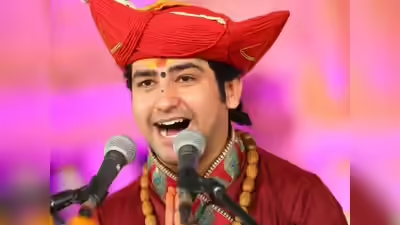
“If the Country Cannot Handle Pakistan, Then Return Home to India” – The Strong Words of Dhirendra Krishna Shastri
India and Pakistan—two nations born from the same soil in 1947—continue to share a relationship marked by conflict, suspicion, and unresolved disputes. Every few years, the shadow of Pakistan looms over India’s internal politics, security debates, and foreign policy discussions. Against this backdrop, the statement of Dhirendra Krishna Shastri— “If the country cannot handle Pakis tan, then return home to India”—carries both symbolic weight and political sharpness.
But what exactly did Shastri mean? Was it a challenge to India’s leadership? A commentary on Pakis tan’s hostility? Or a deeper message about national unity and strength? In this long-form blog, we will break down the statement’s meaning, analyze its implications, and understand its context in the larger India–Pakistan narrative.
1. The Man Behind the Words: Who is Dhirendra Krishna Shastri?
Dhirendra Krishna Shastri is known for his outspoken and fiery speeches that often blend historical reflection with contemporary political critique. As a social thinker and commentator, Shastri has never shied away from making bold remarks on issues of nationalism, governance, and foreign policy.
His recent comment—directed at India’s political class—came during a public address where he was highlighting the failures of successive governments in permanently resolving the Pakis tan issue. His words immediately caught media headlines, with supporters calling them “a voice of truth” and critics labeling them “provocative.”
2. The Core of the Statement
Shastri’s remark, “If the country cannot handle Pakistan, then return home to India” can be unpacked in several layers:
- Metaphorical “Home”: By “return home to India,” he meant returning to the ideals of a united, strong, and decisive India. It was not a literal call to shift borders but a symbolic call for reclaiming confidence.
- Challenge to Leadership: The remark questioned whether India’s leaders truly had the will and strategy to deal with Pakis tan decisively.
- Call for Accountability: Shastri essentially told politicians—if you cannot protect the nation and its sovereignty, you have no moral right to govern.
3. India–Pakistan: A Historical Burden
To understand why such statements still resonate, we must revisit history:
- Partition of 1947: Millions displaced, communal riots, and the beginning of hostility.
- Wars of 1947, 1965, 1971: Full-fledged wars fought with thousands of lives lost.
- Kargil Conflict (1999): Another bloody reminder of Pakis tan’s hostility.
- Cross-border Terrorism: From the 2001 Parliament attack to the 26/11 Mumbai attacks, India has faced repeated terror strikes backed by groups nurtured in Pakis tan.
- Ongoing Border Tensions: Frequent ceasefire violations, infiltration attempts, and Pakis tan’s refusal to stop supporting terror outfits keep the conflict alive.
Given this backdrop, Shastri’s sharp words are rooted in decades of unending friction.
4. Why Pakistan Still Haunts India’s Discourse
Shastri’s statement reflects a common frustration in Indian society—why does Pakis tan, a smaller economy with deep internal crises, still occupy so much space in India’s strategic and political debates?
- Kashmir Dispute: Pakistan’s obsession with Kashmir remains the central issue.
- Terror Networks: Lashkar-e-Taiba, Jaish-e-Mohammed, and other groups target India.
- China–Pakistan Nexus: Pakistan’s growing ties with China complicate India’s strategic calculations.
- Domestic Politics: Politicians in India often use Pakis tan as a rhetorical weapon during elections.
5. Interpreting the “Return Home” Idea
When Shastri said “return home,” he wasn’t asking politicians to literally move anywhere. Instead, his meaning can be interpreted as:
- Return to National Interest First: Stop playing politics with Pakis tan and prioritize the nation’s security.
- Return to Strong Policy: Don’t appease; act decisively.
- Return to Unity: Put aside party lines when it comes to dealing with an adversary like Pakis tan.
6. Public Reactions to the Statement
The remark immediately triggered intense reactions:
- Supporters said: Shastri had spoken what millions feel—that India should stop being defensive.
- Critics argued: His words oversimplify a complex problem; diplomacy, not aggression, is the real solution.
- Neutral voices noted: It is less about handling Pakis tan and more about handling internal divisions within India that Pakistan exploits.
Social media turned the phrase into a trending hashtag, with memes, debates, and quotes going viral.
7. The Political Angle
Shastri’s statement can also be read as a direct challenge to the ruling establishment. Over the years, both Congress and BJP governments have promised to take a tough stand on Pakis tan but have faced limitations:
- BJP: Advocates hard-line policies, yet critics say Pakis tan’s terror activities continue.
- Congress: Advocates diplomacy, yet critics accuse it of being “soft.”
- Regional Parties: Often avoid taking a clear stand, preferring local issues over national security.
By calling out the inability to “handle Pakistan,” Shastri indirectly told all political forces—stop the blame game, deliver results.
8. Handling Pakistan: Military, Diplomatic, and Economic Tools
When we talk about “handling Pakistan,” what does it really mean?
- Military Option: Limited strikes like the 2016 Uri Surgical Strike and the 2019 Balakot Airstrike showed India’s military resolve.
- Diplomatic Isolation: India has pushed to brand Pakistan as a terror-supporting nation globally.
- Economic Pressure: Suspending trade, reducing MFN status, and water treaties are ways of pressuring Pakistan.
- Cultural Disengagement: Banning Pakistani artists and sports engagements reflects symbolic pressure.
But each of these has its limitations. Shastri’s words demand that India think bigger, act stronger, and resolve this once and for all.
9. The Emotional Side: Martyr Families and Public Sentiment
Every time a soldier is martyred on the border, families across India echo Shastri’s anger. For them, “handling Pakistan” isn’t a policy issue—it’s a personal demand for justice.
Shastri’s voice gave words to this silent majority: stop negotiating endlessly and secure India’s honor.
10. Global Dimensions: Why “Handling Pakistan” Is Not Easy
While Shastri’s statement appeals to emotions, the ground reality is complex:
- US Interests: America has long used Pakistan as a strategic pawn in Afghanistan.
- China’s Role: With the China–Pakistan Economic Corridor (CPEC), Pakistan has backing from a global superpower.
- Nuclear Factor: Both India and Pakistan are nuclear states; full-scale war is risky.
- International Image: India aspires to be seen as a responsible democracy, which restricts aggressive options.
11. What Can India Really Do?
Shastri’s words highlight frustration, but the path forward requires multi-layered strategy:
- Continue Strong Defense: Strengthen border infrastructure and surveillance.
- Tackle Terror Financing: Cut off Pakistan’s economic lifelines via FATF and allies.
- Build Internal Unity: Reduce communal divisions that Pakistan exploits via propaganda.
- Global Narrative: Consistently highlight Pakistan’s failures on international platforms.
- Long-Term Patience: Recognize that Pakistan thrives on instability; India’s growth and stability is its strongest reply.
12. Why the Statement Struck a Nerve
Shastri’s bluntness worked because it distilled decades of public frustration into one line. Indians often feel that despite sacrifices, despite being stronger, India still ends up “managing” Pakistan instead of decisively settling the matter. His remark voiced this anger directly.
13. Critics of Shastri: The Counter-Argument
Not everyone agrees. Critics argue:
- The remark oversimplifies geopolitics.
- “Handling Pakistan” is not about crushing it, but managing peace.
- Harsh words fuel jingoism and distract from India’s internal problems.
Some even argue that obsessing over Pakistan gives it more importance than it deserves.
14. Lessons from History
Every time India has taken bold steps (1971 war, 2019 Balakot strikes), Pakistan has been forced into silence, at least temporarily. Shastri’s call is a reminder that history rewards strength, not hesitation.
15. Conclusion: The Power of a One-Liner
Dhirendra Krishna Shastri’s statement— “If the country cannot handle Pakistan, then return home to India”—is more than a rhetorical jab. It is a mirror to India’s leadership and society. It calls for courage, unity, and decisiveness.
Whether one agrees or disagrees, the power of the statement lies in its ability to force debate. Should India continue to manage Pakistan, or is it time to settle the matter once and for all?
For now, the answer remains complex. But what is clear is that India can no longer afford indecision. Shastri’s words remind us that national security is not optional—it is foundational.
Read More latest news

