

Shankaracharya Avimukteshwaranand Saraswati on the “I Love Mohammed” Controversy: A Conspiracy to Divert Attention from the Real Issues
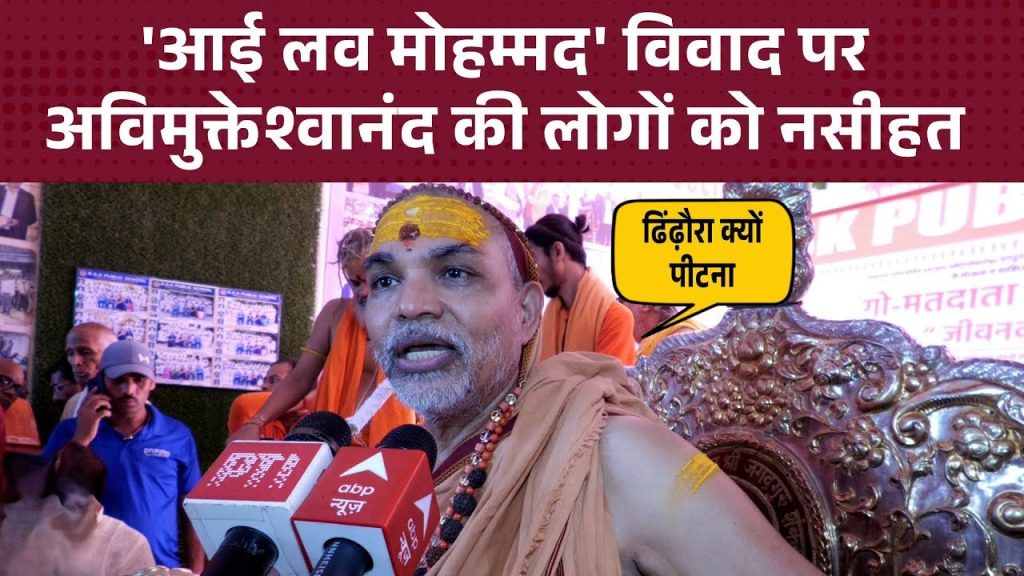
Shankaracharya Avimukteshwaranand Saraswati Indian politics and social discourse are often shaped by controversies that catch fire overnight. Sometimes these controversies emerge from genuine ideological conflicts, while at other times they are strategically created to divert attention from pressing matters of governance, economy, and national interest. One such controversy that recently shook the public space was the “I Love Mohammed” row. In the midst of political parties, media houses, and social media platforms amplifying the debate, Shankaracharya Avimukteshwaranand Saraswati, a revered spiritual leader, came forward with a blunt observation:
“This is a conspiracy to divert attention from the real issues facing the nation.”
His words did not just add a spiritual perspective to the heated controversy, but also invited Indians to reflect on how easily their focus is shifted away from crucial matters toward sensational debates. This blog explores in detail the controversy, the Shankaracharya’s response, the socio-political environment surrounding the debate, and the larger implications of such distractions on democracy and governance.
Understanding the “I Love Mohammed” Controversy
The controversy began when slogans, statements, and online campaigns with the phrase “I Love Mohammed” gained traction. For some, it was an innocent expression of devotion and faith, while for others, it was viewed as a provocation, especially in the context of India’s delicate communal balance.
Politicians quickly picked up on the trend, with one section of leaders condemning it as an attempt to communalize society, while others defended it as freedom of expression. Media outlets devoted hours of primetime coverage to the issue, and social media hashtags turned the debate into a nationwide frenzy.
But amidst the noise, one important question was neglected: What were Indians supposed to be talking about instead?
Shankaracharya Avimukteshwaranand Saraswati’s Intervention
Known for his sharp insights into social and spiritual matters, Shankaracharya Avimukteshwaranand Saraswati did not mince his words. He stated:
“This whole ‘I Love Mohammed’ controversy is nothing but a conspiracy. It is designed to distract the minds of the people from the real and urgent issues the nation is facing.”
By pointing to the political and economic challenges currently affecting India—rising inflation, farmers’ distress, unemployment, border security issues, and the tariff disputes with the US—the Shankaracharya reminded the people that indulging in communal controversies only weakens national unity.
Why the Shankaracharya’s Words Matter
The Shankaracharya is not just a religious figure but also a moral voice who influences millions. When such a figure speaks out against distractions, his words carry weight because they emphasize dharma, justice, and the need for clarity in public life.
- His statement resonates with ordinary citizens who are tired of endless political drama.
- It offers a reminder that the nation’s welfare must come before divisive narratives.
- It serves as a moral checkpoint for political actors who may benefit from stirring controversies.
Real Issues Overshadowed by the Controversy
While media debates raged on “I Love Mohammed,” several burning issues took a backseat in the national conversation.
1. Economic Distress
- Rising unemployment and lack of job opportunities remain pressing concerns for youth.
- Inflation in essential commodities like food and fuel has strained household budgets.
- Farmers continue to demand fair MSP (Minimum Support Price) and relief for crop losses.
2. International Relations
- India has been navigating difficult tariff disputes with the United States.
- Tensions with China and Pakistan along the border require serious diplomatic engagement.
- The role of India in global forums like G20 and UNGA calls for more strategic focus.
3. Domestic Governance Challenges
- Floods, cloudbursts, and urban infrastructure failures have led to loss of lives.
- Waterlogging in cities like Delhi and Mumbai highlight the gap between promises and performance.
- Corruption allegations and scams continue to affect public trust in governance.
The Shankaracharya’s remarks highlight that while these issues demand national attention, they were being ignored in favor of a debate that benefits only those who thrive on division.
The Politics of Distraction in India
The “I Love Mohammed” controversy is not the first time India has witnessed such diversions.
- In the past, issues like film dialogues, celebrity statements, and symbolic gestures have overtaken discussions on GDP slowdown, unemployment, and corruption.
- Political parties often prefer emotionally charged debates because they polarize society and ensure electoral gains.
- Media channels, in search of high TRP ratings, amplify such issues and push serious policy matters into the background.
Shankaracharya Avimukteshwaranand Saraswati’s words remind us that this cycle of distraction only weakens democracy.

The Role of Media and Social Media
The rise of social media has turned every statement into a potential flashpoint. Platforms like Twitter, Facebook, and Instagram amplify slogans, making them trend overnight. Instead of constructive discussions, much of the energy is spent in defending or attacking such slogans.
Mainstream news channels, too, often join the race. For instance:
- Instead of debating farmer suicides, primetime debates revolve around religious slogans.
- Instead of analyzing global oil price shocks, headlines focus on communal one-liners.
The Shankaracharya’s statement indirectly critiques the media’s role in this diversionary politics.
Spiritual Perspective on National Unity
Shankaracharya Avimukteshwaranand Saraswati’s intervention is rooted in the spiritual philosophy of oneness and harmony. Hindu philosophy teaches that truth (satya) and duty (dharma) must guide society. When citizens are dragged into hate-filled distractions, both truth and duty are compromised.
From this perspective:
- Loving one prophet, god, or deity does not need to come at the cost of disrespecting others.
- National unity should always outweigh religious polarization.
- Dharma requires focusing on justice, equality, and the upliftment of all.
Public Reaction to His Statement
The Shankaracharya’s comments sparked mixed reactions:
- Many citizens welcomed his clarity and called it a much-needed voice of reason.
- Some political commentators dismissed his remarks as interference in politics.
- On social media, hashtags related to his statement trended for a while, showing that people resonated with the idea of “real issues being sidelined.”
Historical Context of Distraction Politics
India’s history is full of moments where communal issues have been used as a smokescreen. From the Mandal Commission protests to debates around religious conversions, several controversies have emerged just when the government of the day faced criticism over governance.
The “I Love Mohammed” row fits into this pattern. And Shankaracharya Avimukteshwaranand Saraswati’s words are a reminder of this long-standing strategy of diversion.
Lessons for Citizens
The most important takeaway from the Shankaracharya’s statement is directed not at politicians or media, but at ordinary citizens:
- Don’t get distracted easily.
Recognize when an issue is being blown out of proportion to hide governance failures. - Focus on accountability.
Keep questioning governments on jobs, education, healthcare, and infrastructure. - Promote harmony.
Refuse to be divided along religious lines for political gains. - Engage in constructive debates.
Use social media to highlight real issues rather than amplifying divisive slogans.
Conclusion
The “I Love Mohammed” controversy could have easily remained another temporary firestorm in India’s political and social landscape. But the intervention of Shankaracharya Avimukteshwaranand Saraswati transformed it into a moment of reflection. His powerful statement—that this was a conspiracy to divert attention from real issues—reminds India to rise above distractions and focus on the challenges that truly affect the nation’s future.
In an era where politics thrives on polarizing narratives, spiritual leaders like him offer a much-needed corrective lens. They remind us that the essence of democracy lies not in shouting over one another, but in resolving the problems that impact every Indian citizen.
As citizens, the onus is on us to heed his words, reject distractions, and ensure that national discourse remains centered on truth, justice, and progress.
Read More latest news

