

Mohan Bhagwat’s Call for Three Children Sparks Owaisi’s Fierce Attack – A New Flashpoint in India’s Demographic and Political Debate
Introduction
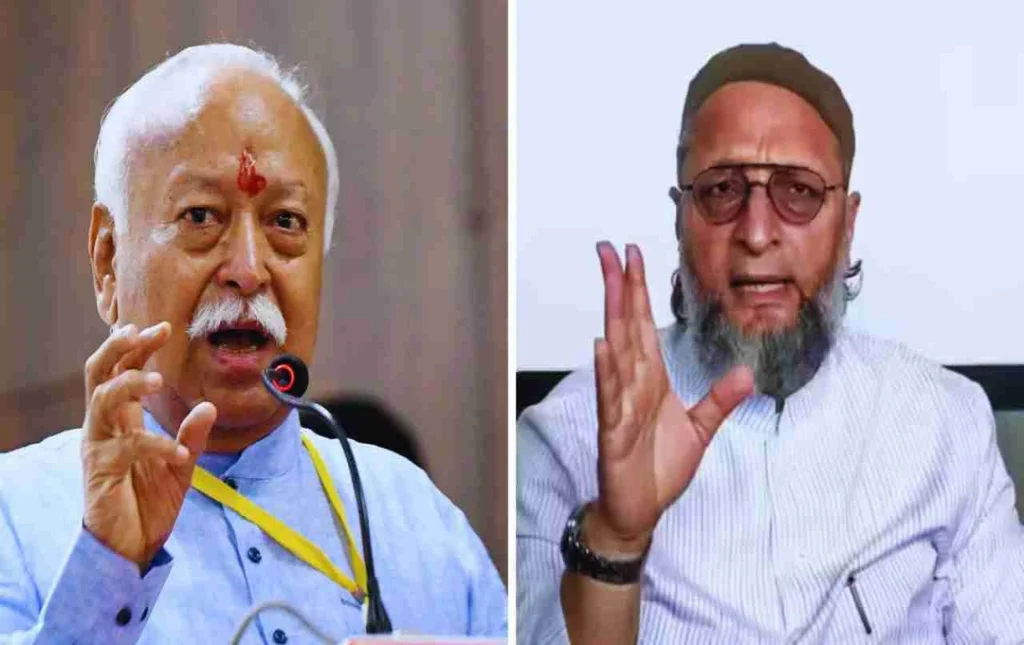
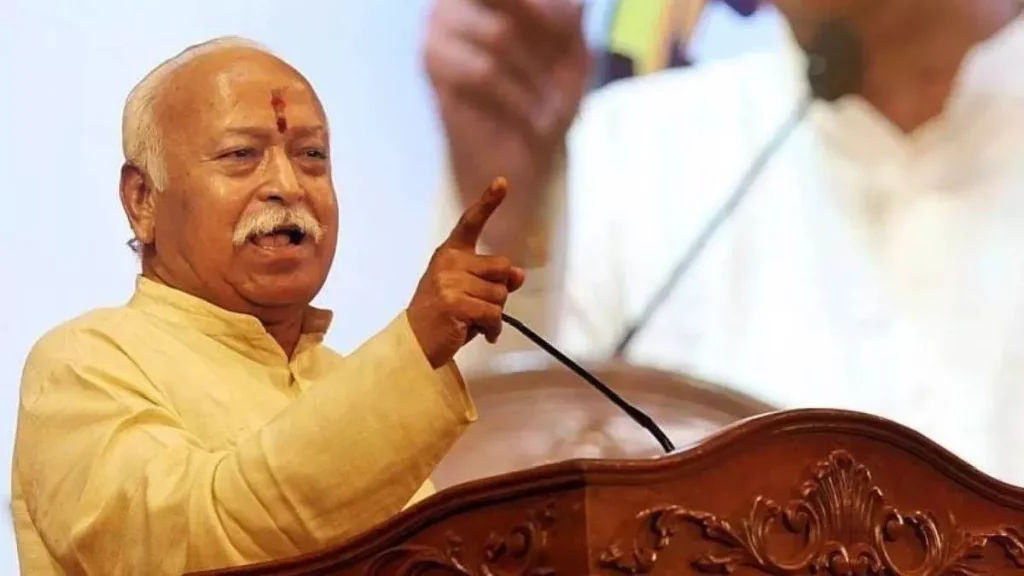
Mohan Bhagwat India’s socio-political landscape thrives on debates that intertwine religion, demography, and politics. The latest flashpoint emerged after Rashtriya Swayamsevak Sangh (RSS) chief Mohan Bhagwat urged families to consider having three children, citing the need to maintain demographic balance in society.
The statement immediately set off political tremors. While supporters of the RSS viewed it as a call for protecting India’s cultural fabric, All India Majlis-e-Ittehadul Muslimeen (AIMIM) chief Asaduddin Owaisi launched a scathing attack, accusing Bhagwat and the Sangh Parivar of engaging in population politics and targeting minorities under the guise of demographic concerns.
This controversy has reignited the age-old debate in India: Should family planning remain a matter of personal choice and state policy, or can socio-religious organizations prescribe population norms? More importantly, is this debate rooted in genuine demographic concerns, or is it another battlefront in the ideological clash between Hindutva forces and minority leaders?
In this comprehensive blog, we analyze:
- What Mohan Bhagwat said and the context of his appeal.
- Owaisi’s counterattack and his arguments.
- Historical background of population policies in India.
- The political undertones of the controversy.
- Reactions from other political parties, experts, and citizens.
- The demographic realities of India.
- The potential impact on Indian society and upcoming elections.
1. Mohan Bhagwat’s Statement: The Call for Three Children
While addressing a gathering of swayamsevaks, Mohan Bhagwat stressed the importance of maintaining India’s demographic balance. He noted that declining fertility rates among certain communities while others maintained higher fertility could lead to an imbalance that may affect the nation’s cultural integrity in the long run.
Bhagwat’s key points included:
- Families should ideally have three children to ensure stability and demographic strength.
- The state should not impose harsh population control measures that disrupt natural social structures.
- Protecting the cultural ethos of India requires ensuring that one community does not grow disproportionately compared to others.
This appeal was not presented as a legal diktat but as a social guideline. Yet, because Bhagwat is the head of the RSS — the ideological parent of the ruling Bharatiya Janata Party (BJP) — his words carry significant weight and political implications.
2. Owaisi’s Counterattack: Sharp and Direct
Asaduddin Owaisi, known for his fiery speeches and uncompromising defense of Muslim rights, wasted no time in responding.
Owaisi’s counterarguments included:
- Accusation of Communal Agenda: He argued that Bhagwat’s appeal was a veiled attack on Muslims, feeding into the long-standing narrative that Muslim population growth poses a threat to Hindus.
- Family Planning as a Personal Choice: Owaisi stressed that decisions about the number of children are personal matters, not to be dictated by religious or political leaders.
- Contradiction to Government Policy: The Indian government’s policies encourage smaller families, with slogans like “Hum Do, Hamare Do”. Owaisi mocked the RSS chief, asking if the Sangh wanted to reverse decades of public policy.
- Scientific Data vs. Fear-Mongering: Owaisi cited demographic studies showing that Muslim fertility rates are also declining steadily and that India as a whole is moving toward replacement-level fertility.
In typical fashion, Owaisi also framed his response as part of a larger struggle against majoritarianism, accusing the RSS of using population narratives as a tool for communal polarization.
3. Historical Background: India’s Population Policy
To understand the controversy, we must revisit India’s population control history:
- 1950s–1970s: India launched its family planning program, one of the first in the world. Slogans like “We Two, Our Two” promoted smaller families.
- Emergency Era (1975–77): Forced sterilization drives under Sanjay Gandhi created deep scars and public resentment.
- Post-1990s: The focus shifted toward voluntary family planning and reproductive health.
- 21st Century: India’s fertility rate declined steadily. By 2021, the Total Fertility Rate (TFR) had dropped to 2.0, below replacement level.
Thus, India has transitioned from population explosion fears to population stabilization challenges. In this context, Bhagwat’s appeal for three children appears to go against the tide of government policies that encourage smaller families.
4. The Political Undertones
Why Did Bhagwat Say This Now?
Many political observers view Bhagwat’s remark as a strategic message to reinforce the RSS’s ideological stance on Hindu consolidation. By invoking demographic concerns, the Sangh seeks to:
- Mobilize Hindu families to resist what it perceives as an imbalance.
- Counter narratives that Hindu population growth is declining faster.
- Keep cultural nationalism alive in public discourse.
Owaisi’s Political Calculus
For Owaisi, Bhagwat’s statement was an opportunity to:
- Reinforce his position as a defender of Muslim rights.
- Portray the RSS as anti-Muslim, thereby consolidating his support base.
- Project himself as a national-level opposition voice, not limited to Hyderabad or Telangana.
Thus, the controversy is not just about children—it is about political positioning ahead of upcoming elections.
5. Reactions from Other Political Parties
- BJP: Officially silent, but many leaders informally defended Bhagwat, saying his words were about “cultural preservation” and not an attack on minorities.
- Congress: Criticized Bhagwat for promoting “outdated and divisive ideas,” while reminding voters of the dangers of demographic politics.
- Samajwadi Party and RJD: Framed it as an attempt to distract people from pressing issues like unemployment and inflation.
- Civil Society and Experts: Demographers highlighted that fertility rates across all communities, including Muslims, are falling, rendering Bhagwat’s fears statistically weak.
6. The Demographic Reality: Myths vs. Facts
Fertility Trends in India
- According to the National Family Health Survey (NFHS-5), India’s overall fertility rate is now below replacement level (2.1).
- Hindu fertility rate: 1.94
- Muslim fertility rate: 2.36
- Other communities: around 1.6–1.9
What Does This Mean?
- The gap between Hindu and Muslim fertility rates is narrowing rapidly.
- By 2050, India’s population will stabilize, and fears of one community “overtaking” another are unfounded.
- Migration, urbanization, and women’s education are driving down fertility across all religions.
Thus, demographers argue that population politics is more about ideology than data.
7. Social and Cultural Impact of the Debate
Bhagwat’s appeal and Owaisi’s rebuttal resonate beyond politics. They influence:
- Family Choices: Ordinary families may feel pressured by social and religious messaging, even if government policy promotes smaller families.
- Communal Harmony: When demographic anxieties are framed in religious terms, it risks widening divides.
- Youth Perspectives: Younger generations, focused on careers and economic stability, may find such appeals out of touch with their realities.
8. International Parallels
This debate is not unique to India. Around the world, population and demography are often politicized:
- Europe: Right-wing parties warn of “Islamization” due to migration and fertility differences.
- China: From the one-child policy to three-child encouragement, state intervention has shaped demography.
- Israel: Fertility differences between Jewish and Arab populations are part of political discourse.
India’s debate, however, is unique because it blends religion, politics, and cultural identity in a democracy with 1.4 billion people.
9. What Lies Ahead?
The Supreme Court’s population-related cases, government policies, and RSS pronouncements suggest that population politics will remain a hot issue.
Possible scenarios:
- RSS doubles down on the three-child appeal, turning it into a campaign.
- Government distances itself quietly to avoid contradicting its family planning policies.
- Opposition parties use it as ammunition to target BJP’s ideological agenda.
- Public opinion may remain divided—some drawn by cultural arguments, others by practical concerns of education, jobs, and costs.
10. Conclusion
Mohan Bhagwat’s call for three children per family and Owaisi’s fierce attack on it encapsulate the fault lines of Indian politics: tradition vs. modernity, majority concerns vs. minority rights, and ideology vs. evidence.
For the RSS, the issue reinforces its cultural mission. For Owaisi, it is an opportunity to project himself as a fearless voice against majoritarian politics. For ordinary Indians, however, the debate may feel distant from everyday struggles of employment, healthcare, and education.
Ultimately, India’s demographic future will not be determined by appeals from political or religious leaders, but by the aspirations of millions of families who weigh the costs and opportunities of raising children in a rapidly changing society.
Read more latest news

