
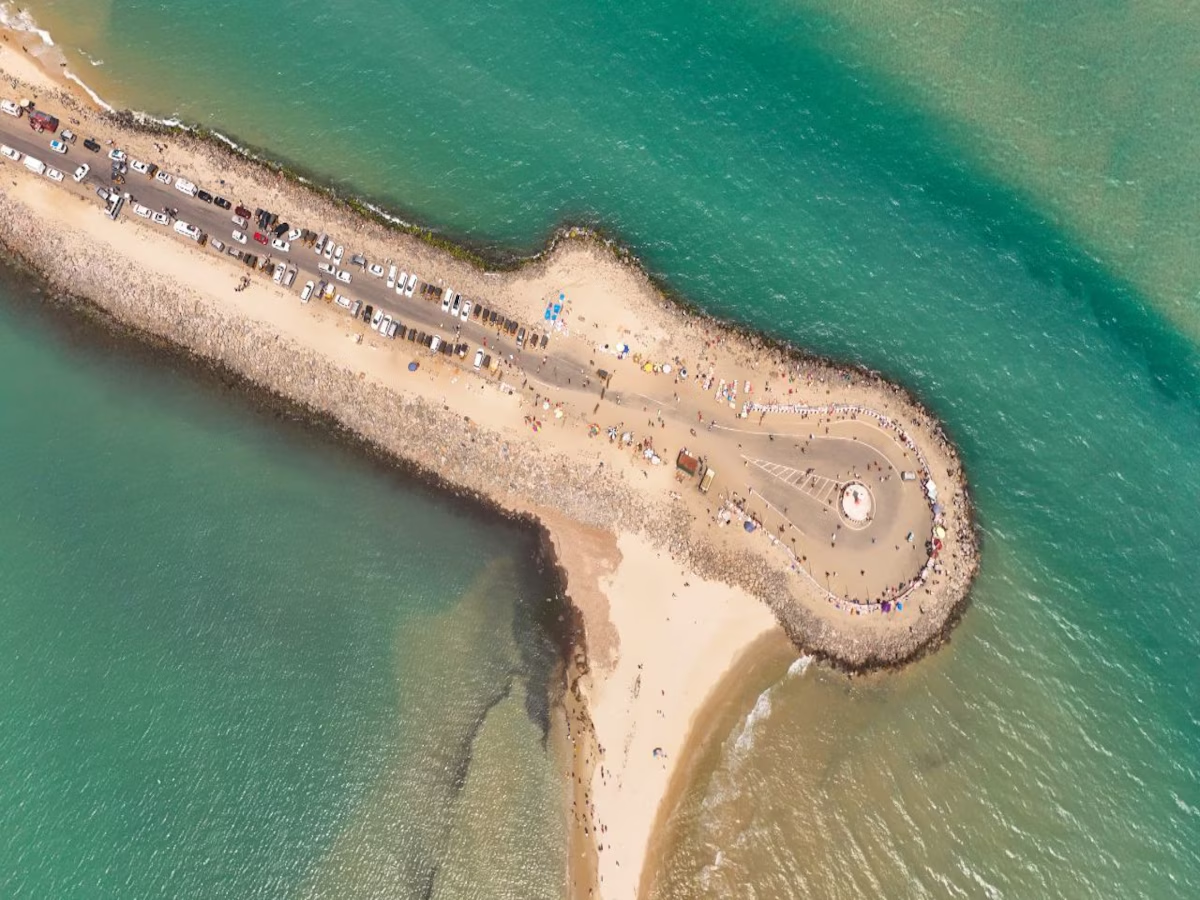
SC: Centre Seeks 4 Weeks to Respond on Declaring Ram Setu as National Heritage
Introduction
The Ram Setu, also known as Adam’s Bridge, has once again entered the spotlight, this time in the Supreme Court of India. The matter pertains to a long-pending plea demanding that the ancient bridge-like formation connecting Rameswaram in Tamil Nadu to Mannar in Sri Lanka be declared a national heritage monument.
The Supreme Court, hearing the matter, has granted the Centre four weeks’ time to file its official reply on the question of heritage status. This judicial development revives a debate that is centuries old, steeped in mythology, science, religion, culture, and politics.
In this blog, we will explore the issue in depth across multiple dimensions:
- The Supreme Court proceedings and what the order means.
- The historical and mythological significance of Ram Setu.
- Previous controversies over the Sethusamudram project.
- The role of political parties in framing the narrative.
- The legal hurdles in declaring it a national heritage site.
- Possible implications for tourism, environment, and national identity.
- What lies ahead in the coming months.
1. Supreme Court Proceedings: The Latest Development
The Supreme Court of India, while hearing the plea, noted that the demand to declare Ram Setu as a national heritage monument has been under consideration for years but has seen no final decision.
The petitioner, BJP leader and former Rajya Sabha MP Subramanian Swamy, has consistently argued that:
- Ram Setu is of immense cultural and religious significance to Hindus, as it is believed to have been built by Lord Rama’s army of Vanaras to cross into Lanka (present-day Sri Lanka) during the Ramayana war.
- It deserves recognition and protection under the Ancient Monuments and Archaeological Sites and Remains Act, 1958.
- Beyond religion, Ram Setu also has geo-historical and archaeological importance.
In response, the Centre informed the Court that it needs four weeks to file a detailed reply, after consulting concerned ministries, including Culture, Shipping, and Environment.
The SC’s direction has set the stage for a high-profile legal and political debate in the coming months.
2. Ram Setu: Mythology Meets Geology
Mythological Significance
- In Valmiki Ramayana, Ram Setu (Setubandh) is described as a bridge built by Lord Rama’s army of monkeys (Vanaras) led by Nal and Neel to cross the sea into Lanka and rescue Goddess Sita from Ravana.
- For millions of Hindus, it is a sacred symbol of faith, courage, and dharma. Pilgrims flock to Rameswaram and Dhanushkodi, viewing the chain of limestone shoals as divine evidence of Ramayana’s events.
Geological Perspective
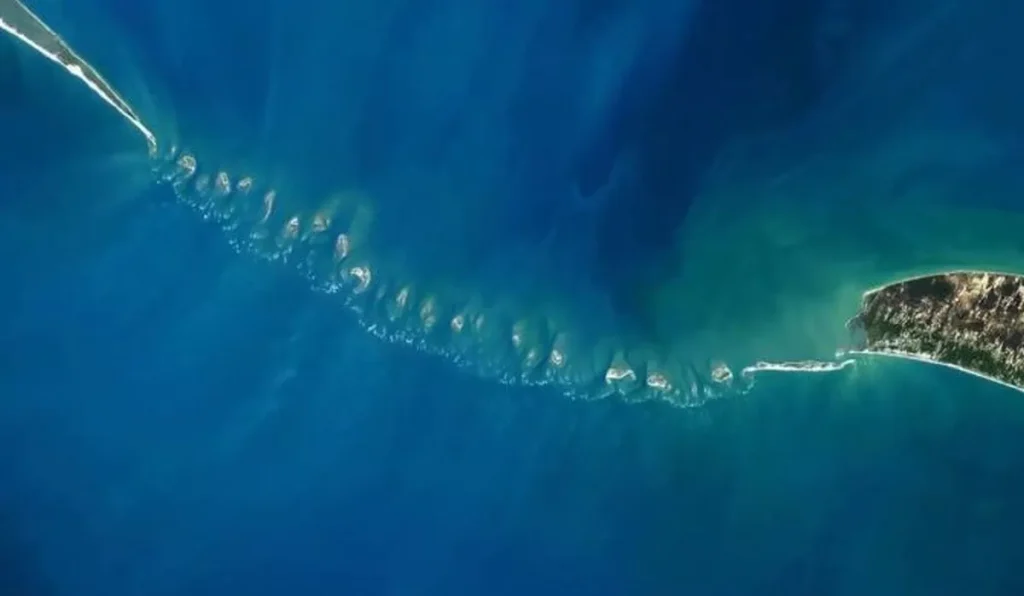
- Geologists describe Ram Setu as a chain of limestone shoals stretching around 30 km across the shallow waters of the Palk Strait.
- Studies differ on whether it is a purely natural formation or partly modified by human activity.
- NASA satellite images released in early 2000s added fuel to the debate by showing a distinct bridge-like structure, though NASA clarified it did not authenticate mythological claims.
Thus, Ram Setu straddles the delicate line between faith and science, both of which give weight to its preservation.

3. The Sethusamudram Project Controversy
The demand to declare Ram Setu a national heritage monument cannot be understood without revisiting the Sethusamudram Ship Channel Project (SSCP).
- Proposed over a century ago, the SSCP aimed to create a navigable shipping channel by dredging the shallow waters of the Palk Strait, thus avoiding the long detour around Sri Lanka.
- In the mid-2000s, the project gained momentum under the UPA government.
- However, the alignment required dredging through Ram Setu, sparking massive opposition from religious groups, environmentalists, and political parties.
Arguments Against Dredging Ram Setu
- Religious Sentiment – Destroying a structure associated with Lord Rama was seen as sacrilege.
- Environmental Concerns – Ecologists warned that dredging could disrupt marine biodiversity, coastal ecology, and increase vulnerability to tsunamis.
- Economic Doubts – Some studies questioned whether the shipping channel would actually be financially viable, given maintenance costs.
The controversy reached the Supreme Court, which stayed the project in 2007. Since then, successive governments have avoided pushing it aggressively, wary of the Ram Setu sentiment.
4. Political Dimensions of Ram Setu
BJP and Ram Setu
- The BJP and allied organizations like the VHP have consistently championed the protection of Ram Setu.
- They argue that it symbolizes India’s civilizational heritage and must be preserved as part of Hindu identity.
- Subramanian Swamy, in particular, has been the face of the legal campaign for heritage recognition.
Congress and UPA Legacy
- The UPA government faced backlash when an affidavit filed in Supreme Court in 2007 questioned the historical existence of Rama, leading to widespread outrage.
- The affidavit was later withdrawn, but the damage to Congress’s image among devout Hindus was considerable.
Regional Politics
- In Tamil Nadu, political parties like DMK and AIADMK have taken shifting positions depending on electoral considerations.
- While DMK historically supported the Sethusamudram project as an economic boon for Tamil Nadu, it faced resistance from religious groups.
Thus, Ram Setu remains not just a religious issue but also a political litmus test across parties.
5. Legal Hurdles in Declaring National Heritage
Declaring a site as a national heritage monument under the 1958 Act involves several conditions:
- The structure must have historical, archaeological, or artistic value.
- Detailed surveys by the Archaeological Survey of India (ASI) are required.
- The site must be deemed to have national importance.
In Ram Setu’s case, the challenge lies in:
- Establishing documented archaeological evidence.
- Balancing religious belief with scientific criteria.
- Navigating the political sensitivities around the issue.
The Centre’s reply in 4 weeks will have to address these dimensions, making it a legally complex case.
6. Environmental and Economic Aspects
Environmental Concerns
- Ram Setu acts as a natural barrier, protecting coastal Tamil Nadu from strong sea currents and possible tsunamis.
- The region is a marine biodiversity hotspot, home to sea grasses, corals, and rare species.
- Any alteration could have unpredictable consequences on fishing communities.
Economic Potential
- If declared a heritage monument, Ram Setu could become a global pilgrimage and tourism destination, boosting local economies in Tamil Nadu.
- However, it would also mean the Sethusamudram project cannot pass through the formation, closing that economic avenue.
7. Cultural and Civilizational Identity
Ram Setu is not just a physical formation—it is a cultural metaphor. For centuries, poets, saints, and storytellers have celebrated it as a symbol of:
- Human determination against impossible odds.
- Divine intervention in human affairs.
- The bridge between India and its civilizational neighbors.
Declaring it a national heritage monument would be seen as an acknowledgment of India’s civilizational continuity from the Ramayana era to modern times.
8. Implications of Supreme Court’s Direction
The SC’s decision to seek a reply from the Centre in 4 weeks has the following implications:
- Pressure on Government – The Centre can no longer indefinitely postpone a decision.
- Political Repercussions – Whatever stand the government takes will have electoral consequences, especially in Tamil Nadu and among Hindu voters nationwide.
- Judicial Precedent – The case could set a precedent for how faith-linked structures are handled under heritage laws.
- Global Spotlight – Ram Setu could attract international attention, much like Ayodhya did during the temple dispute.
9. What Lies Ahead?
In the next four weeks, the government must prepare a carefully balanced affidavit. It could choose among three broad approaches:
- Support Heritage Declaration
- Gain goodwill among religious groups.
- Cement Ram Setu as a symbol of civilizational pride.
- However, foreclose future infrastructure projects in the area.
- Reject Heritage Status
- Risk backlash from Hindu groups.
- Face accusations of being insensitive to faith.
- Possibly justify the move on scientific or legal grounds.
- Seek Middle Ground
- Acknowledge cultural significance but avoid formal heritage declaration.
- Explore alternative protections like “protected site of religious significance.”
- Buy more time through committees and surveys.
Whichever route is chosen, the debate on Ram Setu will remain alive, as it touches deep chords of faith, politics, and identity.
Conclusion
The Supreme Court’s directive to the Centre to respond within four weeks on the Ram Setu heritage plea has reignited a decades-long debate that goes far beyond law and geology. It is about faith versus evidence, development versus preservation, politics versus culture.
Whether Ram Setu is declared a national heritage monument or not, it already occupies an unshakeable place in India’s civilizational consciousness. The Court’s proceedings will decide the legal and administrative status, but in the minds of millions of devotees, Ram Setu has long been, and will always remain, a bridge of faith connecting India’s past with its present.
read more latest news

