
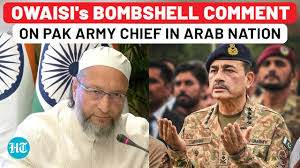
AIMIM President Asaduddin Owaisi Slams Pakistan Army Chief Asim Munir: “Speaking the Language of a Street Man”
Introduction
Asaduddin Owaisi spoke on Pakistan Army Chief In the midst of escalating rhetoric between India and Pakistan, a new verbal battlefront has opened. Pakistan’s Army Chief, General Asim Munir, recently made an inflammatory remark hinting at Pakistan’s nuclear arsenal, perceived as a veiled threat against India. The statement, loaded with provocative undertones, quickly drew reactions from across the Indian political spectrum. Among the most outspoken was All India Majlis-e-Ittehadul Muslimeen (AIMIM) President Asaduddin Owaisi, who dismissed Munir’s remarks as “the language of a street man” — an unusually blunt choice of words that caught attention nationwide.
Owaisi, known for his fiery oratory and willingness to take on political opponents across the aisle, did not mince words in calling out what he described as reckless and irresponsible talk from the Pakistani military establishment. His comments not only spotlighted the ongoing tensions between India and Pakistan but also raised questions about the implications of nuclear rhetoric in South Asian geopolitics.
This blog will explore the context of Munir’s remarks, Owaisi’s strong rebuttal, the diplomatic and strategic dimensions of such rhetoric, and the broader public and political reactions. We will also examine why Owaisi’s statement is significant in India’s political discourse and what it says about the evolving relationship between domestic politics and foreign policy narratives.
1. Context: Asim Munir’s Provocative Statement
General Asim Munir’s comments came during a high-profile address, in which he allegedly referred to Pakistan’s possession of nuclear weapons as a deterrent against perceived threats from India. While Pakistan’s military leadership has made such assertions in the past, this instance stood out for its casual and almost taunting tone.
Analysts point out that such language from the head of Pakistan’s armed forces often serves multiple purposes:
- Domestic audience reassurance – projecting strength to counter internal political instability.
- Signaling to India – reminding its neighbor of Pakistan’s strategic capabilities.
- International signaling – drawing global attention to South Asia’s security volatility.
However, in this case, Munir’s remarks appeared more informal, almost flippant, which amplified the perception of recklessness.
2. Owaisi’s Strong Rebuttal
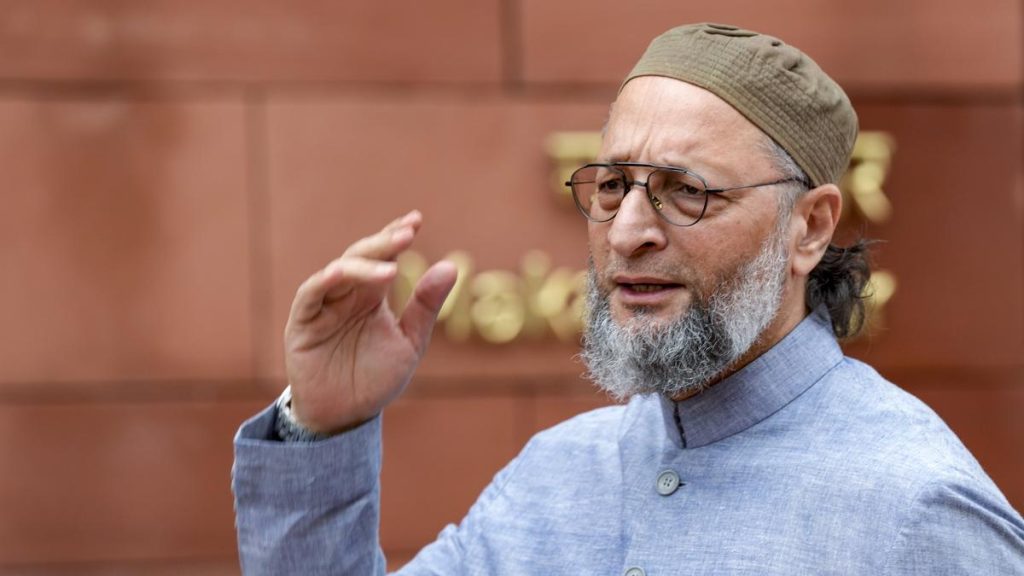
Reacting to Munir’s nuclear rhetoric, Asaduddin Owaisi minced no words. Speaking to reporters, the AIMIM chief said:
“The Pakistan Army Chief is speaking the language of a street man. Such language is not befitting a person of his position. Threatening a country with nuclear weapons is not only irresponsible but also shows the bankruptcy of thought within Pakistan’s military leadership.”
This statement stands out for several reasons:
- Direct Personal Rebuke – Owaisi didn’t just criticize Pakistan’s policy but directly called out Munir’s conduct.
- Dismissive Tone – By equating Munir’s words with street-level talk, Owaisi implied that the remark lacked the dignity, depth, and strategic seriousness expected from a military chief.
- Moral High Ground – Owaisi positioned himself as condemning irresponsible nuclear rhetoric, appealing to both national pride and global diplomatic norms.
3. Political Significance of Owaisi’s Comment
While many Indian leaders regularly criticize Pakistan, Owaisi’s remarks are notable because:
- He represents a party with a strong Muslim voter base – Critics of Owaisi often accuse him of soft-pedaling on Pakistan-related issues, but his sharp words here undermine that perception.
- He’s an opposition leader taking a nationalist stance – In a political climate where the ruling party often frames opposition voices as weak on national security, Owaisi’s clear condemnation strengthens his nationalist credentials.
- He connects with ordinary citizens’ sentiments – The phrase “language of a street man” resonates with the frustration many Indians feel about Pakistan’s repeated threats.

4. The Dangers of Nuclear Rhetoric
Owaisi’s criticism also draws attention to a serious point — the dangers inherent in casually invoking nuclear weapons in public discourse.
- Erosion of diplomatic stability – Normalizing nuclear threats lowers the threshold for their use.
- Escalation risks – Such rhetoric could prompt miscalculations in times of crisis.
- International backlash – The global community is wary of leaders who seem too willing to play the nuclear card.
The United Nations and various global security think tanks have repeatedly warned about the destabilizing effect of such threats, especially in regions like South Asia where historical animosities run deep.
5. India’s Strategic Response
The Indian government, while not directly addressing Munir’s specific comment, has consistently maintained that India is a responsible nuclear power that adheres to its “No First Use” policy, while retaining the right to retaliate decisively if attacked.
By allowing leaders like Owaisi to publicly condemn such threats, India also demonstrates that the rejection of Pakistan’s nuclear bravado is bipartisan and not limited to the ruling party.
6. Public and Media Reactions
Following Owaisi’s remarks, social media platforms saw a flood of reactions:
- Supportive voices praised him for “calling a spade a spade.”
- Critics of Pakistan amplified his statement as proof that even Indian opposition leaders are fed up with Islamabad’s rhetoric.
- Skeptics questioned whether his words would have any real impact on Pakistan’s behavior.
Mainstream Indian media highlighted Owaisi’s statement prominently, often framing it as an example of cross-party unity in rejecting Pakistan’s threats.
7. Historical Parallels: Nuclear Threats in Indo-Pak Relations
Pakistan’s nuclear posturing is not new. Since its first nuclear tests in 1998, Islamabad has used the nuclear card as a deterrent and a diplomatic bargaining chip. However, the tone and context have varied:
- 1999 Kargil War – nuclear threats were implicit but avoided in direct public statements.
- 2001–2002 military standoff – explicit mentions of nuclear weapons raised international alarm.
- Post-2016 Uri attack – Pakistan hinted at tactical nuclear options in response to India’s “surgical strikes.”
Owaisi’s remarks can be seen as part of India’s ongoing effort to push back against such threats, but his choice of words reflects a more personal and rhetorical style.
8. Why “Street Man” Language Stings
The phrase “language of a street man” carries layered implications in South Asian political culture:
- It implies lack of sophistication and absence of formal decorum.
- It suggests emotional impulsiveness rather than calculated strategy.
- It positions the speaker as beneath the stature of their official role.
In other words, Owaisi is accusing Munir of reducing the dignity of his office to the level of everyday quarrels — a powerful insult in diplomatic rhetoric.
9. Pakistan’s Internal Dynamics
Some analysts believe Munir’s statement was less about India and more about Pakistan’s domestic politics:
- Pakistan is facing severe economic crisis and political instability.
- The military’s dominance over civilian leadership is being questioned.
- By invoking the nuclear threat, Munir might be trying to reassert the military’s relevance and control.
If this interpretation is correct, Owaisi’s dismissal of the remark as “street language” may sting even more, as it undercuts the seriousness Munir wanted to project.
10. Implications for Indo-Pak Relations
While this exchange is primarily verbal, it reflects deeper trends:
- Hardening of public attitudes – Politicians on both sides are less willing to use diplomatic language.
- Erosion of back-channel talks – Informal diplomacy becomes harder when public insults dominate headlines.
- Risk of misinterpretation – Overheated rhetoric increases the chance of misreading intentions during crises.
11. Voices from the Strategic Community
Indian strategic experts have generally supported Owaisi’s critique, though with caution:
- Retired military officers – called the remark “unacceptable and provocative.”
- Nuclear policy analysts – stressed the need to avoid “normalizing” nuclear threats.
- Diplomats – welcomed Owaisi’s bipartisan stance but warned against language that could be seen as equally inflammatory.
12. Conclusion: A Rare Moment of Political Convergence
In a polarized political environment, moments of cross-party agreement on national security are rare. Owaisi’s statement — sharp, unfiltered, and nationalistic — shows that when it comes to protecting India’s dignity and security, even leaders with starkly different domestic agendas can find common ground.
By labeling Munir’s nuclear threats as the “language of a street man,” Owaisi not only condemned the recklessness of Pakistan’s military leadership but also reinforced a broader Indian consensus: nuclear weapons are not toys for casual threats.
The incident serves as a reminder that words matter, especially when they come from those with the power to start — or prevent — wars. In that light, Owaisi’s bluntness may be exactly the kind of rhetorical pushback such dangerous talk deserves.
Read More latest news

