
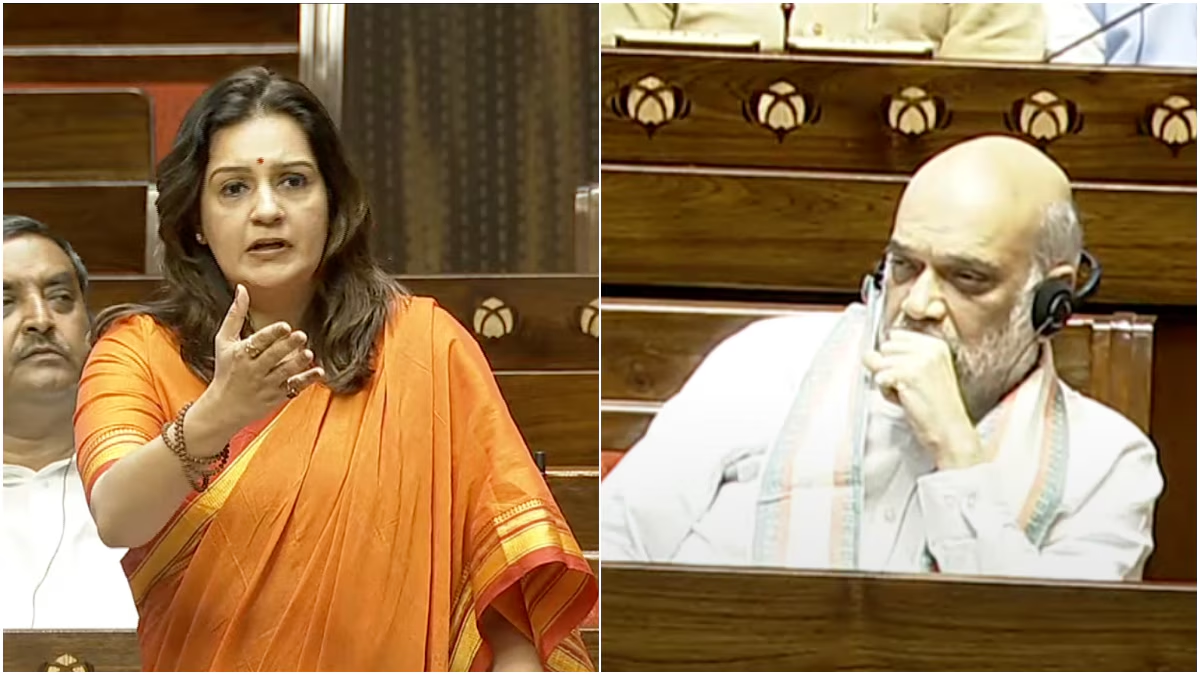
“If India-Pakistan Cricket Match Is Cancelled, That Will Be Operation Sindoor’s Real Success” — Priyanka Chaturvedi’s Challenge to Amit Shah in Rajya Sabha
In a fiery and thought-provoking debate in the Rajya Sabha, Shiv Sena (UBT) MP Priyanka Chaturvedi delivered a sharp critique of the government’s diplomatic posturing and military claims surrounding Operation Sindoor. Amidst applause, interruptions, and retorts, she aimed her remarks directly at Union Home Minister Amit Shah, questioning the contradictions in India’s policy towards Pakistan. Her pointed suggestion was:
“If the government truly believes Pakistan is behind terror, then tell the ICC chairman that an India-Pakistan match cannot happen. That will be the true success of Operation Sindoor.”
This blog analyses her statement in depth—its political message, national sentiment, cricket diplomacy, and the larger questions of consistency in India’s Pakistan policy.
1. What is Operation Sindoor? The Military Context
Before understanding Priyanka Chaturvedi’s remarks, we need to revisit Operation Sindoor. This was a recent covert military operation reportedly conducted by Indian forces along the Line of Control (LoC) in response to the brutal killing of Indian soldiers. The operation was meant to deliver a message to Pakistan’s military establishment and insurgent groups operating out of PoK.
Government sources highlighted its “strategic precision and minimum collateral damage”, presenting it as a diplomatic as well as military victory. Union ministers hailed it in Parliament, and Amit Shah lauded the army for delivering a “befitting reply”.
2. Priyanka Chaturvedi’s Stand: Symbolism vs Substance
When the discussion on Operation Sindoor opened in Rajya Sabha, Chaturvedi’s intervention was not just about military success but about the gap between military posture and political practice.
She said:
“If we believe that Pakistan is responsible for terror attacks on our soldiers and citizens, then we must ensure that we don’t normalize relations in the name of cricket.”
Her contention was that cricket diplomacy often dilutes the political message India wants to send to the global community. Playing cricket with Pakistan, despite calling it a “terror-sponsoring state,” presents a contradictory image.
3. Cricket and Politics: A Long, Controversial History
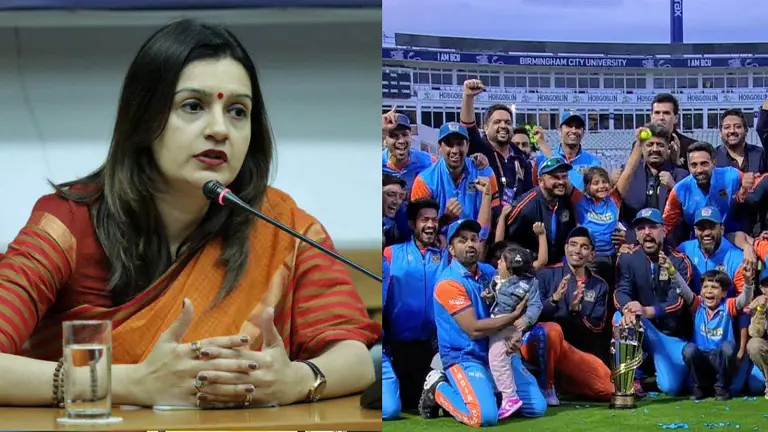
India-Pakistan cricket is not merely a sport. It is laden with history, diplomacy, and emotion. After the 2008 Mumbai attacks, cricketing ties were suspended for years. In recent years, however, India has agreed to play Pakistan in ICC events on neutral grounds—claiming these are obligations under global cricket bodies.
But this has drawn criticism.
Why is India willing to play Pakistan in World Cups if it refuses bilateral talks?
This is the core question Chaturvedi raised.
4. A Challenge to the Government’s Diplomatic Coherence
Chaturvedi directly addressed Home Minister Amit Shah, saying:
“If you truly want to show Pakistan that we are not going to tolerate terror, tell the ICC that India will not play them. That will show diplomatic and political resolve.”
Her message was clear: the success of Operation Sindoor is not just in the battlefield but in international arenas where soft diplomacy is practiced—such as sports, cultural exchanges, and global summits.
This wasn’t just a rhetorical point, it was a challenge to the government’s consistency.
5. The Opposition’s Larger Argument: Dual Policies, Hollow Rhetoric
Chaturvedi’s comments were not isolated. They represented the wider opposition narrative—that the Modi government maintains double standards on Pakistan:
- It labels Pakistan as the “epicentre of terror” in global forums.
- But at the same time, trade continues, diplomatic visas are issued, and sports diplomacy resumes.
The Opposition argues that this weakens India’s moral authority, especially when Indian soldiers are killed or civilians attacked by Pakistan-backed groups.
6. The Government’s View: Strategic Separation of Issues
On the other hand, the BJP government has maintained that sports and diplomacy are separate. While bilateral cricket ties remain suspended, participation in ICC tournaments is explained as a “contractual obligation”.
Supporters of the government say that boycotting Pakistan altogether would:
- Violate international sporting norms.
- Allow Pakistan to play the “victim card” internationally.
- Set a precedent that could hurt India in other multilateral forums.
But this position is often viewed as pragmatic but politically hypocritical—the kind Chaturvedi sharply attacked.
7. Parliament Reactions: Tension, Applause, and Crossfire
Chaturvedi’s remarks drew mixed reactions in Parliament:
- Opposition benches applauded her for saying what many “whisper in corridors”.
- BJP MPs countered that “she is trivializing a military operation” by linking it to cricket.
- Amit Shah did not directly respond to her ICC remark, but emphasized that “terrorism will be responded to strongly, regardless of arena.”
Her comment made headlines precisely because it laid bare the contradictions the government finds hard to explain publicly.
8. The Public Sentiment: What Do the Citizens Think?
Public opinion on India-Pakistan cricket is often emotionally charged. A 2023 survey by a leading news agency showed:
- 68% Indians oppose playing cricket with Pakistan in any form.
- Only 24% supported continuing matches in ICC events.
On social media, hashtags like #NoCricketWithPakistan and #OperationSindoorSuccess began trending after Chaturvedi’s remarks.
Her intervention struck a nerve with many nationalist-leaning youth who are otherwise skeptical of Shiv Sena (UBT), suggesting that her point had cross-party resonance.
9. ICC’s Role and India’s Influence
The International Cricket Council (ICC) is often accused of being soft on Pakistan and too commercially driven. India, being the largest market for cricket, is in a powerful position to influence ICC decisions.
Priyanka Chaturvedi’s suggestion—“convince the ICC chairman”—wasn’t unrealistic. It was symbolic of the influence India already wields.
Critics argue that India is reluctant to flex this muscle, fearing backlash or isolation. But supporters of a tough stance say this is the exact pressure point India should exploit.
10. Sports and National Honor: Where Do We Draw the Line?
Historically, sports have been used as instruments of soft power and protest:
- South Africa was banned from international sports during apartheid.
- Russia faced Olympic sanctions for political aggression.
- Several countries have boycotted events hosted by human rights violators.
So the question is valid: Should India continue to play Pakistan despite calling it a terror state?
Chaturvedi’s argument is not anti-cricket—it is about national honor, consistency, and accountability.
11. Political Messaging vs Realpolitik
At the heart of this debate is a clash between idealistic nationalism and pragmatic diplomacy.
- The BJP projects a strong nationalist image but practices moderated engagement.
- The Opposition accuses the government of double-speak, even though past governments did the same.
Priyanka Chaturvedi’s speech exposed this gap, forcing the government to either reaffirm its current strategy or recalibrate its messaging.
12. Symbolism of Her Statement: Feminine Assertion in a Male-Dominated Debate
It’s worth noting that Chaturvedi’s remark came from a female MP in a largely male-dominated security discourse.
By questioning the “success metric” of Operation Sindoor and proposing a real-world action, she broke the patriarchal mould of jingoistic speech.
Her statement wasn’t just political—it was a strategic assertion of logic over emotion, facts over rhetoric.
13. Media Reactions: Prime Time Storm
TV anchors jumped on the comment with fiery debates:
- Right-wing channels condemned her for “undermining the army.”
- Liberal anchors praised her for “exposing the contradictions in Modi’s foreign policy.”
Editorials in major newspapers ranged from calling her statement “boldly provocative” to “political grandstanding.”
Whatever the opinion, she became the talking point of that day’s session.
14. Final Analysis: Is Cricket Diplomacy India’s Weak Link?
If India genuinely sees Pakistan as an enemy state responsible for terrorist attacks, why is cricket diplomacy the exception?
Chaturvedi’s remark brings back the core question:
Can a country fight terror with one hand and shake hands on a cricket field with the other?
Perhaps the real test of Operation Sindoor isn’t how many targets were hit—but whether India can demonstrate a diplomatic posture that matches its military tone.
15. Conclusion: A Moment That Unmasks Political Realities
Priyanka Chaturvedi’s comment was much more than a one-liner—it was a surgical strike on the gap between India’s words and actions.
She didn’t question the bravery of the armed forces. She questioned the coherence of the government’s foreign and sporting policy. That distinction is crucial.
Whether one agrees with her or not, her intervention revealed:
- The emotional volatility of India-Pakistan relations.
- The limitations of symbolic military actions without strategic follow-through.
- The political courage to challenge popular sentiment with uncomfortable truths.
In that sense, she sparked a debate that India needs more than ever.
Read more latest news

