
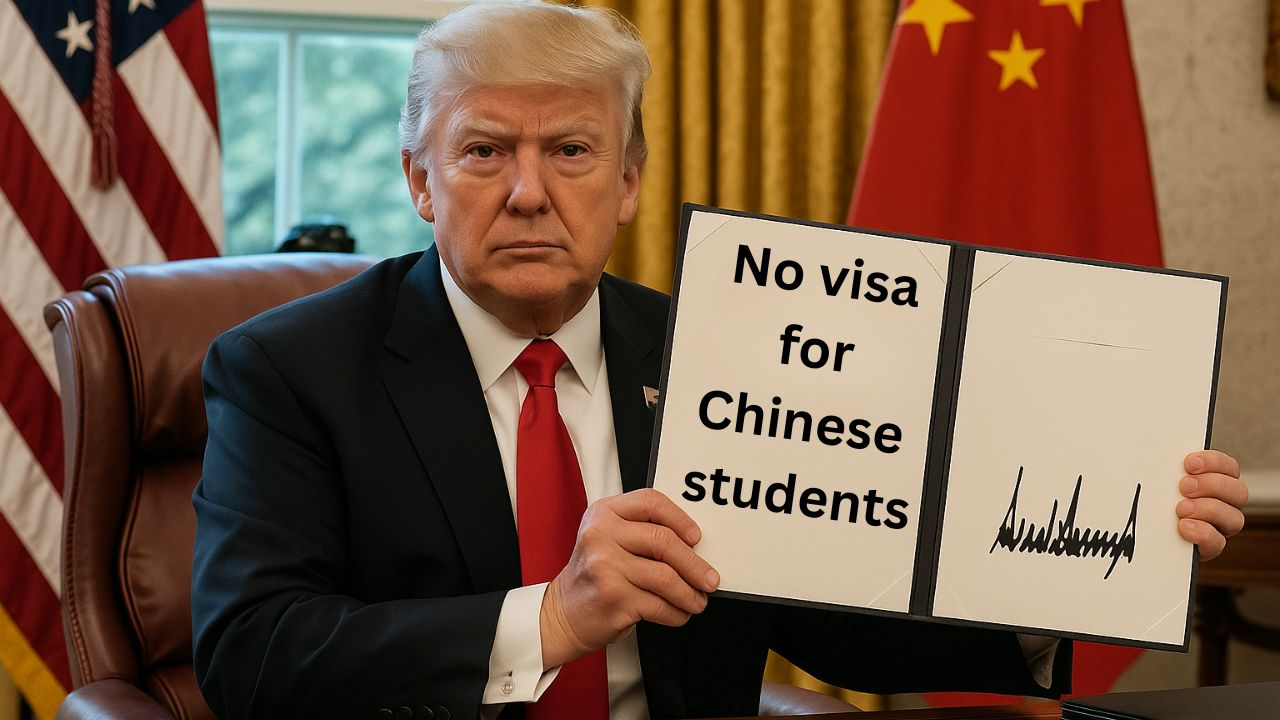
US Government Moves to Revoke Visas of Chinese Students: A Deep Dive into Policy, Impact, and Global Reactions
In a significant and controversial policy shift, the United States government has initiated a new visa revocation strategy targeting Chinese students. This includes individuals associated with critical scientific and technological fields as well as those believed to have ties to the Chinese Communist Party (CCP). This move, while not entirely unprecedented, marks a dramatic escalation in tensions between the two global powers and is expected to have far-reaching implications for international education, global innovation, and diplomatic relations.
Introduction: The U.S.-China Education Nexus
The relationship between the United States and China in the domain of education has long been intricate and mutually beneficial. For decades, Chinese students have flocked to American universities, often dominating the international student population. According to the Institute of International Education (IIE), more than 290,000 Chinese students were enrolled in U.S. institutions in 2023, contributing billions of dollars to the American economy annually.
However, growing concerns over national security, intellectual property theft, and espionage have led U.S. officials to reconsider the open-door approach. This latest decision to revoke visas signals a tightening of educational and scientific exchanges, which could reshape the academic landscape.
The New Visa Policy: What We Know So Far
According to senior officials within the U.S. Department of State and Homeland Security, the new visa policy is aimed at:
- Students studying in critical fields such as artificial intelligence, quantum computing, semiconductors, aerospace, and other areas deemed vital to national security.
- Individuals who are current or past members of, or affiliated with, the Chinese Communist Party (CCP).
- Students attending or having previously studied at universities with alleged military ties in China.
The implementation of this policy involves the revocation of active F-1 (student) and J-1 (exchange visitor) visas, as well as heightened scrutiny during the application process for new visas.
Timing and Implementation
The policy is being rolled out in phases:
- Phase 1 (Ongoing): Revocation of existing visas identified through intelligence and academic records.
- Phase 2 (Planned): New visa application rejections based on stricter vetting protocols.
- Phase 3 (Future consideration): Possible restrictions on post-graduation work through the Optional Practical Training (OPT) program.
The Rationale: National Security vs. Academic Freedom
The U.S. government has defended this policy on the grounds of national security. According to official statements:
“We are taking necessary measures to prevent intellectual property theft and technological espionage that compromise U.S. sovereignty and security.”
Agencies such as the FBI and the Office of the Director of National Intelligence (ODNI) have issued multiple reports over the past decade pointing to alleged efforts by Chinese nationals to steal research data, particularly from labs and research centers tied to national defense.
However, civil rights organizations and higher education institutions have raised alarms over the erosion of academic freedom, arguing that such blanket policies may fuel racial profiling, stoke xenophobia, and harm America’s image as a destination for global talent.
Impact on Chinese Students and Scholars
The consequences of this move are profound and personal for thousands of Chinese students.
1. Academic Disruption
Many Chinese nationals currently enrolled in graduate programs, especially PhD students, are being told they must leave the U.S. within weeks. Research projects have been stalled, degrees remain incomplete, and dreams of academic excellence have been upended.
2. Psychological Impact
The uncertainty has caused anxiety and distress among students, many of whom have invested years and substantial financial resources into their education. There are reports of canceled internships, frozen scholarships, and job offers being rescinded.
3. A “Brain Drain” Reversal?
The U.S. risks losing some of the best scientific minds to rival nations. Countries like Canada, the UK, and Australia are already offering fast-track visas and incentives to attract displaced Chinese scholars.
Reactions from U.S. Universities
Universities across the United States have expressed concern, if not outright opposition.
Statements from Institutions
- Harvard University: “We urge policymakers to balance security with openness. Academia thrives on diversity and global collaboration.”
- University of California System: “Excluding students based on nationality or political suspicion undermines the foundation of academic freedom.”
- MIT: “The visa revocations have jeopardized ongoing research projects and could deter future collaborations.”
Financial Repercussions
Chinese students contribute over $10 billion annually to U.S. educational institutions through tuition and living expenses. A sharp drop in enrollments could lead to funding shortfalls, layoffs, and reduced global prestige.
China’s Response
Unsurprisingly, the Chinese government has denounced the move as political discrimination and academic suppression.
Official Statement from the Ministry of Foreign Affairs:
“The U.S. has once again weaponized visas as a geopolitical tool. This action is irrational, discriminatory, and will hurt bilateral relations.”
China is reportedly preparing retaliatory measures:
- Imposing restrictions on American scholars and students in China.
- Cutting off certain university-level collaborations.
- Increasing scholarships and incentives to encourage returnees to contribute to Chinese research.
Broader Geopolitical Implications
1. Education as a Battlefield
Education has emerged as a new front in the US-China geopolitical rivalry. From 5G and AI to pharmaceuticals and semiconductors, the war for technological dominance is now being waged in classrooms and research labs.
2. Global Academic Cold War?
The U.S. is not alone. Other Western democracies are also reassessing their educational partnerships with China. The visa revocation policy may encourage a broader “academic decoupling,” with Chinese students being pushed towards Chinese or third-country universities.
3. Future of Scientific Collaboration
International research efforts such as those related to climate change, pandemic response, and space exploration may suffer due to reduced information exchange and mutual distrust.
Voices of the Affected: Real Stories
Li Ming, PhD Candidate, Electrical Engineering – Stanford University
“I’ve been working on semiconductor nanofabrication for four years. Now, I’m being told I have to leave the country in 30 days. I’ve published three papers and never had political affiliations. How is this fair?”
Dr. Ellen Brooks, Research Supervisor
“Two of my best researchers were Chinese nationals. Their departure has created a vacuum in our lab, and our grant project timelines are now at risk.”
Policy Analysis: Is the Visa Revocation Justified?
Pros:
- Prevents intellectual property theft in sensitive industries.
- Enhances national security vigilance in light of real threats.
- Sends a political message to China over espionage concerns.
Cons:
- Risks alienating top global talent.
- Encourages racial profiling and undermines inclusivity.
- Could damage U.S. universities’ global reputation.
Most policy experts agree that national security is paramount, but emphasize the need for a nuanced, evidence-based approach that targets individuals rather than entire communities or academic disciplines.
International Reactions
United Kingdom
UK universities, many of which have seen a rise in Chinese student applications, have offered transfer pathways for affected students.
Canada
Canada has criticized the U.S. approach as “overbroad,” but is reviewing its own visa guidelines with respect to critical fields and national security.
Australia and Germany
These countries have called for more global coordination and intelligence sharing, rather than unilateral bans.
Way Forward: Can the Damage Be Repaired?
Diplomatic Channels Must Stay Open
Both Washington and Beijing must prioritize diplomatic dialogue to ensure that academic and cultural bridges are not permanently burned.
Need for a Balanced Approach
It is possible to safeguard security without sacrificing openness. Visa decisions can be more transparent, appealable, and individualized.
Protect Academic Integrity
Universities should create stronger protocols for research integrity, background checks, and funding transparency without stifling international participation.
Conclusion: The Cost of Safety or the Price of Paranoia?
The revocation of Chinese student visas by the U.S. government is a watershed moment in the ongoing recalibration of U.S.-China relations. While the move may be rooted in valid security concerns, its sweeping application risks undermining the very principles that make American academia the gold standard globally—openness, meritocracy, and inclusiveness.
As the world watches, policymakers must tread carefully, ensuring that in the pursuit of national interest, they do not erode the global trust and cooperation so vital to innovation, education, and peace.


https://shorturl.fm/YvSxU