
India Clarifies: Tariff Issues Not Discussed in US-Brokered Ceasefire Talks with Pakistan
In a significant diplomatic statement on May 29, 2025, the Indian government categorically denied any discussions on trade tariffs as part of the ceasefire dialogue held with Pakistan this month in the presence of US mediators. This clarification comes amid widespread speculation and media reports suggesting that economic cooperation, including tariff relaxations and trade routes, may have been discussed as a prelude to peace-building between the two nuclear-armed neighbors.
This blog provides an in-depth exploration of the official statement, the background of the ceasefire talks, India’s position, Pakistan’s role, and the United States’ strategic involvement, along with expert reactions, potential implications, and a historical context of Indo-Pak peace dialogues.
Background: The Ceasefire Talks of May 2025
The latest round of ceasefire discussions between India and Pakistan took place earlier this month, facilitated quietly by US diplomats. This round is part of a broader series of informal engagements that began in late 2023, aimed at de-escalating tensions along the Line of Control (LoC) and promoting stability in South Asia.
Although the ceasefire agreement between India and Pakistan, originally reaffirmed in February 2021, had largely held, 2024 witnessed sporadic violations and an increase in cross-border rhetoric. This prompted Washington to reinitiate quiet diplomacy, urging both sides to return to confidence-building measures (CBMs).
The meetings in question were reportedly held in Oman, a preferred neutral location for backchannel diplomacy.
India’s Official Statement: Tariffs Not on the Table
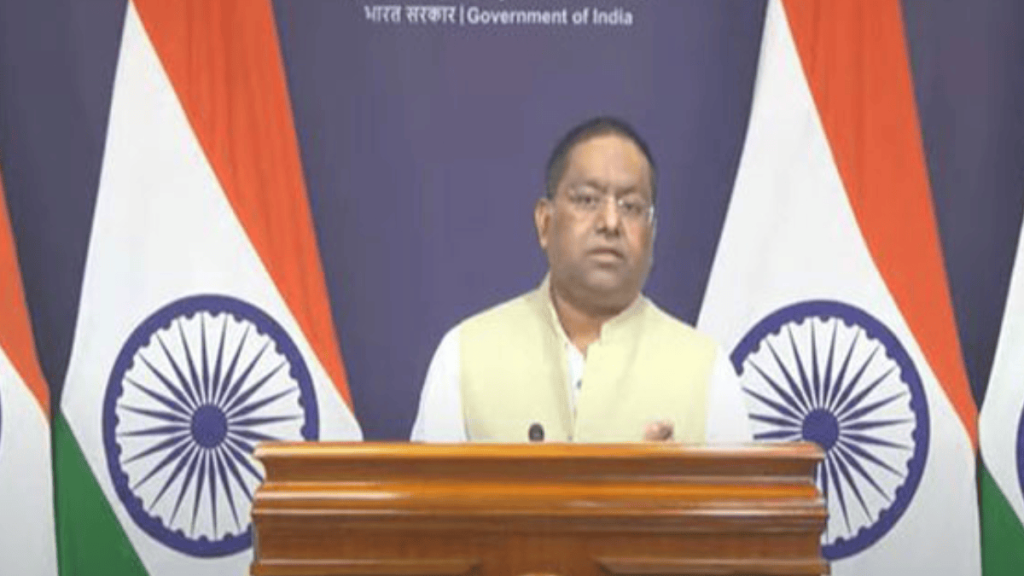
On May 29, 2025, India’s Ministry of External Affairs (MEA) issued a formal response to several media outlets that claimed India and Pakistan had discussed trade tariffs and cross-border commerce as part of ceasefire negotiations.
The Statement:
“Let us be unequivocally clear — the issue of trade tariffs was not part of the discussions held with Pakistan during the recent ceasefire talks. These talks were strictly limited to military de-escalation, prevention of cross-border incidents, and humanitarian confidence-building measures.”
This was further reiterated by the External Affairs Minister during a press briefing, emphasizing that India’s core focus remains security, sovereignty, and peace stability — not trade normalization — in any engagement with Pakistan.

Decoding the Tariff Speculation
The speculation stemmed from a report published in a leading international newspaper, suggesting that economic incentives, such as the opening of specific trade routes (like Wagah-Attari and the Srinagar-Muzaffarabad corridor), and reduction in bilateral tariffs were explored as “economic sweeteners” to cement the ceasefire deal.
This was quickly picked up by Pakistani media, with some outlets portraying it as a diplomatic win and a sign of India’s softening stance. However, India’s denial aims to correct the narrative and reassert its red lines.
Why Is the Tariff Issue So Sensitive?
1. Historical Tensions Over Trade
India and Pakistan have a long, complicated trade history. While there have been moments of positive engagement (such as the MFN — Most Favoured Nation — discussions in the early 2000s), geopolitical events like the Kargil War, 2008 Mumbai attacks, and the Pulwama-Balakot escalation have derailed all major trade normalization efforts.
India revoked Pakistan’s MFN status in 2019 following the Pulwama terror attack. Since then, trade has remained minimal, limited to a few commodities through indirect routes like the UAE.
2. Domestic Political Sensitivities
Trade and tariff discussions with Pakistan can be politically explosive in India. Any indication that New Delhi is offering economic concessions to Islamabad — particularly without major concessions on terrorism or infiltration — can spark domestic backlash.
What Was Actually Discussed in the Ceasefire Talks?
Based on official briefings and diplomatic sources:
1. Recommitment to 2003 Ceasefire Agreement
Both sides reaffirmed their commitment to uphold the 2003 LoC Ceasefire Agreement, originally reaffirmed in 2021.
2. Hotline Communication Protocols
Improvements to cross-border military hotline mechanisms were discussed to avoid misunderstandings and facilitate rapid communication during potential escalations.
3. Prisoner and Civilian Exchanges
Humanitarian issues, such as the release of fishermen and civilians inadvertently crossing the border, were also on the agenda.
4. No Mention of Trade or Tariffs
There was no conversation on trade, tariff relaxation, or border trade corridors, according to Indian officials.
US Role: Facilitator, Not Enforcer
Why the US is Involved
The United States has long sought stability in South Asia, primarily due to:
- Concerns about nuclear conflict.
- Need for stability to counter Chinese influence.
- Protecting American investments and interests in the Indo-Pacific region.
The Biden administration and its successor have quietly worked to encourage dialogue between India and Pakistan without imposing any mediation, which India opposes.
India’s Red Line on Third-Party Mediation
India has consistently maintained that all issues with Pakistan are bilateral, based on the Shimla Agreement (1972) and Lahore Declaration (1999). The presence of the US in these talks is therefore described as “facilitative,” not mediatory.
Pakistan’s Position: Contrasting Narratives
Unlike India’s consistent line, Pakistan’s narrative post-talks has been more fluid:
- Initial reports from Islamabad claimed a “breakthrough in discussions on trade corridors.”
- However, Pakistani Foreign Office later toned down this claim, stating that “economic normalization remains our goal, but no concrete offers were exchanged.”
This points to internal divisions within Pakistan’s civil-military establishment and possibly a desire to use the talks for domestic political optics.
Strategic Analysts Weigh In
1. Prof. C. Raja Mohan (Foreign Policy Expert)
“This is a classic case of misinformation breeding diplomatic mistrust. India is right to clarify its position — the ceasefire framework must first hold before any broader engagement.”
2. Lisa Curtis (Former US National Security Council)
“The US wants peace but understands India’s sensitivities. These talks are about laying the groundwork, not rushing into trade or territorial negotiations.”
Implications for the Region
1. Positive: Stability Signals
Despite disagreements on trade, the reaffirmation of ceasefire commitments is a net positive, reducing immediate risks of escalation along the LoC.
2. Negative: Trade Hopes Diminished
Those hoping for a revival of cross-border trade or regional connectivity will be disappointed. India’s clarity means no such initiatives are imminent.
3. Watch for Election Impact
With both India and Pakistan approaching election cycles, political narratives will shape future engagements. India’s current stance could harden if security incidents increase.
The Larger Diplomatic Chessboard
The India-Pakistan-US equation cannot be viewed in isolation.
China Factor
Both India and the US share concerns over China’s rising regional influence. Stability with Pakistan allows India to focus resources on the LAC and Indo-Pacific strategy.
Gulf Cooperation
Countries like UAE and Saudi Arabia have also been encouraging Indo-Pak dialogue, seeing regional peace as crucial to energy corridors and investment opportunities.
Historical Lens: Past Peace Efforts and Economic Dialogues
- 1999 Lahore Declaration: First post-nuclear test dialogue that also discussed people-to-people contact and trade.
- 2004 Composite Dialogue Process: Included economic normalization talks and saw trade increase temporarily.
- 2011-12 Commerce Talks: Proposals to open Wagah and Khokhrapar-Munabao trade routes were made, but 26/11 and LoC tensions froze progress.
In all these efforts, peace precedents trade — and history shows that without trust, economic deals fail.
Conclusion: A Clear Message from New Delhi
The Indian government’s statement on May 29, 2025, sends a strong and unequivocal message to both domestic and international observers: national security and border stability remain top priorities. Trade talks or tariff discussions cannot precede genuine peace and accountability.
While diplomatic engagement is welcome, India is drawing clear boundaries on what is and isn’t on the negotiating table — and trade concessions to Pakistan are not part of the current dialogue framework.
For any progress to occur, there must be verifiable commitment from Pakistan on counter-terrorism, reduction in infiltration, and restoration of mutual trust. Only then can the two neighbors truly consider reviving economic ties — a step still far on the horizon.


https://shorturl.fm/j3kEj
https://shorturl.fm/fSv4z