
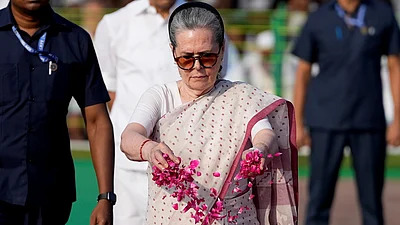
Remembering Pandit Jawaharlal Nehru: Sonia Gandhi Leads Floral Tributes on His 61st Death Anniversary at Shanti Van
Introduction
Jawaharlal Nehru On May 27, 2025, India marked the 61st death anniversary of Pandit Jawaharlal Nehru, the country’s first Prime Minister and one of the principal architects of modern India. Congress Parliamentary Party Chairperson Sonia Gandhi, along with several top Congress leaders, paid floral tributes at his memorial Shanti Van in Delhi. The solemn ceremony was a reminder of Nehru’s towering legacy and enduring influence on Indian democracy, secularism, and governance.
This blog offers an in-depth view of the memorial event, Nehru’s immense contribution to India, how leaders across the political spectrum responded, and why Nehru’s legacy still remains relevant in the 21st century.
A Morning of Reverence at Shanti Van
Shanti Van, situated on the banks of the Yamuna River in Delhi, is the resting place of Pandit Jawaharlal Nehru. Every year on May 27th, leaders, historians, and citizens gather here to pay homage Jawaharlal Nehru.
This year’s tribute was led by Sonia Gandhi, who placed a wreath and offered flowers at the memorial in a solemn gesture of respect. Dressed in white, the color of peace and mourning, Sonia Gandhi stood in silence, deeply immersed in the emotional gravity of the moment. A video capturing the tribute has gone viral on social media, symbolizing the nation’s continued reverence for its first Prime Minister.
Other senior Congress leaders, including Mallikarjun Kharge, Rahul Gandhi, Priyanka Gandhi Vadra, and Jairam Ramesh, also attended the event.
Nehru’s Legacy in Indian Politics
1. The Architect of Modern India
Jawaharlal Nehru is widely regarded as the architect of modern India. As the first Prime Minister of independent India (1947–1964), his vision helped lay the foundation of a secular, socialist, and democratic republic. He emphasized:
- Scientific progress
- Industrialization
- Education reform
- Parliamentary democracy
- Non-alignment in foreign policy
2. Champion of Secularism and Democracy
Jawaharlal Nehru At a time when communal tensions threatened the very fabric of newly-independent India, Nehru’s unwavering commitment to secularism and democracy held the nation together.
His vision of India was inclusive and forward-thinking. He believed in unity in diversity and never shied away from challenging orthodoxy, casteism, and religious fanaticism Jawaharlal Nehru.
3. Advocate of Scientific Temper and Rationalism
Nehru strongly advocated for the cultivation of scientific temper among Indians. His efforts led to the establishment of:
- IITs and AIIMS
- ISRO’s precursor organizations
- Scientific institutions like CSIR, DRDO
India’s space and tech ecosystem today owe much to Nehru’s farsightedness.
Congress Leaders Pay Tribute
Sonia Gandhi’s Silent Message
Though Sonia Gandhi made no public statement during the ceremony, her presence itself was symbolic. As the longest-serving Congress president and the torchbearer of the Nehru-Gandhi political lineage, her tribute reflected continuity and commitment to Nehruvian ideals.
Mallikarjun Kharge’s Message
Congress President Mallikarjun Kharge, in a heartfelt post on X (formerly Twitter), wrote:
“Humble tributes on the death anniversary of Pandit Jawaharlal Nehru ji, the creator of modern India, the fearless guardian of democracy… 21st century India cannot be imagined without the contribution of Pandit Jawaharlal Nehru.”
Kharge’s statement served as a reminder that Nehru’s foundational role in shaping India’s democratic institutions remains unmatched.
Rahul and Priyanka Gandhi
Both Rahul Gandhi and Priyanka Gandhi Vadra have often referenced Nehru in their speeches as a guiding light. While Rahul emphasizes Nehru’s role in protecting democracy and dissent, Priyanka has echoed his ideals of equality and justice.
The Significance of the Death Anniversary in 2025
Political Symbolism
The 2025 anniversary comes at a time of intense political churn in India. With general elections recently concluded, the Congress party is in a phase of introspection and restructuring. Reasserting Nehruvian values amid rising polarization serves not just as a tribute but also as a political message.
Revisiting Foundational Values
As India grapples with debates around secularism, history, and freedom of expression, remembering Nehru becomes all the more significant. His belief in pluralism and institutional democracy serves as an antidote to authoritarian tendencies.
What the Congress Party Said
The official Congress party handle posted:
“On his death anniversary, we honour the nation’s first Prime Minister, Pt. Jawaharlal Nehru, whose vision shaped modern India. His ideals of democracy, secularism & scientific temper continue to guide our way forward.”
This message, while commemorative, was also a subtle nudge to the present political establishment, urging a return to constitutional principles.
A Look Back: Nehru’s Life and Legacy
Early Life and Education
Born on November 14, 1889, in Allahabad, Jawaharlal Nehru was educated at Harrow and Cambridge. He was trained as a barrister in London but returned to India, deeply influenced by Mahatma Gandhi’s call for civil disobedience.
Role in Freedom Movement
Nehru played a central role in the Indian National Congress and the freedom struggle. He was imprisoned numerous times by the British and became a symbol of the younger generation’s aspirations.
Prime Ministership: 1947–1964
Nehru served as the Prime Minister for 17 years — the longest in Indian history. Some of his most enduring contributions include:
- Launching the Five-Year Plans
- Establishing secular education institutions
- Creating the Planning Commission
- Building India’s foreign policy of Non-Alignment
The Relevance of Nehru in Today’s India
Nehru and the Idea of India
Nehru’s vision wasn’t just about governance; it was about nation-building. His concept of India was inclusive — where a Hindu, Muslim, Sikh, and Christian could live as equals. That vision is central to India’s unity today.
Critics and Misconceptions
Over the years, Nehru has been a subject of political criticism. Some blame him for:
- India’s stance in the Kashmir conflict
- The 1962 war with China
- Centralized economic planning
However, historians argue that many of these challenges were part of a larger post-colonial struggle and do not take away from his monumental achievements.
Media and Public Reactions
The event at Shanti Van was covered by major Indian media outlets such as NDTV, India Today, and The Hindu. Videos and photos were widely shared on X, Instagram, and Facebook.
Trending hashtags included:
- #NehruJayanti
- #SoniaGandhi
- #ShantiVan
- #RememberingNehru
Public responses were largely respectful, with many users sharing Nehru’s iconic quotes and images of India during his tenure.
Nehru in Popular Culture
From history textbooks to Bollywood films, Nehru remains a central figure in Indian consciousness. His “Tryst with Destiny” speech delivered on August 15, 1947, remains one of the most powerful orations in Indian history.
Many schools across the country observed his death anniversary by organizing essay competitions, quizzes, and exhibitions on Nehru’s life.
His Enduring Quotes
Some of Nehru’s timeless quotes include:
- “Facts are facts and will not disappear on account of your likes.”
- “The only alternative to coexistence is codestruction.”
- “Democracy is good. I say this because other systems are worse.”
These quotes continue to be relevant in a world struggling with misinformation, authoritarianism, and division.
Nehru’s Legacy Today
In Education
His vision led to the creation of top institutions like:
- Indian Institutes of Technology (IITs)
- Indian Institutes of Management (IIMs)
- University Grants Commission (UGC)
In Foreign Policy
Nehru laid the foundation of Non-Alignment, which India still references in its foreign policy dialogues today.
In Democratic Institutions
Parliament, Election Commission, and the Judiciary — all strengthened under Nehru’s leadership — continue to uphold democracy in India.
Final Thoughts
Sonia Gandhi’s floral tribute at Shanti Van was more than a ceremonial act. It was a reaffirmation of values that continue to shape India’s identity. As India moves forward, the legacy of Pandit Jawaharlal Nehru will remain etched in its constitution, its democratic spirit, and its commitment to unity in diversity.


https://shorturl.fm/FIJkD
https://shorturl.fm/A5ni8
https://shorturl.fm/YvSxU
https://shorturl.fm/oYjg5