
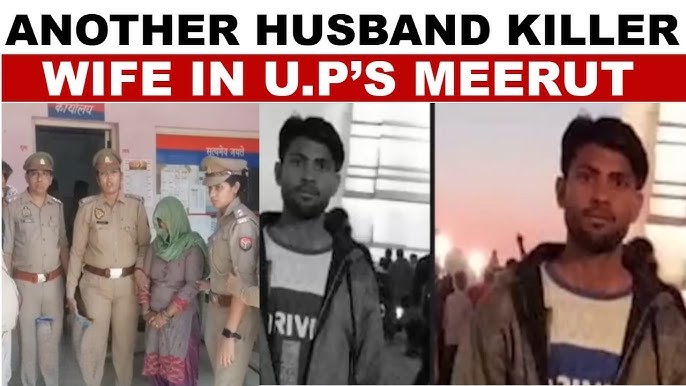
The Snakebite Deception: How a Post-Mortem Unraveled a Chilling Murder in Meerut
Introduction
In what initially appeared to be a tragic rural accident in Meerut, Uttar Pradesh, a young man’s sudden death was attributed to a fatal snakebite. His family mourned, neighbors whispered about the cruelty of fate, and the local police closed the case with routine paperwork.
But fate had little to do with it.
What followed was a forensic breakthrough, an investigation full of dark revelations, and a chilling confession that sent shivers down the spine of an entire community. This was no accident—this was cold-blooded murder disguised with the help of a snake.
The Scene of the Crime: A Quiet Night in Akbarpur Sadat
April 14, 2025. In the quiet lanes of Akbarpur Sadat village, 25-year-old Amit’s body was found lying motionless on a wooden cot. A venomous snake was spotted nearby, slithering in the corner of the room. Villagers and local officials assumed the worst—a snakebite, common in many rural parts of India.
His wife, Ravita, mourned publicly, tearfully explaining that he had screamed in the night, and by the time she woke up, he was already unconscious. She even helped point to what looked like bite marks on his feet. A video shot by a neighbor circulated online, showing the supposedly venomous snake, further reinforcing the narrative.
It was open-and-shut. Or so it seemed.
The Turning Point: A Post-Mortem That Shattered the Lie
When Amit’s body was taken for post-mortem at the district hospital, doctors were surprised. Something didn’t add up.
- There was no venom in his bloodstream.
- The supposed “bite marks” lacked depth or venom delivery.
- Most critically: his neck bore signs of ligature strangulation.
Within 48 hours, the autopsy revealed the chilling truth: Amit was strangled to death. The snakebite story was nothing more than a meticulously crafted smokescreen.
The Plot Exposed: Love, Lies, and a ₹1,000 Snake
As suspicion grew, police began their investigation from scratch. Interviews with neighbors unearthed rumors of an affair between Ravita and a man named Amardeep, a mason from a nearby village.
- Call records revealed frequent late-night conversations.
- Amardeep was seen near Amit’s house days before his death.
- Villagers noted growing tension between Amit and Ravita in recent weeks.
When questioned, the lovers broke under pressure.
They confessed:
- They had been in a secret relationship for over a year.
- Amit had discovered WhatsApp chats between them.
- Ravita and Amardeep decided to eliminate Amit.
Amardeep strangled Amit while he slept. To cover their tracks, they paid ₹1,000 to a snake charmer to bring a venomous snake. The plan was to plant it at the scene and let nature—or at least the illusion of it—take the blame.
Snake as a Murder Weapon: Not the First Time
While this may sound like a tale straight out of crime fiction, it’s not unprecedented.
In 2020, in Kerala, a woman named Uthra was killed by her husband who released a cobra into her bed after failing with a viper earlier. That case too relied on medical forensics to uncover the truth.
The Meerut case joins a disturbing pattern of people using exotic or venomous creatures to commit what they believe are “undetectable” crimes. But thanks to advances in toxicology, forensic pathology, and digital footprints, such crimes rarely stay hidden.
Psychology of the Crime: Betrayal from Within
This case is not just about a murder—it’s about betrayal, deception, and manipulation.
Amit’s death wasn’t just a loss; it was the ultimate betrayal by the person he trusted most—his wife. Psychologists studying domestic crimes often highlight these patterns:
- Illicit affairs are one of the top motives in domestic homicides.
- In many such cases, spouses conspire with lovers due to emotional dependence or social stigma attached to divorce.
- The desire to “erase” the obstacle—often the legal partner—becomes a twisted rationalization.
Ravita and Amardeep chose murder over truth. And they tried to hide it behind nature’s unpredictability—a snake.
The Community Reacts: Fear, Anger, and Introspection
The people of Akbarpur Sadat were horrified.
“We thought it was a snakebite. Everyone was saying ‘these things happen in villages.’ But what happened here is worse than anything we’ve seen,” said Ram Singh, an elderly villager.
Families began questioning relationships, husbands looked suspiciously at their wives, and a sense of distrust spread through the village.
Local women’s groups condemned the act, calling it a black stain on womanhood, while others pointed out that domestic issues should not be punished with death.
Legal Developments: Arrests and Charges
After their confession, both Ravita and Amardeep were arrested under:
- IPC Section 302 – Murder
- IPC Section 120B – Criminal conspiracy
- IPC Section 201 – Destruction of evidence
The court has ordered judicial custody, and the trial is expected to begin within a month. Police are also investigating the snake charmer who supplied the snake to see if he was aware of the intent.
Forensic Importance: The Real Hero
This case, like many modern-day investigations, underscores the growing role of forensic science in ensuring justice.
Without the post-mortem:
- The body would have been cremated quickly.
- The murder would have been passed off as an unfortunate accident.
- Two killers would be walking free today.
In the courtroom, the medical examiner’s report will be the strongest piece of evidence, backed by digital call logs and the confessions.
Media and Public Discourse
As the news broke, the case went viral across India. Twitter hashtags like #SnakeMurder and #MeerutCase began trending. National TV channels ran primetime debates on:
- The rise in domestic crimes disguised as accidents
- Access to venomous animals in rural India
- The need for psychological counseling and relationship education
Many viewers compared this with the infamous Kerala snake murder case, asking whether such crimes are a sign of deeper societal rot.
Lessons and Reflections
- Murder is Never a Solution: If relationships break down, the legal route—divorce, separation, counseling—is always better than crime.
- Post-Mortem is Essential: In rural India, many deaths are buried without investigation. This case proves that even “natural-looking” deaths need verification.
- Community Awareness: Villagers and neighbors should remain aware of domestic tensions and report anything suspicious. In many cases, social silence enables crime.
- Law Enforcement Training: Police stations in remote areas need better training in forensic preservation, first response protocols, and evidence handling.
The Fate of the Snake
Interestingly, the snake used in the murder was captured alive. Forest officials released it into a reserve forest after confirming it wasn’t harmed. Though it played a role in a human crime, the snake—unlike the humans—was innocent.
Final Thoughts: Justice for Amit
Amit’s death was painful, not just because he was murdered, but because he was betrayed by those he loved.
As the case now moves to court, the community and the country watch closely. This isn’t just a crime story—it’s a cautionary tale about how lies, if unchecked, can take lives.
We can only hope that justice—swift, fair, and firm—brings peace to Amit’s grieving family.
read more latest news

