
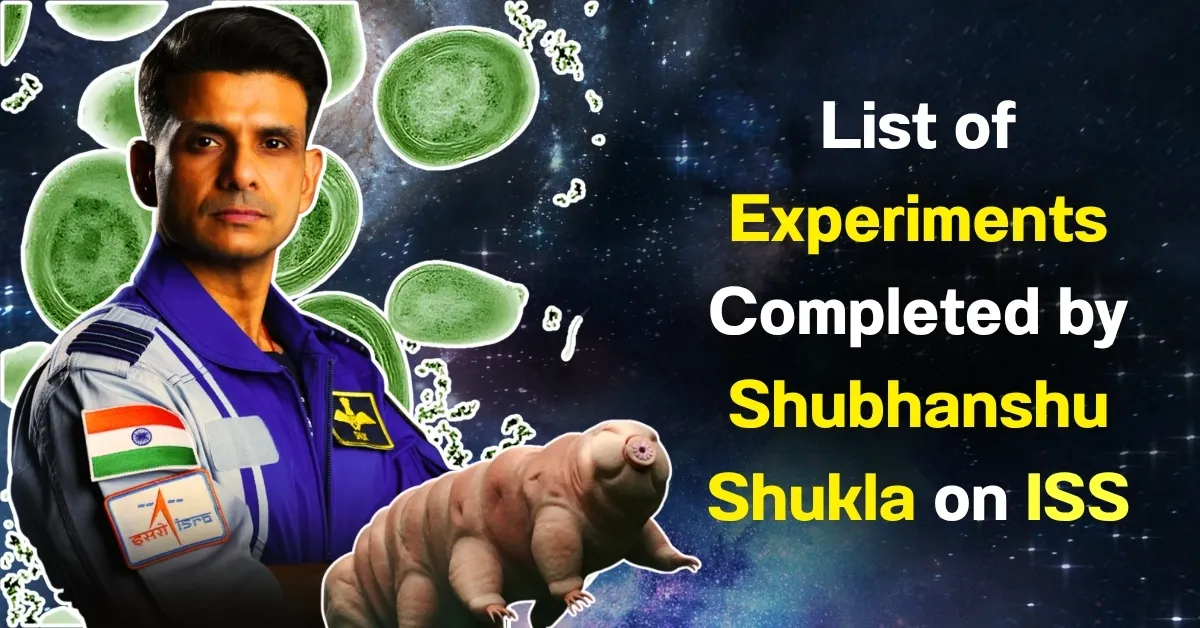
🚀 What Experiments Did Shubhanshu Shukla Conduct in 18 Days at the ISS?
Table of Contents
- Mission Background: Why This Assignment Matters
- Introducing the Seven ISRO‑Led Experiments
- Daily Mission Flow & Experiment Execution
- Early Findings & Preliminary Observations
- Scientific Significance & Earth Applications
- Role in India’s Gaganyaan & Future Space Strategy
- Shukla’s Reflections: Quotes & Outreach
- Next Steps: Post‑flight Analysis & Legacy
- Conclusion
1. Mission Background: Why This Assignment Matters
What experiments did Shubhanshu Shukla do in 18 days at the International Space Station? On June 25, 2025, Group Captain Shubhanshu Shukla—call‑sign “Shux”—launched aboard the SpaceX Dragon “Grace” as part of the Axiom Mission 4 (Ax‑4), becoming the first Indian astronaut to live and work on the ISS and India’s second person in space after Rakesh Sharma in 1984.
While many of the mission’s roughly 60 experiments were from various global partners, seven were Indian‑designed and sponsored by ISRO in collaboration with national academic institutions. Over an extended stay—18 days instead of the planned 14 to accommodate the scientific agenda—Shukla completed all seven research tasks spanning muscle physiology, crop science, microbiology, cognitive science, and human health metrics.
ISRO invested approximately ₹550 crore (~ $65 million) in this mission, including training, logistics, experiments, and counselling—all seen as valuable groundwork for India’s Gaganyaan human flight program aimed at 2027.
2. Introducing the Seven ISRO‑Led Experiments
Here’s a deep dive into each of the focal experiments:
1. Myogenesis (Muscle Regeneration Study)
- Lead: InStem (Bangalore)
- Objective: Understand muscle‑cell damage & regeneration in microgravity; test metabolite supplements for therapeutic use.
- Why It Matters: Astronauts lose up to 20% muscle mass on long missions. Insights could guide countermeasures in space and treatments for sarcopenia/immobility on Earth.
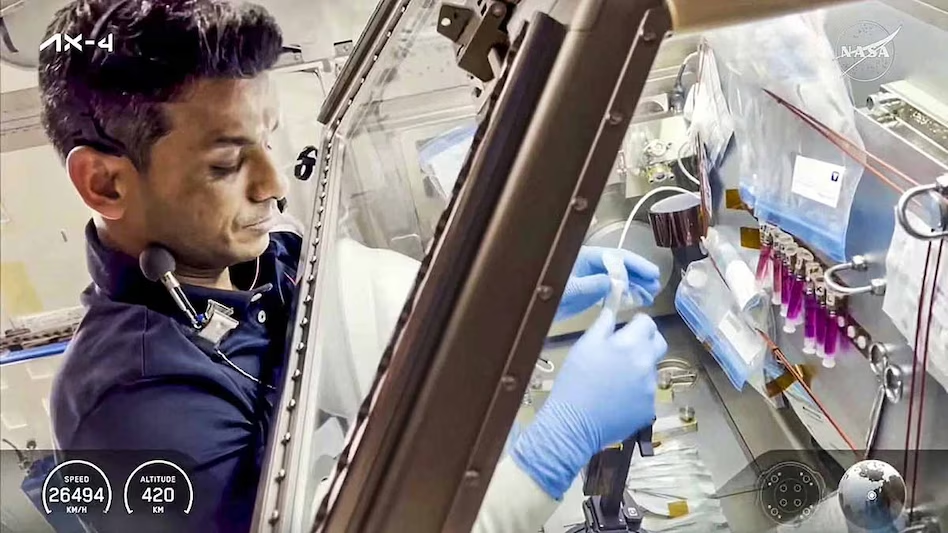
2. Crop Seed Sprouting (Methi & Moong) + Multi‑generational Study
- Lead: University of Agricultural Sciences (Dharwad), IIT Dharwad, IIST & KAU
- Objective: Examine germination/growth of six crop seed types—including methi and moong—under microgravity; track genetics, nutrition, and microbial changes subsequent generations.
- Why It Matters: Growing food in space is essential for long‑duration missions and extraterrestrial colonies.
3. Voyager Tardigrades (Micro‑Animal Resilience)
- Lead: IISc Bangalore
- Objective: Test viability, revival, reproduction, gene expression of water‑bears (Paramacrobiotus sp.) in low-gravity; explore survival mechanisms under cosmic stress.
- Why It Matters: Tardigrades’ toughness could lead to biotech applications for stress tolerance and radiation protection.
4. Space Microalgae Experiment
- Lead: ICGEB & NIPGR (Delhi)
- Objective: Study growth, metabolism, and genetics of three microalgae strains in microgravity and radiation.
- Why It Matters: These algae could offer food, oxygen, biofuel sources, and life‑support systems for spacefarers.
5. Cyanobacteria in Microgravity
- Lead: ICGEB
- Objective: Compare growth and proteomic responses of two strains using urea/nitrate as nutrients over their behavior in microgravity.
- Why It Matters: Cyanobacteria are key components of life‑support ecosystems and may assist in resource recycling.
6. Voyager Displays (Screen‑Use Cognitive Study)
- Lead: IISc Bangalore
- Objective: Monitor physical & cognitive performance using electronic displays: ISO‑9241 pointing tasks, visual attention, stress, mental‑wellbeing—adaptation effects in orbit.
- Why It Matters: Crew interface design and mental‑health support for space travel and terrestrial remote‑working environments.
7. Bone Health & Radiation Monitoring
- Lead: Coordinated via ISRO/ISRO’s Human Space Flight Centre; international partners
- Objective: Track bone loss markers, cardiovascular and skeletal changes (Bone‑on‑ISS), and collect data via Rad‑Nano Dosimeter to assess radiation effects.
- Why It Matters: Bone density preservation is critical to astronaut health; radiation data helps build safeguards for long missions and can benefit Earthly radiation exposure scenarios.
3. Daily Mission Flow & Experiment Execution
Early Days (June 26–30)
- Docking occurred June 26; next day Shukla performed a live video call with PM Modi and ISRO chief, updating on progress.
- Initial tasks: myogenesis setup, algae deployment, tardigrade culture activation, sprouting trays preparation, Voyager Displays baseline tasks.
Mid‑Mission (July 1–7)
- Spore & Algae maintenance: sampling and refreezing; moong/methi petri‑dish imaging .
- Cognitive tests: multiple session of screen‑based tasks & VR experiments under NeuroMotion and ENPERCHAR studies.
- Bone and radiation: ultrasounds, saliva/tear sampling for radiation markers; data collection via Rad Nano Dosimeter.
- Wireless acoustic tests and telemetry recording.
Later Days (July 8–14)
- Continued sampling, secondary task runs, further algae and cyanobacteria data collection .
- Final cognitive and muscle‑cell assays; bone/dosimeter follow‑ups .
- All seven experiments completed successfully by July 14.
4. Early Findings & Preliminary Observations
While in‑depth analysis is pending post‑flight work, initial observations include:
- Completion of all seven ISRO‑led experiments—a rare full success in microgravity science.
- Muscle & bone studies showing anticipated atrophy markers—enabling individual health response profiling .
- Radiation monitoring helped map exposure in ISS zones, guiding future shielding design .
- Algae & cyanobacteria growth tracked successfully, setting stage for life‑support system research .
- Tardigrade resilience and transcript analysis groundwork laid .
- Display/cognitive tasks & VR showed changes in eye‑hand coordination and stress levels—critical for interface design .
Shukla was proactive in aiding mission ops and data acquisition while maintaining rock‑steady physical and mental fitness.
5. Scientific Significance & Earth Applications
🧬 Human Health & Therapeutics
Myogenesis and bone‑health data inform new approaches to counteract muscle and bone degradation—applicable in Earthly geriatric care, rehabilitation, and osteoporosis treatment.
🌾 Space Agriculture
Seed‑sprouting and microalgae work lays a foundation for closed‑loop life‑support systems—food, oxygen, and soil regeneration for lunar/Martian habitats.
🦠 Biotechnology from Extremophiles
Tardigrade gene insights may revolutionize bioengineering, offering radiation tolerance mechanisms useful in medicine, agriculture, and even industrial processes.
🧠 Cognitive & Interface Design
Voyager Displays and cognitive research feed into human‑computer interface design and stress resilience—relevant to remote work, VR ecosystems, and mission control systems.
☢️ Radiation Shielding
Dosimeter outputs improve space‑radiation models; bone‑monitor data shape personalized astronaut health tracking.
6. Role in Gaganyaan & Future Space Strategy
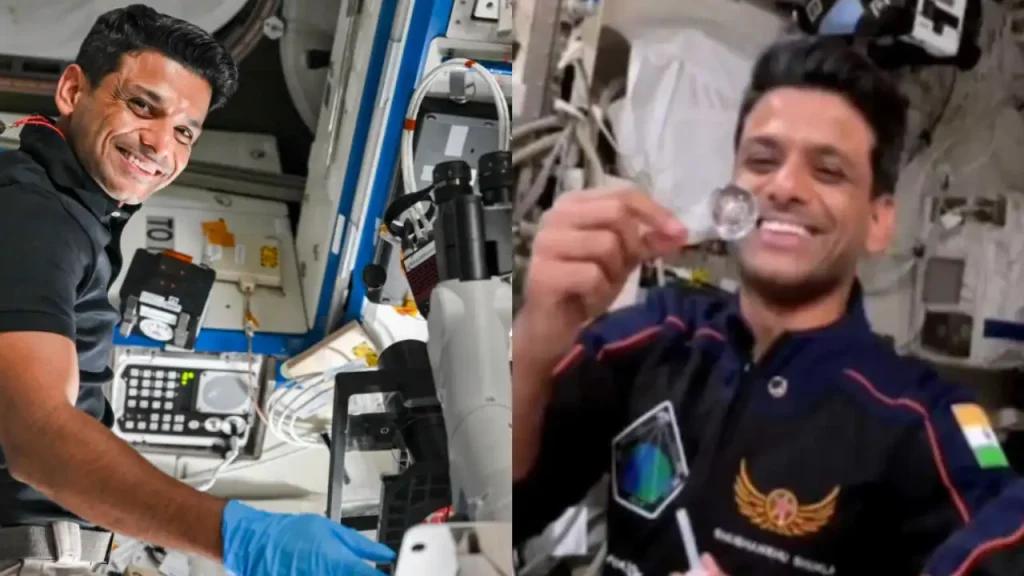
Ax‑4 is a technological and operational rehearsal for ISRO’s Gaganyaan mission: crew‑module design, ground coordination, medical protocols, psychological training, and international collaboration.
The seven experiments provide crucial proof‑points on:
- Biological responses to microgravity
- Sustainable food systems
- Interface usability
- Individual health monitoring
Shukla’s mission informs Gaganyaan’s astronaut selection, in‑flight countermeasures, habitat systems, and safety protocols, fast‑tracking India’s indigenous human spaceflight capacities.
7. Shukla’s Reflections: Quotes & Outreach
- On working for Indian researchers aboard ISS: “…It is exciting and a joy to do this… proud that ISRO has collaborated with national institutions around the country.”
- On experiment focus: “One particular research I am really excited about is stem cell research… studying the effect of space on muscles… cognitive effects… what impact this could have on heart and brain…”
- MVP‑level engagement with ground teams: He gave updates to ISRO chief and PM Modi, reinforcing pride and national unity.
Through live calls, ham‑radio chats, and educational sessions with students, Shukla became a science ambassador, bridging Earth and orbit.
8. Next Steps: Post‑flight Analysis & Legacy
✅ Recovery & Quarantine
Post‑splashdown (July 15), Shukla entered 7–10 days of quarantine and medical evaluation in Houston.
✅ Lab & Data Analysis
Back on Earth, biological samples will undergo genomics, proteomics, metabolomics, and phenotypic analysis across partner labs (InStem, IISc, ICGEB, NIPGR, UAS Dharwad, etc.).
✅ Publications & Peer‑Review
Expect academic papers in top-tier journals; data will refine models in microgravity physiology, agriculture, biotech, and interface design.
✅ Policy & Program Integration
ISRO and Gaganyaan will incorporate findings to refine crew training, life‑support systems, exercise equipment, screening protocols, and mission architecture.
✅ Public Outreach & Awards
Shukla is slated for national recognition—state ceremonies, technology fairs, student engagements, and possibly national honors.
9. Conclusion
Group Captain Shubhanshu Shukla’s 18-day scientific stay aboard the ISS was a landmark event for India—technologically, scientifically, and emotionally.
- Operational success: Full completion of all seven ISRO experiments
- Scientific brilliance: Breakthroughs in muscle health, space agriculture, microbial resilience, radiation tracking, and human‑machine interaction
- Inspirational value: A global symbol of India’s space prowess, collaboration, and youth empowerment
Read more latest news

