

Tejashwi Yadav’s Big Statement Ahead of Bihar Elections: Calls BJP Anti-Reservation, Questions Nitish Kumar’s 20-Year Rule, Says ‘Bihar ka Lal’ Will Lead This Time
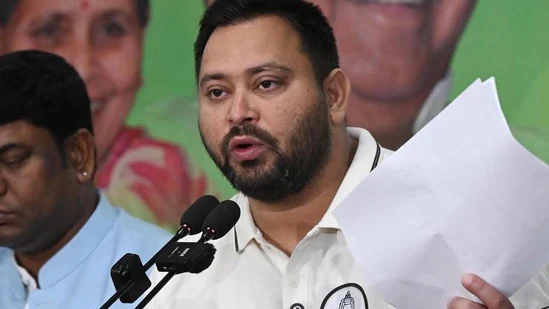
Tejashwi Yadav As Bihar gears up for another high-stakes Assembly election, political temperatures are soaring, alliances are shifting, and rhetoric is reaching a fever pitch. Among the most prominent voices in this politically charged atmosphere is that of Tejashwi Yadav, the young and ambitious leader of the Rashtriya Janata Dal (RJD). Speaking exclusively to Aaj Tak, Tejashwi Yadav launched a scathing attack on both the Bharatiya Janata Party (BJP) and Chief Minister Nitish Kumar, setting the tone for what promises to be one of the most closely watched state elections in India.
In his candid conversation, Tejashwi Yadav accused the BJP of being “anti-reservation,” slammed Nitish Kumar’s “20 years of failed governance,” and declared with confidence that this time, “Bihar ka Lal hi Bihar chalayega.” His message was not just political—it was deeply emotional, aimed at connecting with the grassroots of Bihar, which continues to battle poverty, unemployment, and migration even after two decades of Nitish Kumar’s rule.
1. The Setting: Bihar’s Charged Political Climate
Bihar’s elections have always been about identity, governance, and ideology. From the Mandal era to the Nitish-Modi partnership and now the shifting sands of the INDIA bloc versus NDA, Bihar remains a laboratory of Indian democracy.
As the 2025 Bihar Assembly elections approach, multiple issues dominate the political discourse—unemployment, inflation, the caste census, and the question of who truly represents Bihar’s voice. Against this backdrop, Tejashwi Yadav’s remarks on have added fresh energy to the campaign, especially among youth and backward communities.
The RJD leader’s assertion that the BJP is “anti-reservation” is not a new charge, but the timing and intensity make it potent. With reservation politics once again at the center due to debates over OBC representation and the implementation of caste census data, this narrative could significantly shape voter sentiment.
2. Tejashwi’s Attack on BJP: “They Are Anti-Reservation”
Tejashwi Yadav has always positioned himself as a protector of social justice and the legacy of his father, Lalu Prasad Yadav, who emerged as a champion of Mandal politics in the 1990s. In his interview, Tejashwi Yadav doubled down on this image, accusing the BJP of systematically working against the reservation system.
“The BJP says one thing and does another. They talk about the poor and backward, but their policies are anti-reservation. They want to end the constitutional rights given to OBCs, SCs, and STs,” Tejashwi Yadav said.
This statement comes in the wake of growing concerns among backward classes that the central government’s approach to the caste census and economic reservation for upper castes (EWS) is undermining traditional reservation principles. Tejashwi’s use of the phrase “anti-reservation” taps directly into the emotional and political consciousness of Bihar’s electorate, where caste identity remains a defining factor.
The BJP, of course, has strongly rejected such claims, arguing that it is the only party that has truly empowered OBCs through welfare schemes and representation. However, Tejashwi’s attack aims to revive the Mandal versus Kamandal debate that has historically defined Bihar’s political identity.
3. Questioning Nitish Kumar’s 20-Year Record
Tejashwi Yadav did not hold back when it came to Chief Minister Nitish Kumar, who has been a dominant figure in Bihar’s politics for two decades. The RJD leader accused Nitish of failing to deliver on his promises and questioned what he has achieved in his 20 years of governance.
“Nitish Kumar keeps changing alliances, but what has he changed in Bihar? The state is still poor, still backward, and people are still migrating for jobs. If someone has ruled for 20 years and Bihar is still at the bottom, it means the model has failed,” Tejashwi Yadav declared.
This is a pointed critique that resonates with many in Bihar. Despite infrastructural improvements and better roads, Bihar continues to rank among India’s poorest states in per capita income, education, and healthcare. Migration to Delhi, Punjab, and Maharashtra continues unabated, and the youth unemployment rate remains among the highest in the country.
Tejashwi’s comments reflect a strategy of drawing a sharp contrast between “old governance” and “new leadership.” By painting Nitish as a tired leader with a failed record, Tejashwi Yadav seeks to project himself as a fresh face with energy, modern vision, and empathy for Bihar’s youth.
4. “Bihar Ka Lal” – The Emotional Appeal
The slogan “Bihar ka Lal, Bihar chalayega” is more than just a campaign line—it is a strategic emotional appeal. In a state often seen as politically marginalized by Delhi’s power corridors, this phrase evokes pride and regional identity.
Tejashwi’s message is clear: Bihar does not need outsiders or leaders imposed by central parties; it needs its own son to lead. This nationalist-regionalist fusion is designed to appeal to voters who feel Bihar’s contributions to India—its manpower, intellect, and political history—have not been adequately acknowledged.
“We have given this country leaders, thinkers, and hard workers. But why is Bihar still the poorest? Because those in power never treated Bihar as their own. This time, Bihar’s own son will lead Bihar out of poverty,” Tejashwi emphasized.
This slogan, combined with Tejashwi’s youth-centric image, mirrors the kind of populist, aspirational messaging that worked for leaders like Akhilesh Yadav in Uttar Pradesh and M.K. Stalin in Tamil Nadu. It blends pride, victimhood, and hope—an emotional trifecta that can resonate deeply in Bihar’s socio-political landscape.

5. The Youth Factor: Bihar’s Biggest Voter Base
Bihar is a young state. Over 57% of its population is under 30 years of age, and unemployment remains a key concern. Tejashwi, at 35, is the youngest major leader in the state’s political arena and has effectively positioned himself as the “youth face” of Bihar politics.
During his tenure as Deputy Chief Minister in 2015 and Leader of the Opposition thereafter, he consistently focused on job creation, education, and skill development. His campaign promise of 10 lakh government jobs in the previous elections had made a strong impact, particularly among first-time voters.
In his latest remarks, Tejashwi reiterated that Bihar’s progress depends on empowering its youth, not exploiting them for vote bank politics.
“BJP and JD(U) only give slogans. I want to give jobs. I want to stop the migration of our youth. When our youth go to Delhi or Punjab, they work hard and shine. Imagine if that energy was used to build Bihar,” he said.
By making this argument, Tejashwi once again ties governance to dignity and self-respect, turning the issue of unemployment into one of identity and pride.
6. Nitish Kumar’s Defense: Experience vs. Experiment
Nitish Kumar, who has alternated between alliances with the BJP and the RJD, is facing one of the toughest tests of his political career. His image as “Sushasan Babu” (Mr. Good Governance) has taken a beating over the years due to alliance flips and growing public frustration.
The JD(U) leader, in response to Tejashwi’s criticism, has defended his record by highlighting improvements in infrastructure, women’s empowerment through self-help groups, and electrification.
However, his challenge lies in convincing voters that he still represents change after two decades in power. For many in Bihar, Nitish now symbolizes political compromise rather than consistency. Tejashwi’s relentless focus on Nitish’s “20-year rule” cleverly exploits this fatigue factor.
7. The Caste Equation: Mandal Politics Reimagined
Caste remains at the heart of Bihar’s political landscape. Tejashwi Yadav’s RJD traditionally draws strength from the Yadav-Muslim combination, but recent attempts show a broader outreach towards extremely backward classes (EBCs), Dalits, and even sections of upper castes.
His “anti-reservation” charge against BJP and the promise of implementing the caste census findings fully are designed to consolidate backward caste voters. The RJD leader’s stand aligns with the larger INDIA alliance narrative, which accuses the BJP of undermining social justice.
Meanwhile, BJP has tried to counter by highlighting its own OBC leadership—like giving the party’s state leadership to backward caste leaders and emphasizing welfare schemes like PM Awas Yojana and Ujjwala. But Tejashwi’s strategy banks on emotional identification rather than economic arithmetic.
If the caste narrative intensifies, it could revive the classic Mandal vs. Kamandal divide, which once defined Bihar politics during the Lalu-Advani era.
8. Bihar’s Economic Reality: Numbers That Hurt
Tejashwi’s criticism of Bihar being “the poorest state” is not mere rhetoric—it is backed by data.
- Bihar’s per capita income (around ₹58,000) is less than half the national average.
- The state’s unemployment rate remains high, especially among graduates.
- Out-migration continues, with lakhs leaving for better opportunities in other states every year.
- Healthcare infrastructure is weak, as exposed during the COVID-19 pandemic.
- Education quality remains low, with reports of poor learning outcomes in government schools.
Despite these challenges, Bihar has seen improvements in road connectivity, electricity, and women’s empowerment. But the perception among many is that Bihar is still stuck in a cycle of poverty, which Tejashwi effectively uses as a political weapon against Nitish Kumar.
9. The INDIA Alliance’s Bihar Strategy
Tejashwi Yadav is not fighting in isolation. As a key leader of the INDIA alliance, he represents the broader anti-BJP front’s strategy in Bihar. With Congress, Left parties, and regional outfits in alignment, the opposition aims to consolidate anti-NDA votes under a unified banner.
The INDIA bloc’s messaging focuses on social justice, employment, and constitutional rights, countering the BJP’s narrative of nationalism and welfare delivery. In this setup, Tejashwi is the alliance’s star campaigner in Bihar—a role that could shape his national stature if the coalition performs well.
His message that “BJP is anti-reservation” also complements the alliance’s national narrative that accuses the ruling party of attacking the Constitution and weakening democratic institutions.
10. BJP’s Counter-Narrative: Development, Double Engine, and Delivery
The BJP, on the other hand, is prepared for Tejashwi’s offensive. The party’s campaign revolves around the “double-engine sarkar” model—arguing that Bihar’s development depends on coordination between the Centre and the state.
BJP leaders point to PM Narendra Modi’s welfare schemes—free ration, toilets, LPG connections, and health insurance—as evidence that the party is committed to social justice beyond caste lines.
However, Tejashwi’s repeated emphasis on “Bihar’s dignity” challenges the BJP’s central narrative. His slogan “Bihar ka Lal” implies that no matter how powerful the Centre is, Bihar’s fate should be decided by its own people, not by external control.
This sets up a classic federal vs. centralized power conflict, giving Tejashwi’s campaign a populist, homegrown flavor.
11. Public Sentiment: Fatigue, Frustration, and a Desire for Change
Ground reports from Bihar suggest growing frustration among the youth. Despite years of political promises, employment opportunities remain scarce. Many express admiration for Tejashwi’s articulation of their anger.
His public meetings often draw large crowds, particularly in Patna, Gaya, and Purnia. What distinguishes his rallies is the high youth participation and enthusiasm. Unlike older leaders, Tejashwi uses a conversational, almost relatable style—mixing humor, sarcasm, and emotional appeal.
“Main neta nahi, aapka bhai hoon. Aapka bhavishya mere saath juda hai,” he often tells crowds.
This style humanizes him in contrast to Nitish Kumar’s bureaucratic persona and the BJP’s high-command-driven campaigning.
12. Media Strategy: Emotional Communication Over Ideology
Tejashwi’s interview reflects a maturing media strategy. Unlike his early years, when he was often mocked for inexperience, he now speaks confidently, mixing emotional storytelling with factual attacks.
He uses Hindi idioms, local dialects, and cultural references to connect with voters beyond Patna’s elite circles. His interviews are designed not just for TV audiences but for viral clips on social media platforms like YouTube, Instagram, and X (formerly Twitter), where Bihar’s youth spend their time.
The phrase “Bihar ka Lal” has already begun trending among RJD supporters online, signaling the effectiveness of his message framing.
13. Challenges Ahead for Tejashwi Yadav
Despite the strong rhetoric and growing popularity, Tejashwi faces several challenges:
- Alliance management – Keeping the INDIA bloc united in Bihar won’t be easy, especially with local Congress ambitions.
- Governance credibility – Critics still question his administrative experience and the corruption taint associated with the Lalu-era RJD.
- Caste polarization – BJP could attempt to divide the backward caste base through micro-level social engineering.
- Voter turnout and logistics – Mobilizing young voters who often migrate out of Bihar remains a logistical challenge.
If Tejashwi manages to address these, he could convert his rising popularity into electoral victory.
14. The Broader Message: Bihar’s Fight for Self-Respect
At the heart of Tejashwi Yadav’s campaign is a message of self-respect (Swabhimaan). His criticism of BJP and Nitish Kumar is framed not merely as political opposition but as a battle for Bihar’s pride.
“Bihar ke log sabse mehnati hain. Par humesha unhe neecha dikhaya gaya. Main chahta hoon Bihar apne bal par khada ho,” he told Aaj Tak.
This appeal to dignity and self-reliance taps into Bihar’s collective consciousness—a state that has produced some of India’s greatest leaders but continues to be stereotyped as backward.
15. Conclusion: A Defining Battle for Bihar’s Future
Tejashwi Yadav’s interview has done more than just grab headlines. It has reignited a debate about Bihar’s identity, governance, and political future.
By branding BJP as “anti-reservation,” questioning Nitish Kumar’s “20 years of governance,” and declaring “Bihar ka Lal hi Bihar chalayega”, Tejashwi has framed the election around pride, performance, and people’s power.
Whether he can translate this emotional appeal into votes remains to be seen. But one thing is clear—the Bihar election is no longer just a contest between alliances; it is a generational battle between old politics and new aspirations.
If the youth of Bihar rally behind Tejashwi, the 2025 election could mark the dawn of a new era—one where the son of Bihar takes the reins to reshape the destiny of his state.
Read More latest news

