

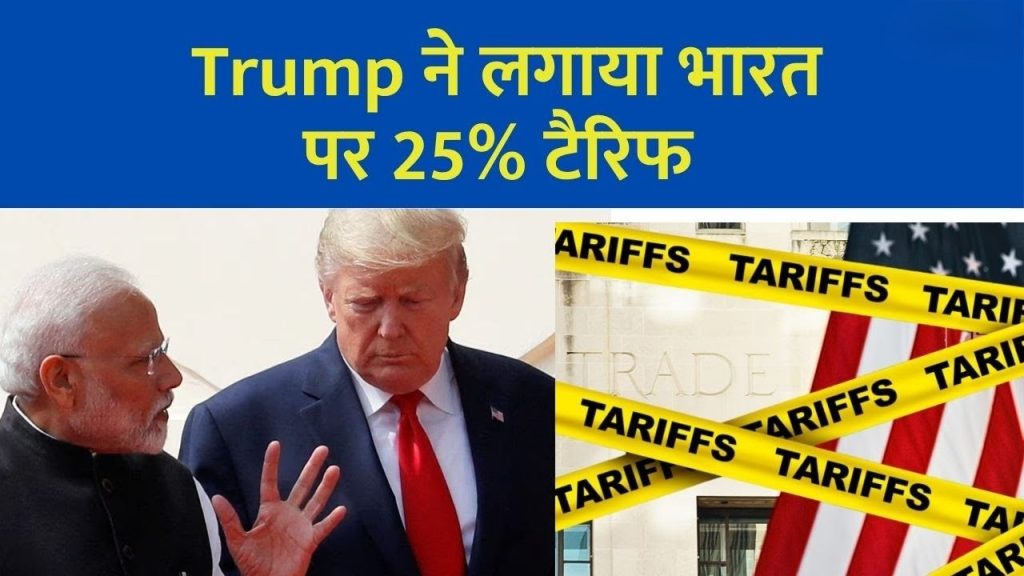
Trump Again Dropped a Tariff Bomb on India: Second Tariff Hike from 25% to 50%
Introduction: The Second Wave of Economic Aggression.
Former US President Donald Trump, who is once again dominating global headlines with his aggressive trade policies, has launched a fresh tariff assault on India. In a move that has stunned global economists and policy strategists, Trump has doubled down on his previous stance and increased tariffs on select Indian exports from 25% to a staggering 50%. This marks the second time he has imposed such a drastic tariff hike, signaling a more aggressive “America First” approach amid his potential return to power.
This decision comes at a critical time when India is positioning itself as a global manufacturing hub, riding on a wave of self-reliance and strategic global partnerships. But Trump’s latest move has raised serious concerns across New Delhi’s diplomatic and economic corridors.
Backdrop: The First Tariff Bomb
To understand the gravity of this move, it’s essential to revisit the events that unfolded during Trump’s first presidential term. Back in 2018-19, under his “America First” doctrine, Trump initiated a tariff war with multiple nations, including China and India. The United States removed India from its Generalized System of Preferences (GSP), a preferential trade program, affecting $5.6 billion worth of Indian exports. Tariffs of up to 25% were imposed on several categories including steel, aluminum, textiles, and auto parts.
Although the Biden administration attempted to normalize trade relations, Trump’s return to political limelight in 2025 and his renewed push for economic nationalism has reignited hostilities.
Details of the New Tariff Hike
The latest announcement increases tariffs on several Indian goods from 25% to 50%. The key affected sectors include:
- Textiles and Garments: India’s second-largest export to the US.
- Steel and Aluminum Products: Vital for India’s industrial economy.
- Leather Goods and Footwear: High-value exports from India.
- Auto Components: Critical sector for Indian MSMEs.
- Pharmaceutical Intermediates: A strategic industry with global dependence.
According to US trade representatives, this move is aimed at curbing “unfair trade practices” and “protecting American jobs.” However, Indian officials argue that this is a politically motivated decision aimed at satisfying Trump’s domestic voter base, especially in the Rust Belt states.
India’s Reaction: Strong but Strategic
India’s initial reaction has been firm but measured. External Affairs Minister Dr. S. Jaishankar, during a press briefing, termed the move as “regressive and unilateral,” stating that India will take “appropriate countermeasures in due course.” Commerce Minister Piyush Goyal added that India will not succumb to pressure and will explore WTO mechanisms to challenge the hike.
The Indian government is considering reciprocal tariffs on American goods, possibly targeting:
- Agricultural imports (like almonds and apples)
- High-end motorcycles (like Harley-Davidson)
- Industrial equipment
- Medical devices
India is also exploring alliances with EU, ASEAN, and African markets to redirect its exports and reduce dependence on the American market.
Impact on Indian Economy
The immediate economic fallout of this tariff hike could be serious:
1. Export Losses:
Indian exporters fear a loss of competitiveness in the US market. Garment exporters from Tiruppur, steel manufacturers from Jamshedpur, and auto parts makers from Pune are bracing for reduced orders.
2. MSME Sector Hit:
India’s micro, small, and medium enterprises (MSMEs) that depend heavily on US contracts will suffer margins and job losses, particularly in Tamil Nadu, Maharashtra, Punjab, and Gujarat.
3. Stock Market Reaction:
Indian markets reacted negatively to the announcement, with Nifty and Sensex shedding nearly 300 points in intraday trading following the news. Export-oriented companies saw a decline in share value.
4. Job Creation and GDP Slowdown:
Lower export demand may result in job losses in export-driven sectors and contribute to a GDP slowdown in the next two quarters.
Political Ramifications in India

This tariff bomb has also created a storm in Indian politics:
- Opposition Parties accused the Modi government of diplomatic failure, saying it was too busy managing domestic narratives while global issues were neglected.
- Congress Spokesperson Jairam Ramesh called it a “diplomatic slap,” asking the government what measures it took when Trump hinted at such a move during his recent campaign speeches.
- BJP Defends: BJP leaders, however, said that Trump’s unpredictability is well known and that India will respond strongly while maintaining global balance.
The issue is likely to feature prominently in Parliament debates and upcoming state election campaigns, especially in export-driven states.
Global Reactions
The international community has responded cautiously:
- European Union: Criticized Trump’s unilateralism and called for WTO-regulated resolutions.
- China: Used the opportunity to woo India into strengthening BRICS and alternative global trade frameworks.
- ASEAN Countries: Expressed concern about rising protectionism and its impact on global supply chains.
Trump’s Political Motivation
Trump’s latest move is widely seen as a populist attempt to consolidate support ahead of the 2026 mid-term elections and possibly the 2028 presidential race. His core narrative remains: bring jobs back to the US, reduce dependency on foreign countries, and punish nations that don’t “play fair.”
By portraying India as a “job snatcher,” Trump is playing to the sentiments of American workers in battleground states like Michigan, Ohio, and Pennsylvania, where manufacturing decline remains a core issue.
The Way Forward for India
India’s response strategy appears to be multipronged:
1. Diplomatic Engagement:
India is mobilizing allies within the G20 and WTO to diplomatically isolate Trump’s policy. South Block is actively engaging with EU, Japan, and Australia.
2. Diversification of Trade Partners:
India is accelerating trade deals with the UK, UAE, and African Union countries. The India-EU FTA is also being prioritized.
3. Strengthening Domestic Manufacturing:
Through schemes like PLI (Production Linked Incentives), India is boosting self-reliance and focusing on import substitution to minimize the damage from trade disruptions.
4. Legal Route:
India is preparing to challenge the tariff hike at the World Trade Organization. Legal experts suggest that unilateral hikes violate Most Favored Nation principles.
What Experts Are Saying
- Arvind Subramanian (Former CEA): “India should avoid reacting emotionally. This is an opportunity to strengthen non-US markets and recalibrate our trade strategy.”
- Nisha Biswal (US-India Business Council): “This move hurts American companies too. There will be lobbying against it within the US.”
- Raghuram Rajan (Economist): “India must use this shock to correct long-term vulnerabilities in our export strategy.”
People’s Voice: Public Sentiment in India
The general public in India is reacting with mixed emotions:
- Exporters: Angry and fearful of business losses.
- Nationalists: Calling for a boycott of American brands and goods.
- General Public: Aware that prices of imported American items like iPhones, cosmetics, and electronics may rise due to potential counter-tariffs.
Social media is flooded with hashtags like:
- #TrumpTariffWar
- #IndiaFirst
- #BoycottAmericanGoods
- #TrumpVsIndia
India-US Relationship at a Crossroads
Despite this setback, it’s important to note that India-US relations go beyond trade. Strategic cooperation in defense, counterterrorism, space, and tech continue. However, this tariff war is a reminder that even the closest partners can turn protectionist when politics intervene.
New Delhi now faces the challenge of defending its economy while maintaining a long-term relationship with Washington, regardless of who is in the White House.
Conclusion: A Test of Strategic Patience
Trump’s second tariff bomb on India has not just shaken trade figures, but also geopolitical calculations. At a time when India is rising on the global stage and seeking to lead the Global South, this development is a test of New Delhi’s strategic patience, diplomacy, and resilience.
While Trump’s move may be a political gambit aimed at a domestic audience, its ramifications for India are real and far-reaching. From trade route diversification to strategic countermeasures, India now has the task of turning this crisis into an opportunity — not just to retaliate, but to redefine its place in global commerce.
One thing is clear: the world is entering a new era of economic nationalism, and India must prepare for many such storms ahead.
Read More latest news

