
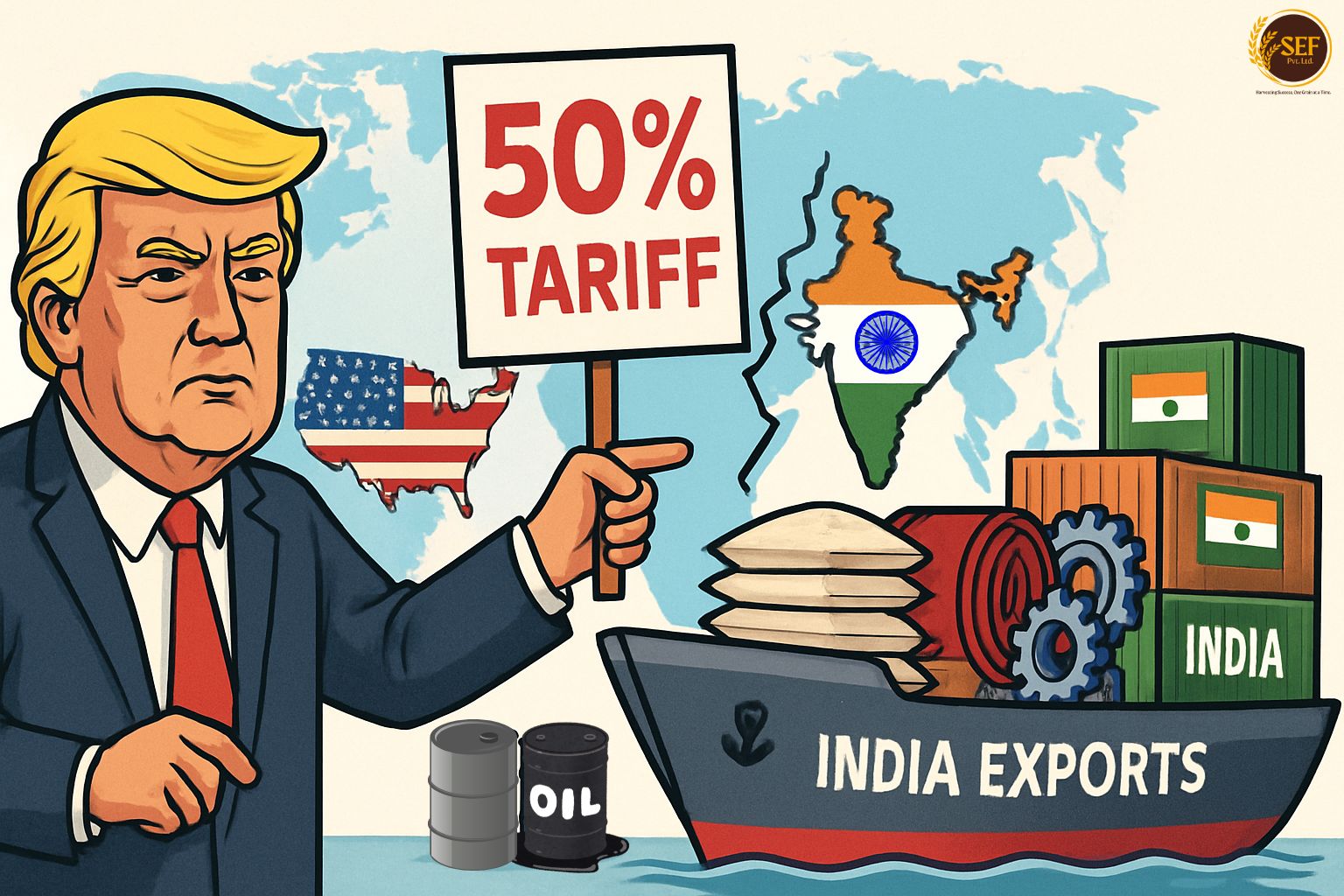
Why a 50% Tariff Will Not Harm India: Understanding the Resilience of the Indian Economy in the Face of Trade Wars
Introduction
Strong Economy The global economy is currently navigating a turbulent phase, where geopolitical shifts, protectionist policies, and trade wars have become common tools in international diplomacy. One of the most recent developments is the announcement of a 50% tariff by the United States on certain imports from India. At first glance, such a steep tariff appears to be a devastating blow to India’s export-driven sectors. Critics argue that this could hurt India’s economy, undermine bilateral trade relations, and negatively impact small businesses.
However, the larger picture reveals a more nuanced reality. Despite these tariffs, India’s economy is strong, diversified, and resilient enough to withstand such external shocks. The impact will not be as severe as many anticipate, thanks to India’s strong domestic demand, self-reliance strategies, diversified trade partnerships, and policy-driven resilience.
This blog explores in depth why a 50% tariff will not harm India. We will analyze India’s economic strengths, the nature of global trade, the role of self-reliant policies like Atmanirbhar Bharat, and how India’s growth trajectory continues to defy external pressures.
Section 1: Understanding the Tariff Context
Before analyzing why India remains unharmed, it is important to understand the context of this tariff hike.
What Is a Tariff?
A tariff is essentially a tax imposed on imported goods. By raising tariffs, the importing country makes foreign goods more expensive, thereby encouraging domestic consumption of local alternatives. The United States under Donald Trump, and now under subsequent leaderships, has often turned to tariffs as a tool of economic negotiation.
Why a 50% Tariff on Indian Goods?
The U.S. government has frequently targeted countries with whom it has trade deficits. India, being one of the largest exporters of pharmaceuticals, textiles, IT services, and certain agricultural products to the U.S., often comes under scrutiny. A 50% tariff is seen as a way to protect U.S. industries and pressure India into renegotiating trade agreements.
But the question remains: will this seriously harm India? The answer is no, and here’s why.
Section 2: The Resilience of the Indian Economy
India is not the same economy it was in the early 1990s when it was highly dependent on imports and external aid. Today, it stands as the fifth-largest economy in the world, with projections to become the third-largest within the next decade.
1. Strong Domestic Demand
One of India’s biggest strengths is its massive domestic consumer base of 1.4 billion people. Unlike smaller export-dependent economies, India can rely on its internal demand to absorb shocks from global trade wars. Even if certain sectors face losses in exports, domestic consumption can offset the impact.
2. Diversified Economy
India’s economy is not solely reliant on exports to the U.S. The service sector (particularly IT and digital services), domestic infrastructure growth, and internal manufacturing reforms ensure that no single external factor can collapse the entire economy.
3. Growth Drivers Beyond Exports
India’s growth is driven by infrastructure development, startup innovation, digital transformation, and government schemes like Make in India and Atmanirbhar Bharat. These initiatives reduce dependence on exports, making tariffs less impactful.

Section 3: Why the 50% Tariff Will Not Hurt India
1. U.S. Is Not the Only Market
While the U.S. is an important trading partner, India has expanded its global trade network. Partnerships with the European Union, ASEAN nations, Africa, and the Middle East ensure that export opportunities remain diversified. If one market imposes tariffs, India can redirect goods elsewhere.
2. Tariffs Also Hurt the U.S. Consumer
A tariff does not simply punish the exporting country. It also makes goods more expensive for consumers in the importing country. For instance, Indian pharmaceutical products and IT services are cost-effective alternatives for the U.S. economy. With higher tariffs, American consumers and companies will face increased costs, forcing U.S. policymakers to reconsider.
3. India’s Self-Reliance Push
Since 2020, India has aggressively pushed its Atmanirbhar Bharat (Self-Reliant India) mission, strengthening domestic manufacturing in sectors such as defense, semiconductors, renewable energy, and electronics. This reduces vulnerability to external tariffs.
4. Limited Impact on Critical Exports
The sectors most affected by tariffs (like textiles, leather, and some agricultural products) are important, but they do not represent the backbone of India’s GDP. The major growth drivers—IT services, infrastructure, energy transition, and digital economy—remain relatively unaffected.
5. Political Leverage
Tariffs are often more about political signaling than actual economic strategy. India’s growing geopolitical importance, especially as a counterbalance to China, means the U.S. cannot afford a full-fledged trade war. This ensures negotiations eventually neutralize extreme measures like 50% tariffs.
Section 4: Case Studies – India’s Past Resilience Against Global Economic Shocks
Example 1: U.S. Tariffs on Steel and Aluminum
In 2018, the U.S. imposed tariffs on steel and aluminum imports, affecting Indian exporters. While there was initial concern, India quickly diversified markets, and the sector stabilized.
Example 2: Oil Price Volatility
India, being a large oil importer, has repeatedly faced challenges due to global crude price fluctuations. However, India has managed by striking deals with Russia, the Middle East, and even investing in renewable energy.
Example 3: COVID-19 Pandemic
The pandemic was one of the biggest global economic shocks, yet India managed to bounce back with one of the fastest GDP growth rates in the world post-2021. This showed the adaptability of the Indian economy.
Section 5: Sectors That Could Face Short-Term Impact
While India overall will not be harmed, certain sectors could face short-term challenges due to a 50% tariff.
- Textiles and Apparel: These are price-sensitive exports, and tariffs could reduce competitiveness in the U.S. market.
- Leather Goods: Similar issues with price competition.
- Agricultural Exports: Items like rice, spices, and certain processed foods may face reduced demand.
However, these industries are already exploring markets in Europe, Africa, and the Middle East to balance risks.
Section 6: Long-Term Benefits of Tariff Pressures
Interestingly, tariff pressures could actually benefit India in the long run by accelerating reforms and diversification.
- Boost to Local Manufacturing: Tariffs push India to invest more in domestic production and consumption.
- Stronger Trade Alliances: India strengthens its trade presence with friendly nations, reducing reliance on the U.S.
- Technological Independence: Tariffs encourage India to develop indigenous technology and reduce import dependency.
Section 7: Global Geopolitics and India’s Strategic Role
India today is not just another developing nation—it is a strategic partner for major powers. The U.S., despite tariffs, values India’s role in:
- Countering China’s influence in Asia.
- Collaborating in defense and technology.
- Participating in global initiatives like QUAD.
Because of this, tariffs are unlikely to escalate into a long-term economic war.
Section 8: The Confidence of Indian Leadership
Prime Minister Narendra Modi and his cabinet have repeatedly emphasized that India’s growth story cannot be derailed by external shocks. Finance Minister Nirmala Sitharaman has also underlined that India’s economic fundamentals remain strong, inflation is under control, and investments are flowing in.
Anurag Thakur, Minister of Information & Broadcasting, once said:
“India has the capacity to turn challenges into opportunities. Tariffs, sanctions, or global slowdowns cannot stop our growth momentum.”
This confidence is backed by data, as India continues to attract record levels of foreign direct investment (FDI) and remains one of the fastest-growing economies in the world.
Section 9: Public Sentiment and Business Outlook
Interestingly, Indian businesses are not panicking over the 50% tariff announcement. Many exporters believe:
- They can adjust supply chains to new markets.
- Domestic demand can absorb excess production.
- Government incentives will support industries facing short-term losses.
Public sentiment, too, is one of resilience. Unlike in the past, where international sanctions could cause widespread panic, Indians today believe in the strength of their economy.
Section 10: The Future of Indo-U.S. Trade Relations
While tariffs may create short-term friction, the long-term outlook for Indo-U.S. trade remains strong. Both countries need each other:
- The U.S. needs India’s growing consumer base and IT expertise.
- India needs U.S. technology, investments, and defense partnerships.
This interdependence ensures that tariffs are more of a negotiation tactic than a permanent barrier. Eventually, dialogue and diplomacy will reduce tensions.
Conclusion
A 50% tariff may sound alarming, but when analyzed through the lens of India’s economic strength, domestic demand, self-reliant policies, diversified trade networks, and geopolitical importance, it becomes clear that India will not be harmed significantly.
Instead of seeing it as a threat, India can use this challenge to further strengthen its economic independence, diversify its markets, and push forward reforms that make it more resilient in the long run.
History shows that India has survived oil shocks, financial crises, and even pandemics. Compared to those, a tariff hike is just another hurdle—one that India is well-prepared to overcome.
India’s growth story remains strong, and a 50% tariff cannot derail the aspirations of 1.4 billion people.
Read more latest news

