
Introduction
liquor smuggling under the cover of burqa In a nation grappling with the dual challenges of enforcing prohibition laws and respecting cultural practices, a case emerging from Katihar, Bihar, has managed to capture the attention of the public and authorities alike. A woman, clad in a burqa, was recently apprehended by local police for allegedly smuggling illicit liquor — a revelation that has sent shockwaves across the region. The arrest not only exposes a unique modus operandi in the ever-evolving world of bootlegging but also raises pertinent questions about the loopholes in prohibition enforcement and the misuse of religious or cultural attire.
liquor smuggling This blog takes a comprehensive look at the incident, exploring the details of the arrest, the socio-political context, reactions from authorities and the public, and the broader implications for both law enforcement and society.
The Incident: A Routine Check That Led to a Shocking Discovery
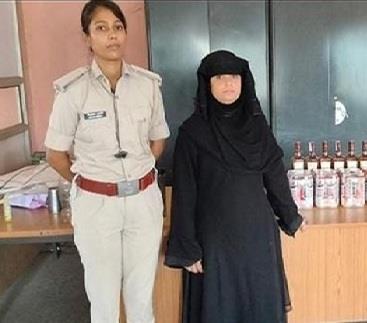
The arrest took place during a routine police check at the Katihar railway station — a known transit point that has often been monitored for illegal activities. According to police sources, officers grew suspicious of a woman in a burqa who appeared anxious and was carrying unusually shaped luggage liquor smuggling.
Upon inspection, the officers were stunned to discover several bottles of liquor cleverly concealed under her traditional attire and within her bags. The liquor was reportedly packed in plastic bottles to reduce the risk of breakage and wrapped to avoid detection through scent.
The woman, whose identity has since been disclosed as a resident of a nearby village, was taken into custody immediately. Further questioning revealed that this was not her first attempt at smuggling, and that she might be part of a larger network operating in the region.
The Legal Context: Prohibition in Bihar
Bihar has been under a strict prohibition law since April 2016, when the state government banned the manufacture, sale, and consumption of alcohol. While the move was initially hailed as a progressive step toward social reform, its implementation has been riddled with challenges.
Since the enactment of prohibition, smuggling and black market sales of alcohol have surged. Smugglers have continuously adapted their methods to avoid detection, using private vehicles, cargo, and even disguised individuals. The Katihar case adds a new layer to this — the use of religious clothing to bypass scrutiny.
Legal experts argue that while the intent behind the law is noble, the enforcement mechanism has gaps that need urgent attention. With many underprivileged individuals lured into smuggling due to poverty and lack of employment, the lines between crime and survival often blur.
The Smuggling Network: Organized or Opportunistic?
Initial investigations into the woman’s activities have led police to believe that she is likely part of a well-organized liquor smuggling ring. Her arrest has prompted a deeper probe into how these networks recruit, train, and use individuals to transport contraband.
One theory suggests that smugglers are increasingly turning to women for these operations, assuming that they attract less suspicion — especially when dressed in religious garments like burqas. This tactic, while effective in the short term, is both unethical and deeply problematic.
The misuse of cultural attire not only undermines the sanctity of religious customs but also creates tension in communities already grappling with communal sensitivities.
Public Reaction: Shock, Sympathy, and Outrage
The news of the arrest has sparked a flurry of reactions across social media and local communities. While many have expressed outrage at the use of religious garments to commit a crime, others have highlighted the socio-economic conditions that may have pushed the woman into this line of work.
Some voices have even defended the woman, stating that the real culprits are the masterminds behind the smuggling rings who exploit vulnerable individuals for their gain. Others have called for strict punishment, warning that leniency could encourage more such acts.
Women’s rights groups have also entered the discourse, urging law enforcement agencies to ensure that arrests and investigations are conducted with sensitivity and without community profiling.
Law Enforcement’s Response: Tightening the Noose
The Katihar police, after receiving commendation for their swift action, have vowed to intensify their efforts in cracking down on smuggling networks. Checkpoints are being reinforced, and surveillance at railway stations, bus terminals, and highways has been increased.
Authorities are also working with cybercrime units to track communications and financial transactions that could lead them to the bigger players in the liquor mafia. The state government, meanwhile, is pushing for policy reviews to assess the effectiveness of the current prohibition strategy.
Senior officers have reiterated that no community or individual will be targeted unjustly, but that all attempts to exploit cultural norms for illegal activities will be dealt with firmly.
The Cultural Dilemma: Faith vs. Fraud
One of the most controversial aspects of this case is the use of a burqa to hide illegal goods. While many argue that criminals will use any means necessary to avoid detection, the cultural implications of this act cannot be ignored.
Religious leaders from the Muslim community have spoken out against the misuse of the burqa, emphasizing that such acts not only bring shame to the community but also contribute to increasing stereotypes and discrimination.
They have urged followers to uphold the dignity of religious symbols and condemned those who use faith as a shield for unlawful activities. At the same time, they have called for empathy and support for individuals driven to such extremes by socio-economic hardship.
Societal Factors: Crime Rooted in Compulsion?
Experts in sociology and criminology have long debated the relationship between poverty and crime. In states like Bihar, where unemployment remains a significant issue and education levels are low, many find themselves caught between desperation and legality.
The woman arrested in Katihar reportedly comes from a marginalized background. Interviews with locals suggest she may have been coerced or lured into smuggling with the promise of money — a narrative not uncommon in cases involving human trafficking and narcotics as well.
Addressing these underlying issues through policy changes, welfare programs, and education could go a long way in reducing the prevalence of such crimes.

Media’s Role: Informing or Sensationalizing?
As with many high-profile cases, the media’s coverage of the Katihar incident has been a mixed bag. While some outlets have responsibly reported on the incident, focusing on the legal and social aspects, others have sensationalized the issue, risking communal disharmony and spreading stereotypes.
Responsible journalism is crucial in such cases, especially when the situation involves sensitive cultural and religious elements. It is essential for media houses to maintain a balance between reporting facts and preserving the dignity of individuals and communities involved.
Broader Implications: Rethinking Prohibition?
The case has reignited the debate on prohibition in Bihar. Critics argue that instead of curbing alcohol consumption, the law has driven it underground, creating a booming black market and encouraging criminal networks.
They call for a reassessment of the policy, suggesting alternative models like regulated alcohol sales, stricter punishments for mafia leaders, and public awareness campaigns about the harms of alcohol.
Proponents of prohibition, however, point to the reduction in domestic violence and improved household savings as evidence of the law’s success. They believe that the current challenges are teething problems that will be overcome with better enforcement.
Conclusion: A Wake-Up Call for Many Stakeholders
The arrest of a female smuggler using a burqa in Katihar is more than just a criminal case — it’s a reflection of multiple societal layers colliding. From the failure of prohibition enforcement and exploitation of vulnerable individuals to the cultural insensitivity and media sensationalism, the incident is a wake-up call.
Policymakers must look beyond punitive measures and address the root causes of such crimes. Law enforcement agencies need better tools and training to handle such complex cases sensitively. Communities must work together to ensure that cultural symbols are respected and not misused.
As for the woman at the center of it all, her story is a poignant reminder that sometimes, beneath the fabric of tradition and crime lies a desperate plea for survival.
The road ahead demands collaboration, empathy, and a commitment to justice that transcends appearances. Only then can we hope to build a society where laws are upheld, cultures are respected, and every individual has the opportunity to choose dignity over desperation.
read more latest news


Very good https://shorturl.at/2breu
Awesome https://lc.cx/xjXBQT
Awesome https://is.gd/N1ikS2
Awesome https://is.gd/N1ikS2
Good https://is.gd/N1ikS2