
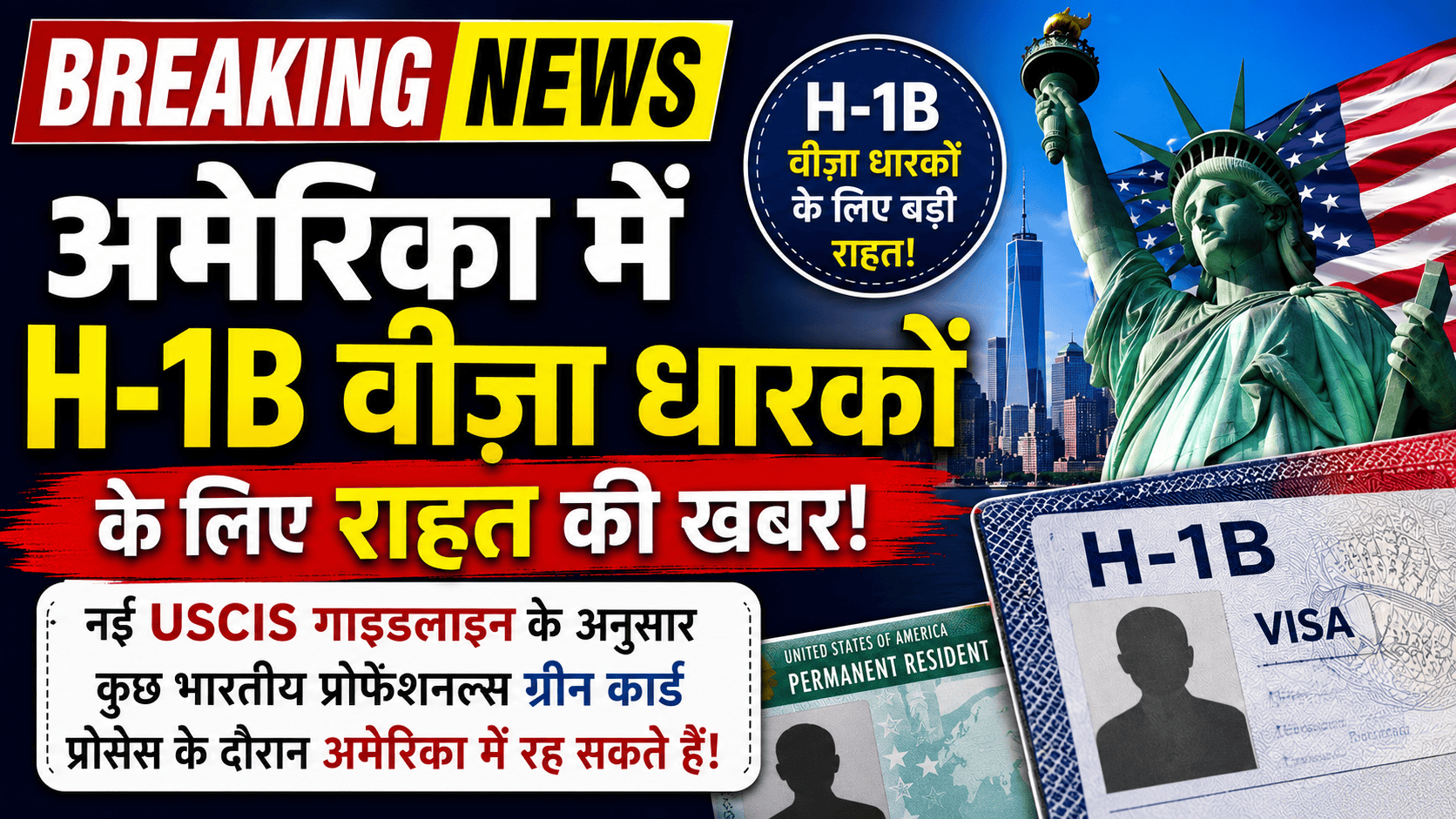
Relief for H-1B Visa Holders: New USCIS Guidelines Bring Hope to Indian Professionals in the United States
The United States has long been a dream destination for skilled professionals from around the world, especially from India. Thousands of Indian IT engineers, healthcare workers, researchers, financial analysts, and technology experts travel to America every year on H-1B visas in search of better career opportunities and global exposure. However, the journey from an H-1B visa to permanent residency has often been stressful, uncertain, and filled with long waiting periods.
Now, there is welcome news and a major policy shift that offers significant relief for H-1B visa holders in the United States. The latest USCIS guidelines are expected to help many Indian professionals remain legally employed in the country while their green card applications are being processed. This development has brought optimism to thousands of families who have been waiting for stability and clarity in the immigration system.
For years, Indian professionals faced severe challenges because of green card backlogs, visa expiration issues, and fears of losing employment authorization. But these new USCIS changes could mark the beginning of a more flexible and supportive immigration framework. The announcement is being widely discussed across the Indian diaspora because it provides much-needed relief for H-1B visa holders who were previously uncertain about their future in America.
Understanding the H-1B Visa System
The H-1B visa is a non-immigrant work visa that allows U.S. companies to employ foreign workers in specialized occupations. Most H-1B workers are employed in sectors such as information technology, engineering, healthcare, finance, and education.
Indian professionals dominate the H-1B visa category, with major American tech companies hiring thousands of Indian employees every year. Companies such as Google, Microsoft, Amazon, Meta, and Apple rely heavily on skilled workers from India.
Despite offering excellent career opportunities, the H-1B system has always been complicated. The visa is temporary in nature, and workers must depend on employers for sponsorship. More importantly, obtaining a green card can take many years due to country-specific caps and immigration backlogs.
This is why the latest USCIS update is being viewed as a huge relief for H-1B visa holders who have been living in uncertainty for decades.
What Are the New USCIS Guidelines?
The United States Citizenship and Immigration Services (USCIS) recently introduced updated guidelines aimed at improving flexibility for skilled foreign workers during the green card process. The changes primarily benefit workers whose permanent residency applications are pending for extended periods.
Under the revised rules, certain H-1B visa holders may continue living and working in the United States even if their original visa validity period is nearing expiration. This step provides significant relief for H-1B visa holders who otherwise feared deportation or forced relocation.
The updated guidelines also simplify extension procedures and provide more clarity regarding employment continuity during immigration processing. Indian professionals who have already started the employment-based green card process are expected to benefit the most.
Experts believe these measures could reduce anxiety among skilled workers and improve workforce stability for American companies.
Why Indian Professionals Are the Biggest Beneficiaries
Indian nationals face the longest green card waiting periods in the employment-based immigration system. Because of per-country limits, some Indian applicants may wait decades before receiving permanent residency approval.
Many Indian professionals came to America on H-1B visas years ago and built successful careers, purchased homes, and raised families in the country. However, the uncertainty surrounding immigration status often created emotional and financial stress.
The new USCIS rules provide much-needed relief for H-1B visa holders from India because they allow professionals to continue working legally while awaiting green card approval.
This is especially important for families with children studying in American schools and spouses who also depend on visa status for employment authorization.
The Green Card Backlog Problem
One of the biggest immigration challenges in the United States is the green card backlog. Employment-based green cards are limited annually, and country-specific quotas create major delays for applicants from high-demand nations like India.
As a result, many Indian H-1B visa holders remain stuck in temporary visa status for years. Some estimates suggest that highly skilled Indian workers may have to wait decades for permanent residency.
This prolonged uncertainty has affected career growth, family planning, travel freedom, and financial security. The updated USCIS guidance offers considerable relief for H-1B visa holders because it acknowledges the reality of these long waiting periods and provides temporary stability.
Immigration experts say the changes may not completely solve the backlog issue, but they represent an important administrative improvement.
Impact on American Companies
The updated immigration policy is not only beneficial for foreign workers but also for American employers. Technology firms and multinational companies depend heavily on skilled international talent.
When employees face visa uncertainty, companies risk losing experienced workers. Frequent visa renewals and immigration complications can also increase operational costs.
The latest reforms offer relief for H-1B visa holders while simultaneously helping companies retain valuable employees. Businesses can continue long-term projects without disruptions caused by visa-related departures.
Industry leaders have welcomed the move, arguing that retaining skilled professionals strengthens innovation and economic growth in the United States.
Economic Contribution of Indian H-1B Workers
Indian professionals contribute significantly to the U.S. economy. They work in critical sectors including software development, cybersecurity, healthcare, artificial intelligence, cloud computing, and financial services.
Many Indian-origin entrepreneurs have also launched successful startups in America, creating jobs and contributing to technological innovation.
The new USCIS rules provide relief for H-1B visa holders who play a major role in maintaining America’s global competitiveness. By allowing skilled workers to remain in the country during immigration processing, the government ensures continuity in essential industries.
Analysts believe this approach benefits both the U.S. labor market and the broader economy.
Mental Health and Family Stability
Immigration uncertainty can create immense emotional pressure. Many H-1B workers worry constantly about job security, visa renewals, and potential relocation.
Families often face challenges related to children’s education, healthcare access, home ownership, and financial planning. In some cases, dependent children risk losing legal status after turning 21.
The updated USCIS framework provides emotional relief for H-1B visa holders who have spent years navigating immigration uncertainty.
For Indian families, this policy shift represents more than an administrative update—it offers hope for long-term stability and peace of mind.
Flexibility During Job Changes
One major concern among H-1B workers has been changing employers during the green card process. Many employees feared losing immigration benefits if they switched jobs.
The updated guidelines improve flexibility in some employment transition scenarios, giving professionals more confidence to explore career growth opportunities.
This additional flexibility is another important form of relief for H-1B visa holders, especially in competitive industries where changing companies is common for career advancement.
Professionals can now pursue better opportunities without feeling trapped due to immigration concerns.
Immigration Experts React to the New Policy
Immigration attorneys and policy experts have largely welcomed the updated USCIS guidance. According to experts, the changes reflect recognition of the serious backlog issues affecting skilled workers.
Many experts describe the move as practical and necessary because highly skilled immigrants contribute directly to the American economy.
The policy is being praised as meaningful relief for H-1B visa holders who previously faced uncertainty despite following legal immigration procedures for years.
However, experts also emphasize that broader congressional immigration reform is still necessary to address systemic problems permanently.
Challenges Still Remain
While the updated guidelines are encouraging, some challenges continue to exist. The green card backlog itself has not been eliminated, and country-based quotas remain unchanged.
Additionally, visa processing delays and administrative complications can still create uncertainty for applicants.
Although the changes provide temporary relief for H-1B visa holders, many advocacy groups argue that long-term reforms are needed to modernize the employment-based immigration system.
Immigration advocates continue to push for legislation that increases green card caps and removes discriminatory country limits.
How the Changes Affect Dependents
H-1B workers often move to the United States with spouses and children under H-4 dependent visas. Many spouses also seek employment authorization to support family income.
The updated USCIS guidelines indirectly help dependent family members by allowing principal H-1B holders to maintain legal work status during lengthy green card processing periods.
This creates broader relief for H-1B visa holders and their families, reducing fears related to job interruptions or forced relocation.
Families can continue building stable lives in the United States while awaiting immigration decisions.
Growing Demand for Skilled Immigration
The U.S. economy continues to face demand for highly skilled workers, especially in technology and healthcare sectors. Companies frequently report shortages of specialized talent.
Indian professionals have become a crucial part of America’s skilled workforce ecosystem. Their contributions in software engineering, AI research, and digital transformation are globally recognized.
The latest immigration flexibility measures provide strategic relief for H-1B visa holders while helping America remain competitive in innovation-driven industries.
Experts believe attracting and retaining global talent will remain a priority for the U.S. economy in the coming years.
Political Debate Around Immigration
Immigration policy has always been a politically sensitive issue in the United States. While some lawmakers support expanding opportunities for skilled immigrants, others advocate stricter visa regulations.
The recent USCIS update reflects a balanced administrative approach that supports legal skilled migration without changing congressional immigration laws.
For Indian professionals, the policy offers practical relief for H-1B visa holders without requiring immediate legislative approval.
However, future immigration policies may still depend on changing political leadership and congressional priorities.
The Indian Community’s Response
Indian communities across America have welcomed the announcement with optimism. Social media platforms, immigration forums, and professional groups are filled with discussions about the new guidelines.
Many professionals see the policy as overdue recognition of their contributions to American society and the economy.
The changes have brought emotional and professional relief for H-1B visa holders who spent years worrying about immigration uncertainty.
Community organizations are also encouraging workers to consult immigration attorneys and stay updated on USCIS announcements.
Future of U.S.-India Professional Mobility
The movement of skilled Indian professionals to the United States has strengthened economic and technological ties between the two countries.
Indian engineers and developers continue to play key roles in shaping the future of global technology. Improved immigration flexibility could further enhance collaboration between American companies and Indian talent.
The recent USCIS measures provide long-awaited relief for H-1B visa holders and reinforce the importance of skilled migration in the global economy.
As industries evolve with artificial intelligence, automation, and digital transformation, demand for international expertise is expected to rise further.
Advice for H-1B Visa Holders
Immigration experts recommend that H-1B workers remain proactive and informed about policy changes. Visa holders should regularly monitor USCIS announcements and maintain communication with legal advisors.
Workers should also ensure that documentation related to employment and green card applications remains updated.
Although the recent reforms provide relief for H-1B visa holders, careful planning is still necessary to avoid legal complications during immigration processing.
Professionals are advised to maintain valid status, track application timelines, and understand eligibility for extensions under the updated rules.
Conclusion
The latest USCIS guidelines mark an important development for skilled immigrants in the United States, particularly for Indian professionals navigating lengthy green card backlogs. By allowing certain workers to remain in the country during immigration processing, the policy offers meaningful stability and security.
For thousands of families, this represents genuine relief for H-1B visa holders who have spent years balancing career ambitions with immigration uncertainty. The changes acknowledge the valuable contributions of skilled foreign workers and provide practical support during one of the most challenging aspects of the immigration journey.
While broader immigration reform is still needed to fully address backlog issues, the updated USCIS approach is undoubtedly a positive step forward. It helps workers continue their professional growth, supports American businesses, and strengthens the relationship between the United States and global talent communities.
As Indian professionals continue contributing to innovation, healthcare, education, and technology in America, the new immigration flexibility measures symbolize hope, opportunity, and long-awaited relief for H-1B visa holders seeking a more secure future in the United States.
Read more latest news

