
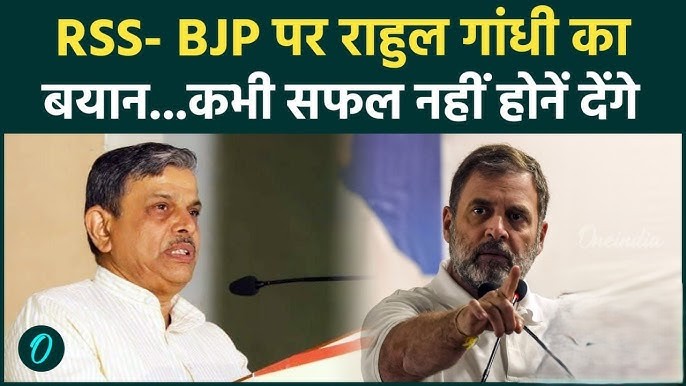
“Their Mask Has Come Off”: Rahul Gandhi’s Fiery Retort to Hosabale on the Constitution
1. Introduction
RSS leader Hosabale’s statement On June 26–27, 2025, a political storm erupted over remarks made by Dattatreya Hosabale, General Secretary of the Rashtriya Swayamsevak Sangh (RSS). He suggested reconsidering the inclusion of the words “socialist” and “secular” in the Constitution’s Preamble—terms added during the 1976 Emergency under the 42nd Amendment.
Responding swiftly, Rahul Gandhi, Leader of the Opposition in the Lok Sabha and senior Congress leader, launched a scathing response. Through social media and public statements, he accused the RSS and BJP of harboring ambitions to substitute the Constitution with the Manusmriti—an ancient Hindu code with casteist overtones RSS leader Hosabale’s statement.
This exchange signals a defining moment in Indian politics, with clashes over the Constitution’s soul and secular foundations at the forefront. In this blog, we’ll dive deep into:
- Hosabale’s original remarks
- Rahul Gandhi’s responses with their sharp language
- Political and legal ramifications
- Voices from other parties and broader public sentiment
- The larger ideological confrontation driving this debate
2. What Hosabale Actually Said
RSS leader Hosabale’s statement During an event commemorating 50 years since the Emergency, Hosabale questioned whether the terms “socialist” and “secular” should remain in the Constitution’s Preamble, citing that they were added in a politically charged era.
“The Preamble… drafted by Baba Saheb Ambedkar never had these words. During the Emergency… then these words were added,” he said, urging a discussion.
His argument was rooted in constitutional history: the terms were indeed introduced by the 1976 amendment, raising the question of whether they reflect India’s founding values or represent an imposition during a controversial period .
3. Rahul Gandhi’s Response: “The Mask Has Come Off”
Almost immediately, Rahul Gandhi responded through a powerful social media post that showcased his political strategy:
- “The mask of RSS has come off again. The Constitution irks them because it speaks of equality, secularism and justice.”
- “RSS‑BJP doesn’t want the Constitution; they want Manusmriti… to strip the marginalized and poor of their rights and enslave them again.”
- “Snatching a powerful weapon like the Constitution from them is their real agenda… Every patriotic Indian will defend the Constitution till their last breath.”
🎯 Key Claims by Rahul Gandhi:
- The RSS is opposed at its core to values like secularism and equality.
- Their ideological preference lies in Manusmriti—a text long criticized for reinforcing caste and patriarchy.
- He portrayed their proposal not as a neutral historical note, but as a deliberate attempt to alter the constitutional foundation and civil rights.

4. Context: Why the Preamble Debate Matters
The Preamble represents the basic philosophy and guiding values of the Constitution: justice, liberty, equality, fraternity, and its identity as secular and socialist. These terms underpin critical rights like affirmative action, minority protections, and religious freedom.
After the 42nd Amendment, mainstream consensus—affirmed by the Supreme Court—held that “secular” and “socialist” are integral to the Constitution’s framework. In fact, a court ruling in November 2024 rejected attempts to remove them.
Thus, Hosabale’s remarks aren’t merely historical—they carry potent constitutional implications.
5. Opposition’s Response and Rally Differences
Rahul’s critique was echoed by party colleagues:
- Jairam Ramesh cited the Supreme Court’s 2024 ruling, reinforcing that socialist and secular are ingrained in the basic structure of the Constitution.
- KC Venugopal reiterated Congress’s aim to safeguard these principles against ideological revisionism.
- Karnataka CM Siddaramaiah stated, “We will defend its values of secularism, social justice, and democracy—like a rock”.
- Lalu Prasad Yadav (RJD) termed RSS as “casteist and hateful” for opposing constitutional values.
- Left parties like CPI(M) warned that the proposal reflects longstanding efforts to dismantle democratic ideals.
Together, these voices framed Hosabale’s comments as a “deliberate assault on the soul of the Constitution”.
6. BJP and RSS: Staying Silent (for Now)
So far, neither the RSS nor the BJP has responded directly to Rahul Gandhi’s emotional statements or media coverage. Given the highly charged political environment, they appear to be maintaining strategic silence, allowing the narrative to unfold rather than jumping in immediately.
7. The Ideological Chessboard: Manusmriti vs. Constitution
Rahul’s evocation of Manusmriti is heavyweight framing. The ancient legal code prescribes rigid caste hierarchy and family structures, standing in stark contrast to the equality and civil rights promised by the modern Constitution.
By stating RSS prefers Manusmriti over the Constitution, Rahul is not merely making a political critique—he is framing the ideological fault line:
- Constitution = modern, inclusive, rights-based, democratic.
- Manusmriti = hierarchical, casteist, authoritarian, discriminatory.
This binary encapsulates a much larger ideological battle over the soul of India’s republic.
8. Legal and Institutional Ramifications
The suggestion to revisit the Preamble risks:
- Triggering constitutional amendments, which require two-thirds parliamentary approval—a major political fight.
- Political mobilization from secular and progressive forces.
- Potential legal challenges if there are attempts to remove or dilute these terms, based on prior 2024 Supreme Court precedents.
Rahul’s response aims to raise the constitutional stakes for any such moves.
9. Public Resonance and Media Reaction
The media spotlight intensified with headlines like:
- “Rahul blasts RSS, says Constitution irks Sangh”
- “‘Mask has come off’: Rahul flays RSS over call to drop ‘secular’”
On social media, debates surged between supporters praising Rahul’s stand and detractors accusing him of rhetoric that threatens Hindu symbolism or national unity.
10. Broader Socio-Political Stakes
This clash symbolizes a deeper divide in India’s political landscape:
- Secularism vs. Majoritarian Identity
- Constitutional pluralism vs. cultural homogenization
- Minority rights vs. centralized nationalism
- Legacy of anti-caste, anti-colonial movements vs. return to pre-modern social hierarchies
Rahul positions this as a battle not just for electoral power—but for India’s soul.
11. Historical Echoes
Debates over the Preamble’s language aren’t new:
- In 1975-77, during Emergency, Indira Gandhi’s regime added socialist and secular values to fortify constitutional identity.
- Opposition to this change had emerged from right-wing circles historically.
- In 2023, questions about the Preamble surfaced again, with Congress defending the 1976 amendment.
Hosabale’s stance revives this historical cycle.
12. What Happens Next?
Key developments to monitor:
- Official reaction from RSS and BJP—weighing political expediency versus ideological positioning.
- Parliamentary debate if moves to amend Preamble are proposed.
- Judicial engagement—Supreme Court might reaffirm the basic structure doctrine.
- Public mobilization—marches, campaigns, constitutional literacy drives by civil society.
- Opposition unity—Congress, Left, regional secular parties could form a pro-Constitution alliance.
13. Why Rahul Gandhi’s Anger Matters
Rahul’s sharp rebuke signals:
- A defensive posture to preempt ideological shifts.
- A rebranding strategy—projecting Rahul as defender of democracy and minority rights.
- An effort to mobilize public opinion around constitutional ethos, beyond short-term politics.
14. Concluding Thoughts
The Hosabale-Rahul exchange is more than political rhetoric—it’s about the heart of Indian democracy. At stake are foundational questions:
- Who defines India’s core values?
- Are we anchored in pluralism or hierarchy?
- How do we balance freedom, plurality, and national identity?
In Rahul Gandhi’s fiery words—”their mask has come off”—lies both warning and invitation: that every Indian must reflect on and defend the Constitution’s promise of equality, secularism, justice, and fraternity.
read more latest news

