
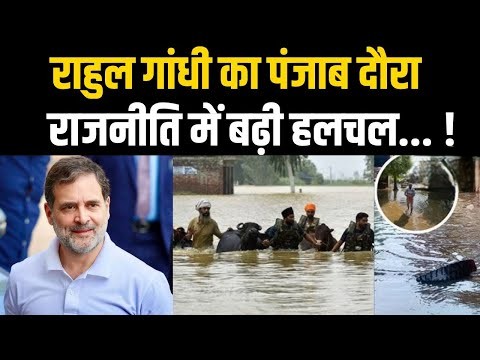
Rahul Gandhi’s Visit to Flood-Affected Areas in Gurdaspur: Heated Argument Near Pakistan Border as He Insists on Meeting Victims.
Introduction
On a rain-soaked September day, Congress leader Rahul Gandhi arrived in Punjab’s Gurdaspur district to visit areas devastated by recent floods. His visit, intended to provide support to affected villagers, took a dramatic turn near the Dinanagar sector at Makoda Pathan, a location uncomfortably close to the Pakistan border.
While Rahul Gandhi’s message was one of solidarity with flood victims, the incident became the subject of a political storm after he engaged in a heated argument with police officers, who tried to stop him from moving closer to the border. Rahul Gandhi insisted on meeting the people stranded across the Rabi river, whose villages had been hit hardest.
This episode not only sheds light on Punjab’s recurring flood crisis, but also raises critical questions about politics, security, and the role of leaders during natural disasters.
In this detailed blog, we will examine:
- The background of the floods in Gurdaspur
- Rahul Gandhi’s visit and the heated exchange with police
- Political reactions to the incident
- The security dilemma near the Pakistan border
- The challenges faced by flood-affected villagers
- And the larger implications for Indian politics
Flood Situation in Gurdaspur: A Recurring Crisis
Geography of Gurdaspur and Its Vulnerability
Gurdaspur district in Punjab lies in the foothills of the Himalayas, with several rivers flowing through it, including the Ravi, Beas, and Ujh. While these rivers sustain agriculture in the region, they also make it highly vulnerable to flash floods during monsoon.
In the recent floods, heavy rainfall combined with overflowing rivers inundated villages, washed away crops, damaged homes, and displaced thousands. The situation was worsened by the Ravi river swelling dangerously, cutting off entire clusters of villages.
Impact on Villages
- Agriculture Destroyed: Fields of paddy and maize submerged under water.
- Displacement: Families forced to leave their homes and take shelter in makeshift camps.
- Health Concerns: Stagnant water leading to fears of water-borne diseases.
- Livelihood Crisis: Farmers and laborers lost weeks of work, adding to their financial stress.
For villagers living on the other side of the Ravi river, near the sensitive border belt, help was slow to reach. It was here that Rahul Gandhi wanted to go.
Rahul Gandhi’s Visit
Arrival in Gurdaspur
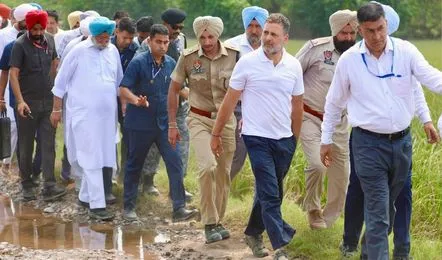
Rahul Gandhi arrived in Dinanagar block, accompanied by local Congress leaders, relief workers, and media. His itinerary included meeting affected villagers, assessing the damage, and assuring them of his party’s support.
He visited relief camps, spoke with women and farmers, and highlighted the urgent need for better flood management systems in Punjab.
The Turning Point: Makoda Pathan
The controversy began when Rahul Gandhi reached Makoda Pathan, a spot dangerously close to the Pakistan border. The Ravi river had cut off several villages on the other side, and Rahul Gandhi expressed his intent to cross the point and meet stranded villagers.
Police officers, citing security concerns due to proximity to the international border, stopped him. This led to a heated argument.
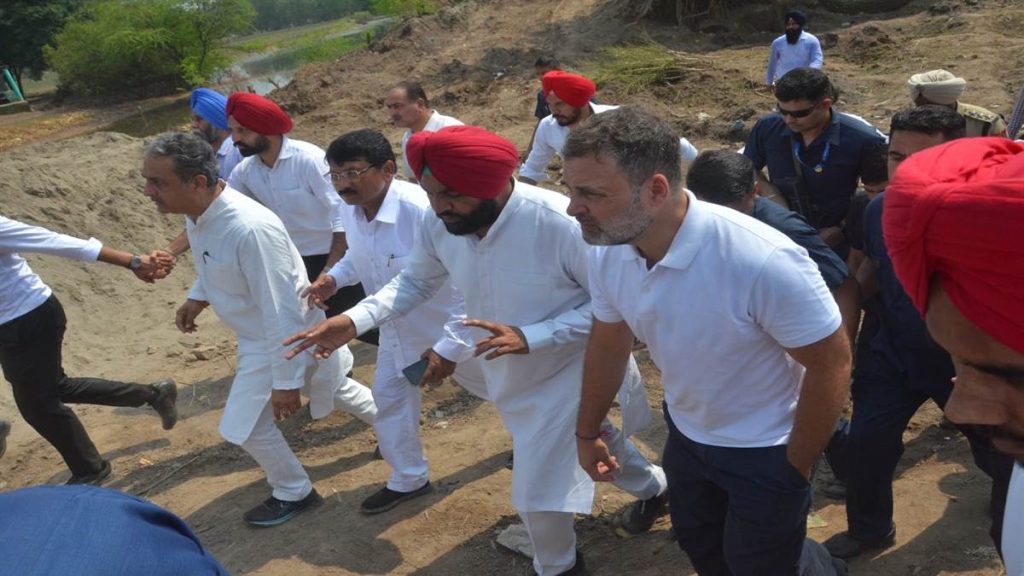
The Heated Argument
What Happened
Eyewitness accounts and video clips show Rahul Gandhi engaging in a tense exchange with police officers.
- Police argued that going further would breach security protocols, as the area was close to Pakistan.
- Rahul Gandhi countered that helping citizens was more important than restrictions, insisting: “These are our people. If they are suffering, I must meet them.”
- Voices were raised, with Rahul Gandhi accusing the authorities of denying him access to flood victims.
Why the Argument Matters
This was not a minor disagreement. It highlighted the tension between political duty and security restrictions. Rahul Gandhi projected himself as a leader willing to risk personal safety to stand with the people, while the administration tried to enforce caution.
The standoff lasted several minutes before Rahul Gandhi finally agreed to meet villagers at a safer location.
Security Concerns Near the Pakistan Border
Why Police Stopped Him
The Makoda Pathan area is only a few kilometers from the international border. Authorities feared that:
- Cross-border mischief could not be ruled out.
- A political leader’s movement in such a sensitive zone might attract unwanted attention from Pakistan.
- In case of an incident, it would become a major diplomatic and security crisis.
Past Incidents
Border areas in Punjab have often seen issues like:
- Smuggling of drugs and weapons from across the border.
- Occasional firing incidents.
- Infiltration attempts by anti-India elements.
Given this backdrop, police argued that Rahul Gandhi’s demand was risky.
Political Reactions
Congress’s Stand
Congress leaders hailed Rahul Gandhi’s determination to meet the flood-affected people. They projected him as a leader of the masses, unafraid of challenges.
Statements included:
- “Rahul ji has always been among the people in times of crisis.”
- “He was stopped because the government doesn’t want him to expose the administration’s failures.”
BJP and Ruling Government’s Stand
The ruling BJP and its allies criticized the incident, arguing that Rahul Gandhi:
- Was trying to create drama for media attention.
- Showed irresponsibility by ignoring security warnings.
- Should focus on long-term solutions instead of photo-op politics.
Neutral Observers
Political analysts noted that Rahul Gandhi’s move was a calculated gesture—projecting empathy and courage, but also courting controversy to keep himself in the headlines.
Voices from the Ground: Flood Victims’ Perspective
For villagers, the politics mattered less than their immediate needs. Their voices reflected desperation:
- “Our homes are under water. We need food and shelter, not arguments.”
- “If Rahul Gandhi comes, at least our voices will be heard.”
- “We are trapped between the river and the border. No one cares about us.”
This highlights how border villages in Punjab face double isolation—from natural disasters and from security restrictions.
Larger Political Implications
Rahul Gandhi’s Image
This incident feeds into Rahul Gandhi’s evolving image as a street-level leader willing to challenge the system. After his Bharat Jodo Yatra, he has increasingly positioned himself as a leader who connects directly with ordinary people.
Punjab Politics
Punjab is a politically sensitive state. By highlighting flood issues, Rahul Gandhi aims to:
- Reconnect Congress with rural voters.
- Project BJP and AAP governments as failing in disaster management.
National Politics
The incident also has a national resonance. With elections on the horizon, Rahul Gandhi’s actions can be used to showcase him as a leader of empathy compared to what Congress portrays as the BJP’s administrative coldness.
Challenges in Punjab’s Flood Management
Beyond the politics, the floods in Gurdaspur reflect systemic issues:
- Lack of Flood Control Infrastructure
- Embankments and dams not maintained properly.
- Overflowing rivers not managed with adequate warning systems.
- Coordination Gaps
- State and central agencies often blame each other.
- Relief operations are slow to reach remote villages.
- Neglect of Border Villages
- People living close to Pakistan border face extra restrictions.
- Their plight is often invisible in mainstream politics.
- Climate Change Factor
- Rising rainfall intensity is making floods more frequent and unpredictable.
Social Media and Public Perception
Videos of Rahul Gandhi’s argument with police went viral on Twitter, Facebook, and Instagram. The clips were used by both supporters and critics:
- Supporters: “Rahul Gandhi cares for people, not his own safety.”
- Critics: “Drama scripted for cameras.”
The public narrative split reflects India’s polarized politics, where every action is judged through a partisan lens.
Beyond the Drama: What Next for Flood Victims?
While the argument between Rahul Gandhi and police dominated headlines, the real issue remains: rehabilitation of flood victims.
- Relief Measures Needed: Immediate food, medical aid, and shelter.
- Long-Term Planning: Better flood control mechanisms, climate adaptation policies.
- Inclusion of Border Villages: Special attention to those cut off by geography and politics.
Rahul Gandhi’s visit, if it leads to more focus on these needs, will have served its purpose.
Conclusion
Rahul Gandhi’s visit to flood-affected areas in Gurdaspur, Punjab, will be remembered not just for his empathy toward victims, but also for the heated argument with police near the Pakistan border.
The incident captures the complex interplay of disaster, politics, and security. On one side stands the leader insisting on standing with the people; on the other, the administration tasked with maintaining safety.
For the people of flood-hit villages, however, the debate matters less than survival. Their message is simple: “Help us rebuild our lives.”
As India prepares for future challenges of climate and disasters, the Gurdaspur episode is a reminder that real leadership is tested in crises. Whether Rahul Gandhi’s actions translate into tangible support for the affected remains to be seen.
Read more latest news

