

When Pakistan’s Army Chief Reached China: What Did Asim Munir Say?
Introduction
On July 25, 2025, Field Marshal Syed Asim Munir, Chief of Army Staff (COAS) of Pakistan, arrived in Beijing for an important official visit. This was his first trip to China after the May 2025 India–Pakistan hostilities, and it held great significance in a changing regional landscape.
What he said upon his arrival—and subsequent meetings—revealed the evolving depth of China‑Pakistan strategic ties, Pakistan’s assurances on security, and Islamabad’s readiness to strengthen cooperation with Beijing at multiple levels.
1. The High‑Profile Arrival and Context
Asim Munir’s visit was unexpectedly prioritized over scheduled trips to Sri Lanka and Indonesia.
From the moment he landed, his mission was clearly articulated:
- Meet with top Chinese officials including Vice President Han Zheng and Foreign Minister Wang Yi.
- Reaffirm bilateral military and diplomatic links.
- Address growing safety concerns over Chinese citizens in Pakistan.
2. Wang Yi’s Concerns and Munir’s Response
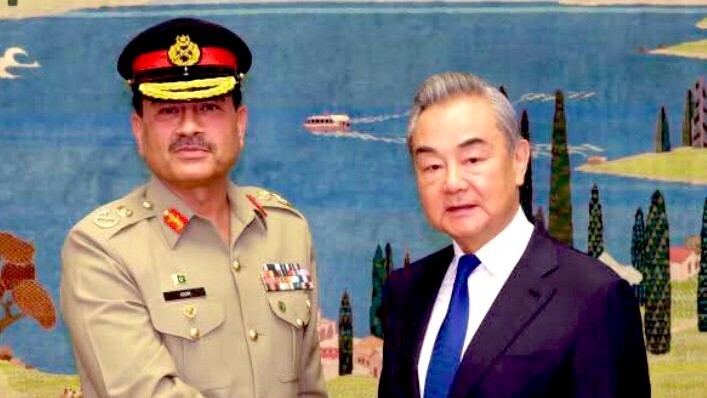
During their meeting, China’s Foreign Minister Wang Yi raised pointed concerns about the safety of Chinese nationals, institutions, and projects in Pakistan. This issue had become critical after a series of terror attacks targeting Chinese engineers, especially a deadly bombing in Karachi in October 2024.
In response, Asim Munir:
- Described Pakistan–China relations as “solid as a rock” and referred to bilateral partnership as a timeless brotherhood.
- Assured that the Pakistan Armed Forces would take all necessary measures to protect Chinese personnel and infrastructure.
- Emphasized that friendly cooperation with China is a consensus across Pakistani society, and thanked Beijing for supporting Pakistan’s socio‑economic development.
3. At PLA Headquarters: Guard of Honour and Military Talks
Upon reaching the PLA Army Headquarters, Munir was presented with a full military guard of honour, reflecting the depth of mutual respect between the two armies.
The Pakistani army chief met with senior PLA leaders—including:
- General Zhang Youxia, Vice Chairman of China’s Central Military Commission
- General Chen Hui, PLA Army Political Commissar
- Lieutenant General Cai Zhai Jun, Chief of Staff
They discussed issues ranging from counter-terrorism, defence modernisation, joint training, and interoperability to address hybrid and transnational threats.
Munir reaffirmed Pakistan’s unwavering commitment to expand military-to-military cooperation across all domains.
4. Reaffirming the “Iron‑Clad” Pakistan‑China Alliance
In multiple public and private exchanges during the visit, Munir highlighted recurring themes:
- Calling the strategic partnership “iron‑clad” and based on mutual trust and shared values .
- Describing the alliance as all‑weather and essential for South Asian stability.
- Pledging coordination on both connectivity projects like CPEC and regional security coordination.
Another statement captured this spirit:
🗣 “Pakistan and China are all‑weather friends and brothers… the Pakistan-China friendship is higher than mountains, deeper than oceans and sweeter than honey.”
5. Key Themes in His Statements
a) Safety for Chinese Nationals
Munir repeatedly vowed to ensure maximum security support for Chinese workers injured in prior terrorist attacks. He acknowledged attacks and assured full collaboration to prevent future incidents.
b) Strategic Continuity
He emphasized that despite political changes in Pakistan, the consensus to cooperate with China remains intact across institutions and society.
c) Defence Cooperation
Munir pledged to expand joint military exercises, defence modernisation, training programs, and interoperability efforts between Pakistan Army and PLA forces.
d) Connectivity and CPEC
He reassured Chinese leadership of Pakistan’s continued support for CPEC, and the common goal of connectivity and development projects under Belt and Road framework.
6. Regional and Geopolitical Subtext
Munir’s visit occurred in the aftermath of the May 2025 India–Pakistan conflict, where Indian sources alleged China had provided real-time inputs to Pakistan during operations, and China-made military systems were used by Islamabad.
From Beijing’s perspective, the visit was also a signal of solidarity following mounting criticism in the Global South, emphasizing that China remains Pakistan’s top strategic partner, especially amid rising Indian-U.S. alignment.
Western media described China’s expectant focus on Pakistani commitment to protect its nationals, while analysts suggested India would monitor the deepening military ties and CPEC developments closely.
7. Significance of His Rank and Timing
Asim Munir was promoted to the rank of Field Marshal on May 20, 2025, after Pakistan’s military operation during the conflict with India was hailed internally as a success. This made him only the second Field Marshal in Pakistan’s history.
His visit as a newly elevated military chief further elevated its symbolic weight, underscoring that Pakistan was intent on asserting its military stature on the international stage.
8. Reactions and Headlines
Media across Pakistan and China praised the visit:
- Pakistan’s ISPR described the visit as a reaffirmation of iron-clad strategic partnership and regional cooperation.
- Chinese Foreign Ministry called it a sign of continued mutual trust and guideline alignment in the region.
International Observers:
- Reuters highlighted Wang Yi’s call for stronger security measures and Munir’s assurances, noting the visit followed tense India–Pakistan clashes earlier in May.
- Economic Times noted the visit’s urgency and timing ahead of Munir’s planned Southeast Asian itinerary.
9. What It Means For India and the Region
India, which views Pakistan–China military cooperation as a significant strategic challenge, has watched the developments warily.
- India has officially expressed concern over Chinese military support to Pakistan, particularly during the recent conflict.
- Washington’s growing engagement with Pakistan—including meetings with Munir—has pushed New Delhi to consider diversifying partnerships including with China as a hedge.
Munir’s public statements on enduring China–Pakistan ties and readiness to guard Chinese interests reinforce the regional realignment pressures India faces.
10. Conclusion: Message Delivered
So what did Asim Munir say upon arriving in China?
- He described the Pakistan–China bond as unbreakable, all-weather, and rock-solid.
- He pledged the Pakistani armed forces’ full commitment to safeguard Chinese nationals and projects.
- He reiterated society-wide consensus in Pakistan favoring close cooperation with Beijing.
- He emphasised building deepening military coordination, defence modernisation, and joint training, with key focus on CPEC and regional stability.
In short: “Brotherhood stands firm. We stand with China in safeguarding your interests. Our strategic partnership is unshakeable.”
Munir’s statements and symbolism mark a carefully calibrated message—both to China and the world—that Pakistan considers Beijing its foremost partner in military, economic, and geopolitical arenas.
Read more latest news

