
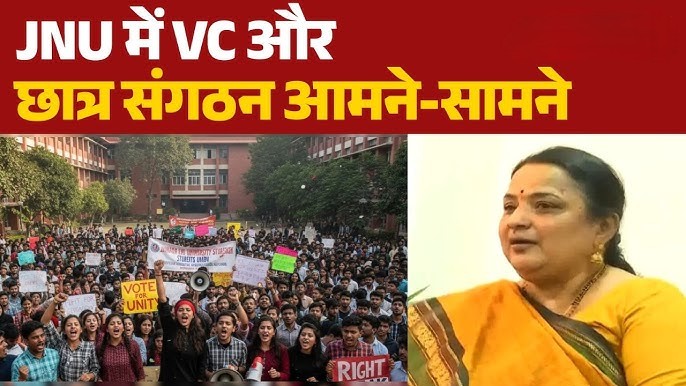
JNU Students Stage a Massive Protest Against the Vice Chancellor, Demand Resignation of Shantishree Pandit Over Alleged Casteist Remarks.
Introduction: A Campus Erupts in Dissent
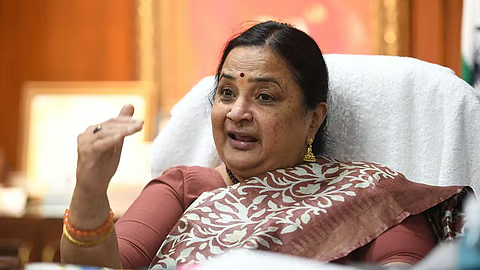
Jawaharlal Nehru University has once again found itself at the center of national debate as JNU students protest against the Vice Chancellor over alleged casteist remarks. The demonstration, which began as a gathering outside administrative offices, quickly grew into a large-scale movement demanding accountability and justice. At the heart of the controversy is Vice Chancellor Shantishree Dhulipudi Pandit, who has been accused by sections of the student community of making remarks perceived as casteist.
The JNU students protest has triggered discussions across academic, political, and social circles about discrimination, freedom of expression, and the responsibility of institutional leaders. For a university long associated with vibrant student activism, this moment has added another chapter to its history of resistance and ideological clashes.
The Legacy of Activism at JNU
Founded in 1969, Jawaharlal Nehru University has earned a reputation as one of India’s most politically active campuses. Student movements at JNU have historically revolved around issues such as social justice, academic freedom, minority rights, and democratic governance.
Over the decades, the university has witnessed numerous mobilizations—from fee hike agitations to debates around campus autonomy. The current JNU students protest fits into this broader tradition of dissent, where students often see themselves as defenders of constitutional values and social equity.
What Sparked the Controversy?
The controversy reportedly began when statements attributed to Vice Chancellor Shantishree Dhulipudi Pandit surfaced, which some students and faculty members interpreted as caste-insensitive. Student organizations alleged that the remarks undermined the dignity of marginalized communities and contradicted the inclusive ethos of the university.
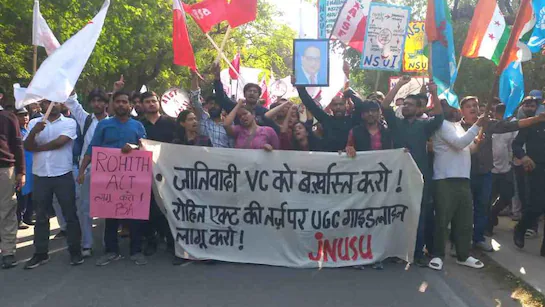
As news of the alleged remarks spread, discussions intensified across hostels, classrooms, and social media platforms. Within days, JNU students protest actions were organized, demanding a public clarification and apology from the administration.
Student leaders claimed that the remarks were not merely personal opinions but reflected systemic biases that must be addressed at the highest level of university governance. The administration, however, maintained that the comments were being misrepresented and taken out of context.
The Protest Movement Gains Momentum
What began as a small gathering soon evolved into a massive demonstration. Hundreds of students assembled near the administrative block, raising slogans and holding placards calling for the resignation of the Vice Chancellor.
The JNU students protest included speeches from representatives of various student groups, emphasizing unity across caste, religion, and gender lines. Demonstrators argued that universities should serve as safe spaces for critical dialogue and social inclusion.
The protestors organized teach-ins, cultural performances, and panel discussions to contextualize the issue within broader debates about caste discrimination in Indian institutions. As the days passed, the JNU students protest began attracting attention from alumni, civil society organizations, and political observers.
Key Demands of the Students
The primary demand emerging from the JNU students protest was the resignation of Shantishree Pandit. Students argued that leadership requires moral authority, and any perception of bias could erode trust.
Other demands included:
- A transparent inquiry into the alleged remarks.
- Implementation of stronger anti-discrimination mechanisms.
- Greater representation of marginalized communities in decision-making bodies.
- Public reaffirmation of the university’s commitment to constitutional values.
Protesters insisted that their movement was not driven by political rivalry but by a commitment to social justice.
Administration’s Response
The administration responded by urging calm and dialogue. Officials stated that the Vice Chancellor’s comments had been misunderstood and that no intent to offend existed. They emphasized the need for constructive engagement rather than confrontation.
However, the JNU students protest continued, with demonstrators asserting that the issue transcended individual intentions and pointed to structural problems. Calls for mediation and formal meetings were made, but tensions remained high.
In official communications, the administration reiterated its commitment to inclusivity while denying allegations of caste bias.
Political and Public Reactions
Given JNU’s prominence, the JNU students protest quickly became a national talking point. Political leaders from different parties weighed in, with some supporting the students’ demand for accountability and others accusing protestors of politicizing the campus.
Social media platforms amplified the debate, with hashtags related to the JNU students protest trending for several days. Alumni groups expressed mixed reactions—some endorsing the protests, others advocating dialogue and institutional stability.
The incident reignited discussions about caste sensitivity in academia and the responsibilities of public figures in shaping inclusive narratives.
The Broader Debate on Caste in Higher Education
India’s higher education system has long grappled with issues of representation and discrimination. Despite constitutional safeguards and affirmative action policies, instances of caste-based exclusion continue to surface.
The JNU students protest has thus become emblematic of a larger struggle against systemic inequities. Students argue that universities must go beyond formal compliance and actively cultivate environments where marginalized voices are heard and respected.
Experts note that institutional leaders play a critical role in setting the tone for campus culture. Allegations of casteist remarks, even if contested, can undermine trust and reinforce perceptions of bias.
Campus Atmosphere and Academic Impact
As the JNU students protest intensified, academic activities were partially disrupted. Classes were occasionally boycotted, and administrative meetings were delayed. While some faculty members expressed solidarity with students, others cautioned against prolonged disruption.
The university’s reputation as a premier institution also came under scrutiny. Prospective students and parents closely monitored developments, concerned about stability and academic continuity.
Yet many participants argued that temporary disruption was a necessary price for long-term reform. According to protest leaders, meaningful change often requires sustained pressure.

Voices from the Ground
Students participating in the JNU students protest described their motivations as rooted in personal experiences of marginalization. Several speakers shared stories of subtle discrimination and emphasized the importance of institutional accountability.
Faculty supporters stressed that open dialogue about caste and privilege is essential in educational spaces. They argued that protests serve as catalysts for introspection and reform.
At the same time, some students expressed discomfort with the confrontational tone of the movement, calling for mediated discussions to resolve the crisis.
The Role of Student Organizations
Various student unions and associations played a significant role in organizing the JNU students protest. Coordination meetings were held to ensure peaceful demonstrations and avoid escalation.
Posters, pamphlets, and social media campaigns helped mobilize participants. Cultural events such as poetry readings and street plays highlighted themes of equality and resistance.
The movement’s decentralized nature reflected JNU’s tradition of participatory activism.
Legal and Institutional Dimensions
Questions have also arisen regarding possible legal implications. If formal complaints are filed, the matter could involve internal grievance committees or external bodies.
The JNU students protest has underscored the need for clear guidelines on addressing allegations of discriminatory speech by institutional leaders. Legal experts note that universities must balance freedom of expression with anti-discrimination obligations.
Possible Outcomes and Future Scenarios
The trajectory of the JNU students protest remains uncertain. Several scenarios are possible:
- Dialogue and Reconciliation: The Vice Chancellor may issue a detailed clarification or apology, leading to de-escalation.
- Independent Inquiry: A formal investigation could assess the allegations.
- Administrative Changes: Pressure may lead to leadership restructuring.
- Prolonged Standoff: If neither side yields, protests could continue.
Whatever the outcome, the episode will likely shape campus politics for years to come.
Reflections on Leadership and Accountability
Leadership in educational institutions carries unique responsibilities. Universities are not merely administrative bodies; they are intellectual communities committed to equality and inquiry.
The JNU students protest highlights how perceptions of bias can trigger widespread mobilization. Even unintentional remarks can have significant consequences when made by those in positions of authority.
Many observers argue that this moment presents an opportunity for deeper institutional reform rather than polarization.

Conclusion: A Defining Moment for JNU
The ongoing JNU students protest represents more than a dispute between students and an administrator. It reflects broader societal tensions around caste, representation, and institutional accountability.
As the situation unfolds, all stakeholders—students, faculty, administrators, and policymakers—face the challenge of balancing dissent with dialogue. The demand for the resignation of Shantishree Pandit underscores the seriousness with which students view allegations of caste insensitivity.
Whether through reconciliation or restructuring, the resolution of this crisis will send a powerful message about the values that define Jawaharlal Nehru University. In a country striving for social justice and equality, campus debates often mirror national conversations. The outcome of the JNU students protest may well influence how institutions across India address similar controversies in the future.
Read More latest news

