
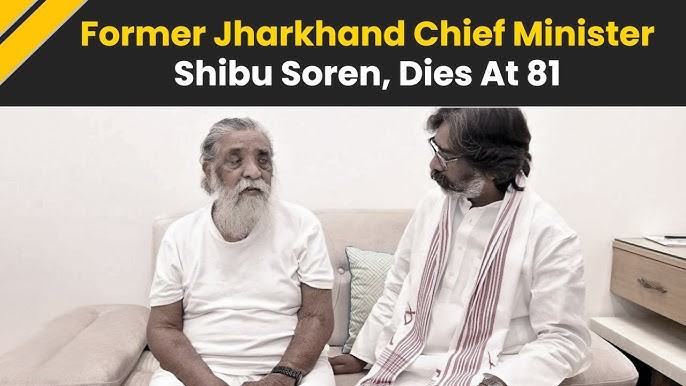
Shibu Soren Passes Away at 81: The End of an Era in Jharkhand Politics
The political landscape of Jharkhand and tribal India lost a towering figure with the passing of Shibu Soren, the founder of Jharkhand Mukti Morcha (JMM), at the age of 81. Fondly called ‘Guruji’, Shibu Soren was more than just a politician—he was a symbol of the long struggle for tribal rights, Jharkhand’s statehood, and social justice in India’s eastern belt. His demise not only brings an end to a remarkable personal journey but also marks the closure of a defining chapter in regional and national politics.
A Life Dedicated to Tribal Empowerment
Born on January 11, 1944, in Nemra village of the then Bihar (now Jharkhand), Shibu Soren grew up witnessing the exploitation and marginalization of tribal communities. His father was reportedly murdered for standing up against moneylenders, which sowed the seeds of rebellion in young Soren’s heart. Determined to fight the injustice meted out to his people, he immersed himself in grassroots activism.
Soren’s early political life was shaped by his commitment to ending the exploitation of Adivasis and forest dwellers. He started mobilizing tribal communities in the Santhal Parganas region and eventually launched a socio-political movement that led to the formation of the Jharkhand Mukti Morcha (JMM) in 1972.
Formation of JMM and the Movement for Jharkhand Statehood
Under Soren’s leadership, the JMM became a potent force that voiced the long-standing demand for a separate Jharkhand state—a homeland for the tribals who were systematically marginalized in undivided Bihar. Throughout the 1970s and 80s, Soren organized multiple rallies, agitations, and protests demanding Jharkhand’s statehood. His grassroots support base and unwavering focus on tribal welfare made him a revered figure.
Even though the state of Jharkhand was eventually carved out of Bihar in 2000, it was the result of decades-long efforts led by Soren and his compatriots. For this reason, he was often hailed as the “Father of Jharkhand”.
Shibu Soren in National Politics
Though firmly rooted in regional politics, Soren was no stranger to the national political stage. He was elected to the Lok Sabha seven times and held several portfolios in the Union government. Most notably, he served as the Union Coal Minister during the UPA regime under Manmohan Singh.
His time in national politics was not without controversy, as he faced allegations related to various criminal cases, including the Shashinath Jha murder case. Soren was convicted in 2006 but was later acquitted by the Delhi High Court in 2007 due to lack of evidence.
Despite these legal troubles, his political career continued to flourish in Jharkhand. He became the Chief Minister of Jharkhand thrice, albeit for short periods, reflecting both his influence and the political instability that often plagued the state.
Legacy of the Tribal Leader
Shibu Soren’s legacy is deeply interwoven with the story of Jharkhand’s creation and its political evolution. He was not just a political leader but a cultural icon among the tribal communities. His speeches, often delivered in Santhali or Hindi, resonated deeply with the masses, especially in rural and tribal belts.
He consistently advocated for land rights, employment, education, and health for Adivasis. Soren’s politics was one of resistance, revival, and representation—a unique blend of regional assertion and democratic engagement.
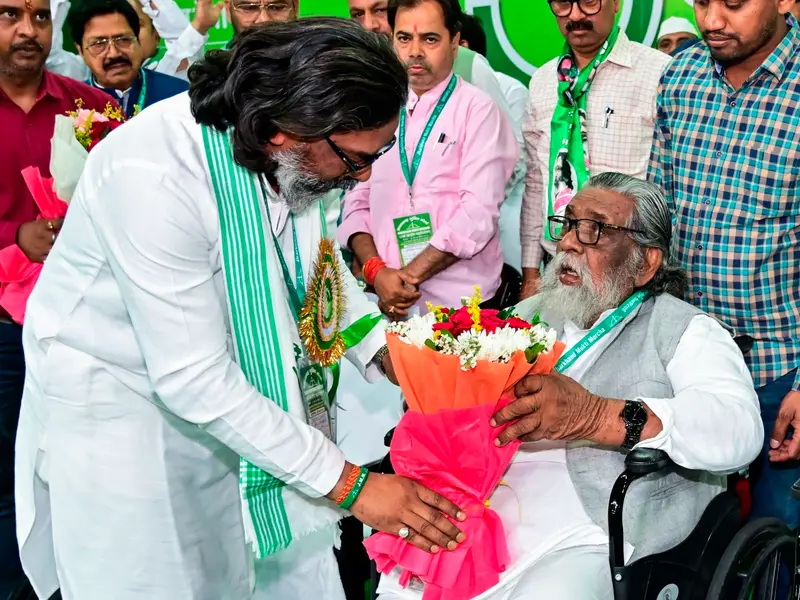
Even in his later years, when his health began to decline, he remained the moral compass of the JMM, while his son Hemant Soren emerged as the political face of the party and served as Jharkhand’s Chief Minister.
The Political Symbolism of ‘Guruji’
Among his followers and even his political opponents, Shibu Soren was known as ‘Guruji’, a title that went far beyond honorific. It symbolized the respect he commanded not only as a political leader but as a spiritual and social guide for the tribals of Jharkhand. His grassroots connect was unmatched—he did not need a suit or a social media team to reach people; his very presence at a rally would electrify thousands.
He represented a rare blend of old-school activism and electoral politics, a voice for those who had never found representation in the corridors of power. For Adivasis, he was more than a party chief—he was a living embodiment of their struggles, fears, dreams, and aspirations.
A Controversial Yet Resilient Journey
No political career spanning over five decades can be devoid of controversy, and Soren’s was no different. His alleged involvement in the Shashinath Jha murder case brought a dark cloud over his image in 2006, when he was convicted and had to resign as Coal Minister. However, in a dramatic turnaround, the Delhi High Court acquitted him in 2007, citing insufficient evidence.
Another major controversy was linked to his short tenure as Jharkhand CM in 2005. He was sworn in with the help of some independent MLAs, but was unable to prove his majority on the floor of the Assembly. This political episode triggered widespread debate on the constitutional process and horse-trading in Indian politics.
Yet, despite these setbacks, Soren’s resilience stood out. Each time he fell, he came back stronger, with the backing of tribal voters who never abandoned their ‘Guruji’.
Reactions Pour In: Nation Mourns the Loss
The news of Shibu Soren’s death triggered a wave of grief across the country. Political leaders from all parties expressed their condolences. Prime Minister Narendra Modi posted on X (formerly Twitter), stating:
“Saddened by the demise of Shibu Soren ji. He was a towering leader who fought for the rights of tribal communities. His contribution to the creation of Jharkhand and upliftment of its people will always be remembered. My condolences to his family and followers.”
Congress President Mallikarjun Kharge said:
“Shibu Soren’s life was a struggle for justice. The Congress party acknowledges his decades of contribution to people’s movements.”
Jharkhand CM and Shibu Soren’s son, Hemant Soren, was visibly emotional as he addressed the media:
“With the death of my father, I have lost my guiding star. His sacrifices for Jharkhand and the Adivasi community will inspire generations.”
Regional leaders like Babulal Marandi, Raghubar Das, and Tejashwi Yadav also expressed their grief and hailed his unmatched contribution to Indian federalism and subaltern politics.
The Funeral: A State Farewell
The Jharkhand government announced a three-day state mourning. Flags were flown at half-mast. Thousands gathered at Ranchi’s Morhabadi Ground, where Shibu Soren’s mortal remains were brought for the final public darshan. The air was thick with chants of “Guruji Amar Rahein” (Long Live Guruji).
His body was draped in the national flag, and floral tributes were offered by politicians, bureaucrats, tribal elders, and common citizens. Emotional scenes unfolded as his body was taken in a funeral procession from Ranchi to his ancestral village, Nemra, where he was cremated with full state honours.
Jharkhand Mukti Morcha’s Future Without Shibu Soren
Shibu Soren had long stepped back from active politics due to his age and deteriorating health, leaving his son Hemant Soren as the face of the party. However, his death creates a symbolic vacuum in JMM. His aura and moral authority often helped unify various tribal groups under one banner, especially during crises.
Now, the challenge for Hemant and the JMM leadership will be twofold:
- To preserve the ideological legacy of Shibu Soren, which revolved around justice, land rights, and anti-exploitation politics.
- To expand the party’s base among youth and urban voters without compromising the tribal core agenda.
There is also the task of maintaining cohesion in the party ranks. With opposition parties trying to reassert their strength in Jharkhand, especially in the run-up to the 2024 Lok Sabha and the 2025 state elections, the JMM will have to work hard to hold its ground.
The Ideology of Shibu Soren: More Than Identity Politics
Often slotted into the bracket of “identity politics”, Shibu Soren’s political ideology was far more layered. He believed in decentralized governance, natural resource management, and local economic empowerment. His fight was against the systemic exploitation of Adivasis, especially in mineral-rich areas like Dhanbad, Dumka, and Singhbhum, where illegal mining and displacement were rampant.
He also opposed the unrestricted entry of corporates into tribal zones without proper land acquisition and rehabilitation policies. In that sense, he was an environmentalist and an anti-corporate voice in a region that is often exploited for its coal, iron, and bauxite reserves.
While he never positioned himself as an intellectual, his grassroots wisdom and ability to read socio-political currents made him one of the sharpest minds in regional politics.
A Cultural Icon Beyond Politics
Shibu Soren’s legacy is not confined to politics. He was a symbol of tribal pride, Santhali culture, and folk resistance. Local poets and writers often eulogized him in their works. His life has been documented in tribal folklore, street plays, and oral histories.
Several educational and cultural institutions in Jharkhand bear his name. His autobiography, “Jharkhand Ka Sapoot” (Son of Jharkhand), though less publicized, gives an insider’s account of political struggles, betrayals, and victories.
What Shibu Soren’s Death Means for Tribal Politics in India
His death could trigger a reassessment of tribal politics across India, not just in Jharkhand. From the Bhil tribals of Madhya Pradesh to the Nagas of the northeast, Soren’s model—of combining identity assertion with democratic participation—served as an example.
In an era when tribal issues are either co-opted or marginalized by mainstream parties, Shibu Soren stood as a lone warrior who refused to dilute his core principles. His passing leaves behind a vacuum that few can fill.
Read more latest news


https://shorturl.fm/i6ykf