
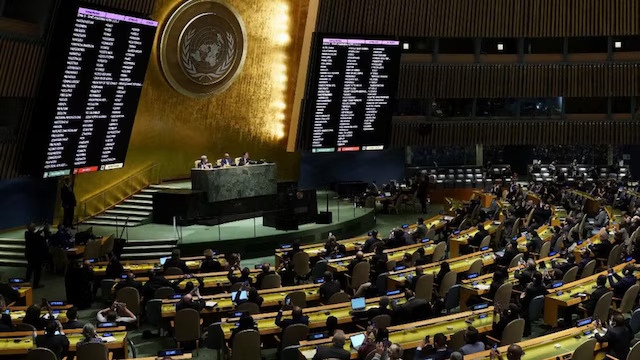
In Big Policy Shift, US Sides With Russia On Ukraine War Resolution At UN; India Abstains
In a surprising turn of events, the United States recently shifted its foreign policy stance regarding the ongoing Ukraine war by aligning itself with Russia at the United Nations. This monumental change has sparked global debates and speculation about the strategic and diplomatic ramifications of such a policy reversal. The shift, which occurred during a high-profile session at the United Nations, has not only raised eyebrows in diplomatic circles but has also shifted the balance of power and influence at the UN.
Along with the US siding with Russia, India’s decision to abstain from the vote has added another layer of complexity to this already multifaceted situation. As major global players, both the United States and India have historically been seen as key supporters of Ukraine’s sovereignty and territorial integrity. However, this new development has led many to question the reasons behind the change and what it means for the future of the international order, as well as the ongoing war in Ukraine.
This article explores the implications of the US’s decision to side with Russia, India’s abstention, and the larger geopolitical context within which these actions are taking place.
The Shift in US Policy: A Complex Turn
For much of the war in Ukraine, the United States has been one of Ukraine’s most vocal supporters, providing military aid, financial assistance, and diplomatic backing to the embattled country. US policy has been clear: support Ukraine’s right to self-determination and protect its territorial integrity against Russian aggression. However, in a dramatic shift, the US recently sided with Russia during a key vote on the UN resolution addressing the war.
The change in US policy has taken many by surprise, leaving analysts, diplomats, and politicians scrambling to understand the motivations behind the shift. Several factors may have contributed to this decision.

1. Changing Strategic Priorities
One potential explanation for the US’s shift in stance lies in changing strategic priorities. Over the past few months, the global landscape has evolved rapidly. The US is facing mounting challenges on multiple fronts, from tensions with China in the Indo-Pacific to a growing rivalry with Iran. These challenges have forced the US to reassess its foreign policy priorities and seek opportunities to recalibrate its global strategy.
The US’s decision to align with Russia on the UN resolution could be a part of a broader strategy to reduce tensions with Moscow, especially as the US faces increasing pressure to address its own internal issues and global economic concerns. The need for strategic cooperation with Russia on matters such as nuclear arms control, regional security, and counterterrorism efforts may have outweighed the desire to maintain a hardline stance against the Kremlin on the Ukrainian conflict.
2. Domestic Political Pressures
Another factor to consider is the influence of domestic politics. The US is entering an election cycle, and political leaders may be seeking to present themselves as pragmatic statesmen, willing to seek peace and stability in the face of global conflicts. The American electorate has become increasingly fatigued by the prolonged nature of the Ukraine war and the substantial costs of supporting Ukraine. As public opinion shifts, political leaders may be attempting to position themselves as agents of change, advocating for a policy of diplomatic engagement rather than continued escalation.
By siding with Russia, the US may be signaling its intent to find a diplomatic resolution to the Ukraine conflict, appealing to those who believe that the war must end sooner rather than later. Such a policy could also be aimed at reducing the financial and military burden of supporting Ukraine, which has been a contentious issue for many American voters.
3. The Push for a Global Realignment
The US’s decision to side with Russia could also be seen as part of a larger effort to realign the global balance of power. With the rise of China as a global superpower, Russia’s role in the international system has become increasingly important to the United States, particularly in the context of managing China’s growing influence.
By seeking to de-escalate tensions with Russia over Ukraine, the US may be positioning itself to work more closely with Moscow to counterbalance China’s growing influence. Russia, with its vast resources, geopolitical leverage, and close ties with China, plays a crucial role in shaping the future of global power dynamics. In this context, aligning with Russia may be seen as a strategic move to ensure that the US can maintain its leadership role on the global stage while simultaneously mitigating the threat posed by an increasingly assertive China.
India’s Abstention: A Calculated Decision
While the US’s shift toward Russia has been the focus of much international attention, India’s decision to abstain from the vote has also drawn considerable interest. India, which has historically maintained a neutral stance on the Ukraine war, has consistently called for a peaceful resolution to the conflict. However, its decision to abstain from the UN vote rather than explicitly support either side has raised questions about India’s evolving foreign policy.
India’s abstention can be understood in the context of several key factors that influence its approach to the Ukraine war.
1. Maintaining Strategic Autonomy
India has long valued its strategic autonomy, a policy that allows it to maintain balanced relations with various global powers. As a member of the BRICS group (Brazil, Russia, India, China, and South Africa), India has maintained cordial ties with Russia, despite growing Western pressure to condemn Moscow’s actions in Ukraine. However, India has also strengthened its ties with the United States and other Western nations over the past two decades, particularly in the areas of defense, trade, and technology.
By abstaining from the vote, India signals its reluctance to take sides in the Ukraine conflict and its desire to preserve its strategic relationships with both Russia and the West. India is also mindful of its regional security interests, particularly with regard to its complex relationship with China. In this context, abstaining from the vote can be seen as a way for India to preserve its diplomatic flexibility and avoid being caught in the middle of a growing East-West divide.
2. The Need for a Balanced Approach to the Conflict
India’s neutral stance on the Ukraine war reflects its broader approach to international conflicts, which emphasizes dialogue, diplomacy, and peaceful resolution. India has consistently called for an immediate ceasefire and the initiation of peace talks between Russia and Ukraine. India’s abstention can be seen as a message that it prioritizes a peaceful solution to the conflict, rather than taking sides in a highly polarized geopolitical struggle.
Moreover, India’s economic interests are closely tied to both Russia and Ukraine. Russia is a major supplier of defense equipment, energy resources, and raw materials to India, while Ukraine remains an important partner for food security, particularly in terms of grain exports. As such, India’s decision to abstain allows it to maintain a balanced approach that does not jeopardize its economic and security interests.
3. Domestic Considerations
India’s domestic politics also play a significant role in shaping its foreign policy decisions. The Indian government, led by Prime Minister Narendra Modi, has consistently emphasized the importance of national security, economic growth, and social stability. By abstaining from the vote, India may be signaling its desire to avoid domestic political fallout from either supporting or condemning the war. The Ukrainian conflict has sparked significant debates within Indian society, with various groups expressing differing views on the issue. Abstaining allows the government to sidestep potential political divisions and maintain domestic harmony.
The UN Resolution: A Divisive Moment
The UN resolution in question, which addressed the ongoing war in Ukraine, was a pivotal moment in the global diplomatic landscape. The United Nations has long been a forum for discussing and resolving international conflicts, and the war in Ukraine has dominated many UN sessions since its outbreak in 2022. The resolution called for an immediate ceasefire, the withdrawal of Russian troops from Ukrainian territory, and the initiation of peace negotiations between the warring parties.
The decision by the US to side with Russia on the resolution marked a significant departure from its previous stance. Historically, the US has supported UN resolutions that condemned Russia’s actions and called for international sanctions. However, in this instance, the US opted to support Russia’s position on the need for negotiations and dialogue, signaling a shift in its approach to the conflict.
India’s decision to abstain from the vote further highlighted the divisions within the international community on how to address the war in Ukraine. Many countries, particularly those in the Global South, have taken a similar position to India, calling for dialogue and diplomacy but refraining from taking sides in the conflict.
Conclusion: A Turning Point in Global Diplomacy
The US’s decision to side with Russia on the Ukraine war resolution at the United Nations represents a dramatic shift in global diplomacy. This change, along with India’s abstention, signals the complex and evolving nature of international relations in the 21st century. The shift reflects broader geopolitical trends, including the growing competition between major powers and the increasing influence of emerging economies like India.
The implications of these shifts remain to be seen, but they represent a significant turning point in the ongoing conflict and in global diplomacy. As the war in Ukraine continues to unfold, the decisions made by key global actors like the United States and India will shape the trajectory of the conflict and the future of international relations.
Read more latest news

